



























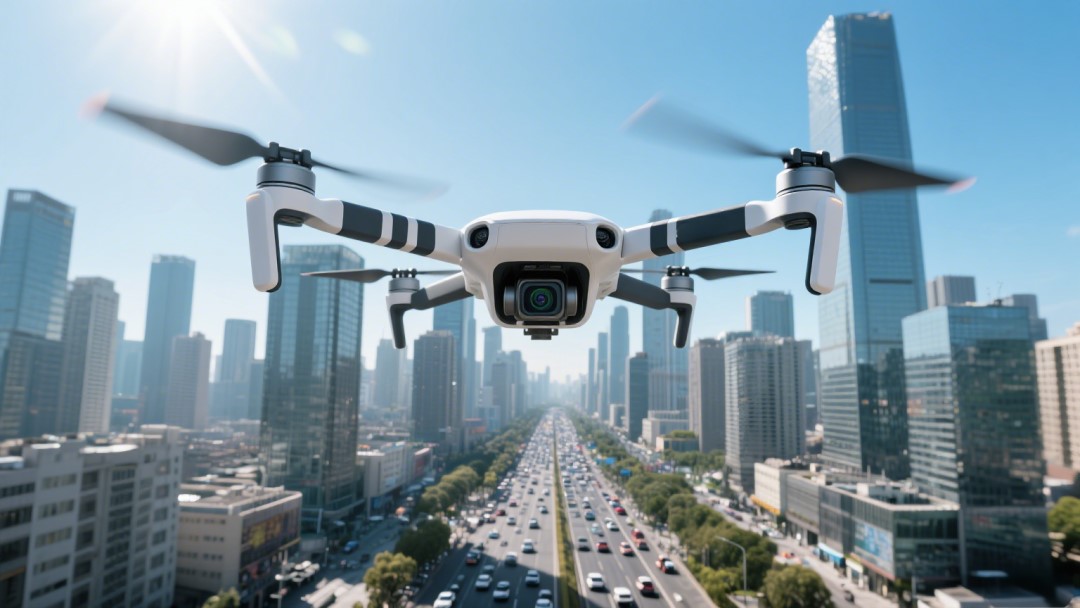

(Singapore, 12.02.2026) Dajiang Innovations (大疆创新) has been China’s leading drone manufacturer for about a decade, commanding 70 to 75% of the domestic market. Globally, it dominates the civilian and commercial drone sector with a 70 to 80% share, cementing its position as the world’s foremost drone brand.
DJI is not merely a drone manufacturer; it delivers complete imaging ecosystems that combine hardware (cameras and sensors), stabilization (gimbals), and software (image processing, editing, and transmission). These integrated solutions play a vital role in photography, filmmaking, surveying, mapping, and industrial operations, all of which represent key markets for DJI.
For years, DJI reigned over an almost empty sky, its vision as sharp as an eagle’s. But according to a column on the Chinese tech media platform 36Kr, that sky is filling fast. The once-unrivaled giant in China now faces newcomers who are not just observing from afar. They are testing DJI’s boundaries, gradually encroaching on its imaging solutions and possibly drone domains.
Previously, rivals would quietly adjust launches to avoid direct clashes whenever DJI unveiled a new product, the column “Beyond the Page” (版面之外) notes.
That is changing. Reports indicate that Chinese smartphone maker Vivo has confirmed embarking on a Vlog camera project, clearly challenging DJI’s Pocket series — a line of ultra-compact handheld action cameras designed for effortless vlogging, travel footage, social media clips, and everyday filming, all with high-grade stabilization in a portable form factor.
Even before Vivo’s move, Liu Jingkang, founder of Insta360 (影石)— known for 360-degree and action cameras — publicly rebuked DJI, a rare move in China’s tech industry. Liu accused DJI of unfair competitive practices, including “exclusive supply-chain” arrangements that restrict rivals’ access to key components and distribution channels, besides other aggressive tactics to squeeze competitors.
DJI’s edge lay in hardcore engineering, “Beyond the Page” pointed out. From obstacle-avoidance algorithms and proprietary transmission systems to frictionless brushless motors, it spent over a decade building very deep moats. Competing with DJI requires flying steadier, farther, and delivering clearer action footage — and most couldn’t match it.
Today, challengers are more strategic. DJI remains a traditional engineering powerhouse, obsessed with precision and absolute control. Insta360, by contrast, operates like a digital-native company. It recognizes that most users do not care whether transmission range is 15 km or 20 km — what matters is creating a viral short video with a single tap.
Insta360’s breakthrough is “shoot first, frame later,” enabled by 360° capture. DJI still demands that beginners master camera movement and composition; Insta360 allows users to simply raise the camera and let algorithms do the rest. DJI competes by pushing performance limits; rivals compete by lowering barriers to entry.
Globally, consumer drones continue to grow, but the fastest momentum is in lightweight, affordable models priced around US$400 (≈S$505), optimized for social sharing and quick content creation rather than professional production.
Insta360 has entered the consumer drone market with a new sub-brand, Antigravity. Its debut model, the Antigravity A1, is a quadcopter featuring an integrated 360° camera system for immersive aerial footage and FPV-style (First-Person View) flight. Designed to weigh under 249 g, it complies with regulatory limits in many regions and has been available commercially since December last year.
With this move, Insta360 has stepped beyond drone accessories and established its own dedicated drone lineup under the Antigravity brand.
Meanwhile, DJI’s approach continues to prioritize flight stability and control, often at the cost of portability or software polish. New entrants flip this logic: they start with the camera — and make it fly. Younger users increasingly value instant visual appeal: filters, skin smoothing, and automated enhancements. DJI’s color science is precise but engineered rather than flattering, leaving room for competitors to shine.
Vivo’s entry into the Pocket segment is straightforward. Smartphone brands already excel in computational photography and AI imaging, mastering skin smoothing, lighting, and visual enhancements. For everyday vloggers, looking good on camera often outweighs perfect gimbal angles. The smartphone market is already saturated, and imaging hardware and AI processing have reached new heights. Pocket-sized cameras designed for drones offer a natural outlet for these capabilities.
The rise of new players reflects broader market dynamics. Companies like Insta360 thrive on rapid iteration: launching features quickly, testing with users, and adjusting on the fly. They do not fear imperfect versions; they fear being too slow. DJI, with its vast teams and long development cycles, optimizes for generational leaps rather than speed.
New challengers also exploit niches that DJI may overlook: ultra-light folding designs, built-in selfie sticks, social-media-first features, even indoor pet tracking. These grow from the periphery instead of directly challenging DJI.
Previously, DJI’s main rivals were smaller drone brands. Now, they include smartphone giants like Vivo with billion-dollar R&D budgets and global supply chains. This raises the stakes considerably, Beyond the Page underlined.
These developments do not signal DJI would decline. In professional, agricultural, and industrial sectors, its dominance remains formidable. Consumer market, however, has evolved. It reflects an industry expanding beyond the lane initially defined by DJI.
DJI now faces a strategic choice: remain the guardian of engineering purity, or pivot toward emotional, consumer-driven appeal. The era of DJI quietly dominating may be waning. The coming years could see a more pedestrian — but perhaps “mainstream” — DJI, concluded the column.