



























(SINGPOARE 2026.1.20) BrainCo (强脑科技), the prominent Chinese developer of brain–computer interface (BCI) technologies, is gearing up for a potentially strong debut on the Hong Kong Stock Exchange, buoyed by solid investor support and the current enthusiasm for tech IPOs.
However, uncertainties remain. The company has yet to publicly release its financials, its technology could face execution challenges or might struggle to translate into a profitable business, and broader market volatility may affect IPO performance.
Still, according to Hong Kong’s Phoenix Technology media, BrainCo’s IPO looks bright and could mark a milestone for China’s neurotechnology sector, signaling that Chinese BCI companies could compete strongly with global leaders such as Elon Musk’s Neuralink.
By early this month, BrainCo had raised 2 billion yuan (S$369 million), the largest single financing among Hangzhou’s “Six Little Dragons” (杭州六小龙). Bloomberg later reported that the company has quietly filed for the Hong Kong IPO, potentially the first of the Six Little Dragons to go public.
The Six Little Dragons are: DeepSeek, an AI startup focused on large language models and AI infrastructure; Unitree, a robotics company; Game Science, a video game developer; Manycore Tech, a spatial computing and 3D/AI tech firm; DEEP Robotics, which specializes in industrial and AI-integrated robotics; and BrainCo.
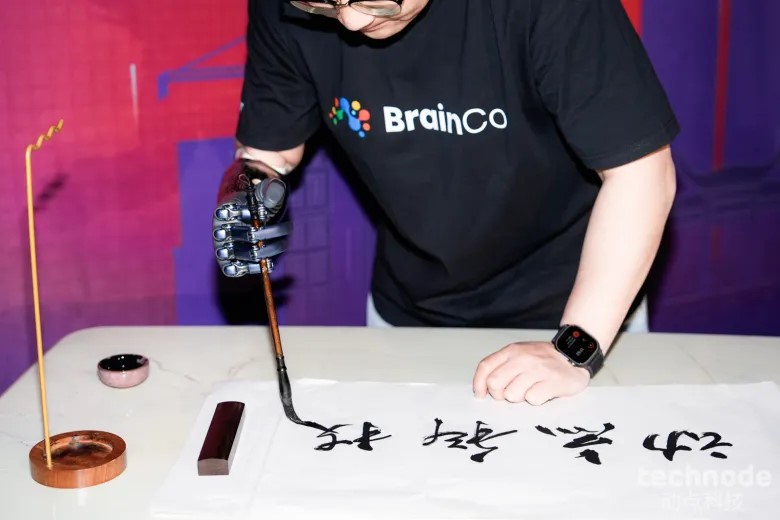
Last year, BrainCo reached a defining moment in its decade-long history., noted Phoenix. Daily visitor traffic has since surged, and media, study groups, and public figures are all guided at its headquarters by “experience officers”: some with a prosthetic leg moving fluidly, and one pianist performing with prosthetic hands. Nearly ten disabled employees tested the company’s products firsthand. “Every leg sold has been personally tried on to ensure post-production quality,” an insider pointed out.
“Credit is due to DeepSeek’s globally renowned breakthroughs last year, without which Hangzhou’s ‘Little Dragons’ would not have gained massive recognition and achieved such success,” remarked a company receptionist.
Previously relatively unknown, BrainCo now has offices in Hangzhou, Shenzhen, and the US. Founder Han Bicheng (韩璧丞) focuses primarily on R&D, rarely appearing publicly. Although some former executives from Alibaba and Huawei have introduced corporate management practices, the company has now returned to a lean, elite startup model.
Perfect timing helped propel BrainCo into the spotlight: the collective reputation of the Six Little Dragons, global attention on Musk’s neurotech, and supportive domestic policies. In June 2025, Neuralink ignited worldwide interest with a one-hour video, proposing that by 2028, humans could interface directly with AI.
BCI technology allows neurons to connect to external devices, enabling users to control robotic arms or restore sight. BCI methods include invasive, semi-invasive, and non-invasive approaches. Invasive BCIs carry the highest risk and development difficulty but offer the most potential; semi-invasive techniques are less risky; non-invasive solutions are mature but limited in capability.
In 2025, the BCI sector saw 16 financing events totaling 983 million yuan —nearly four times the 201 million yuan raised in 2024. Valuations are rising rapidly: China’s NeuroXess has raised hundreds of millions of yuan and StairMed won 350 million yuan for invasive BCI. Neuralink raised around US$600 million (S$771 million) by mid-2025, reaching a US$10 billion valuation.
High costs and R&D difficulty mean BCIs rarely yield near-term profits. Neuralink took eight years to generate revenue, with commercialization expected around 2030. But Phoenix Technology reported that BrainCo achieved its first full-year profitability in 2025, mainly driven by consumer-focused products. “Revenue from devices like meditation and sleep aids helps support prosthetics financially,” an insider said.
Founded in 2015 by Han at Harvard’s Innovation Lab—the first China-led incubated project there —the company has focused so far only on non-invasive BCIs. Today, BrainCo has three main product lines: intelligent bionics (prosthetic hands and legs), intelligent health (sleep aids and attention-training devices), and intelligent education.
Overseas, bionic hands can cost tens of thousands of dollars. International revenue accounts for nearly half of BrainCo’s total sales. In China, BrainCo provides affordable packages starting at 50,000 yuan enabling 400–500 disabled persons to access prosthetics.
For broader market, BrainCo sells wearable EEG (electroencephalography) devices that track attention and meditation. Attention-training headbands for children sparked privacy concerns in 2019, leading local authorities to suspend their use. Currently, only adult versions are sold online.
Another popular product is the Deep Dolphin BCI smart sleep device, which uses transcranial microcurrent stimulation to boost melatonin and endorphin production. Though not certified as a medical device, it is reported to improve sleep within 7–14 days, with individual results varying.
In 2025, China officially recognized BCIs as a “future industrial frontier.” By December, the country completed its first fully implanted BCI clinical trial with NeuroXess, which enables a high-degree paraplegic patient to control devices with thought.
Riding domestic policy support, the Six Little Dragons’ reputation, and global hype around Neuralink, BrainCo has set a record financing round among Hangzhou’s startups. The 2 billion yuan raised will go to fund core R&D, extreme engineering breakthroughs, and large-scale production, with the goal of helping one million disabled people worldwide regain mobility over the next five to ten years.
BrainCo has FDA-approved prosthetics in the US, which demonstrates its R&D-to-commercialization capabilities—a key attraction drawing investors. Beyond prosthetics, the company aims to become a foundational technology platform that collaborates with automakers on fatigue monitoring, with home companies on smart mattresses, and with gaming firms like 37 Interactive on future gaming interaction.
Despite its promising outlook, BrainCo now still faces significant challenges: technological breakthroughs, ethical approvals, and commercial viability all remain potential obstacles, remarked Pheonix Technology. But all conquests of disabilities demand will, it added.