


























(SINGAPORE 2026.2.6) — Following a panel discussion with distinguished professionals and business leaders, Saktiandi Supaat, Chair of Singapore’s Finance and Trade and Industry Committee in Parliament, emphasized a key takeaway: Artificial Intelligence (AI) holds immense potential to boost productivity in Singapore’s mature, ageing economy. However, strategic steps must be taken to ensure effective AI adoption and sustain AI investments.

Many of the 12 panelists at the session urged the government to move beyond simply offering grants for AI training. They recommended focusing more on initiatives that drive productivity. Speaking with Fortune Times after the pre-Budget discussion, Saktiandi shared that this consensual view would be a focal point in his discussions with the National Budget Committee. He highlighted that the integration of AI into the workforce, especially within SMEs, is crucial for Singapore’s economic transformation.
Singapore’s 2026 National Budget will be presented in Parliament on February 12 by Prime Minister and Finance Minister Lawrence Wong. The pre-Budget roundtable, hosted today by the Institute of Singapore Chartered Accountants (ISCA), serves as a platform for thought leaders to offer insights ahead of the official budget release.
Several panelists voiced the opinion that government-funded AI training programmes should be crafted to produce specific, measurable outcomes—such as equipping workers with AI skills that facilitate career transitions or provide the expertise needed for an AI-driven job market. Currently, AI training programmes focus on introducing learners to tools and methodologies, without attaching much weight to performance metrics.
Moreover, rather than continuing to follow traditional sector-specific strategies that treat industries as silos, panelists proposed creating inclusive, cross-sector transformation maps. These maps would offer a more holistic view of how AI is influencing entire business value chains, rather than just pictures of individual sectors.
To support workforce development, the Singapore government this year is offering enhanced co-funding of up to 70% for companies investing in AI training and skill development. This initiative is part of an ongoing effort to help businesses integrate AI and upskill employees. However, some panelists pointed out that the government has yet to present a clear long-term vision for how these efforts will shape Singapore’s economy in the future.
The combination of the AI revolution and a shifting geopolitical landscape is compelling governments to play a more proactive role in guiding businesses, as macroeconomic factors become increasingly pronounced. Many panelists expect Singapore’s government to ramp up its macroeconomic efforts, particularly in helping businesses—including SMEs—expand internationally.
“The geopolitical upheavals we’re witnessing have created a truly multilateral world,” said Saktiandi. “We’re seeing a move away from reliance on the US and China as the main growth drivers, as the global supply chain shifts. Our businesses will need to adapt rapidly to this change.”
He underlined that in this flux Asean represents a major opportunity for Singaporean companies looking to expand abroad, calling it a “low-hanging fruit.” He added, “Ironically, the rise of bilateral Free Trade Agreements (FTAs) and unconventional partnerships, fueled by global fragmentation, presents new—and complex—opportunities.”
Saktiandi pointed to the growing coordination between the government, trade organizations, and business federations as they work to link foreign investments with local SMEs. While these initiatives are not new, the increased urgency sparked by the AI revolution, trade tensions, and Singapore’s ageing population has made prompt action more critical than ever.
Reiterating the potential of AI, Saktiandi noted that while the technology could drive productivity in a maturing economy, poor execution or reduced investment in AI could thwart our endeavors. “It’s essential to integrate AI into the workforce—not just through training, but by redesigning work processes so that SMEs and workers can leverage AI meaningfully,” he said. “We need to enhance human capital strategies to close any skills or productivity gaps.”
He also stressed the importance of balancing government support to prevent widening disparities between sectors. AI adoption could be flourishing in manufacturing while areas like retail might fall behind.
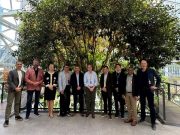
The panelists included Selena Ling of the Association of Banks in Singapore; industry leaders such as Ang Yuit of the Association of Small and Medium Enterprises, Lennon Tan of the Singapore Manufacturing Association, and Ernie Koh of the Singapore Chinese Chamber of Trade and Industry, along with others from trade organizations, business federations, and various industries.
Selena Ling lamented the stark contrast in AI funding across the world, pointing out that global giants like Amazon allocate far greater budgets to technological projects than governments, including Singapore’s. She called for greater government involvement in advancing AI development and advised introducing more specialized AI courses tailored to local industries, moving beyond basic training programmes like Google Pilot.
“I believe the government should implement a productivity-based incentive system,” Ling suggested. “Companies could receive base funding to launch AI projects, followed by additional incentives tied to the social impact and productivity brought by those projects.”