























(SINGAPORE 2025.12.18) Last week China’s largest battery manufacturer, CATL (宁德时代), secured a major energy-storage contract under the Indonesia–Singapore “Green Economic Corridor” initiative to supply a 4 GWh (gigawatt-hour) EnerX battery system linking the two countries.
An EnerX system is designed to store electricity—particularly from renewable sources like solar and wind—and then release it when needed to stabilize the grid, balance supply and demand, or provide backup power. Energy storage is now globally viewed as the cornerstone that ensures renewable energy is dependable, economical, and scalable. Without it, the shift to a clean-energy future would grind to a halt.
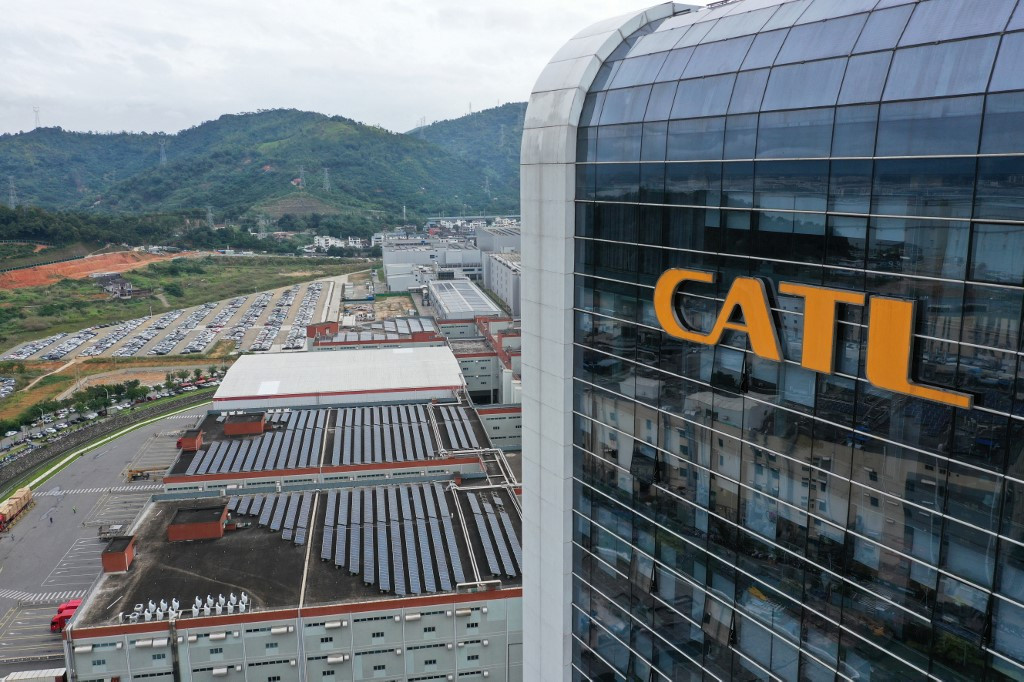
The 4 GWh EnerX system will be produced at CATL’s new West Java facility and store solar energy generated in the Riau Islands before transmission to Singapore via subsea cable. Earlier this year, CATL already delivered 2.2 GWh EnerX units for the same bilateral project, rapidly expanding its footprint in Southeast Asia.
According to earlier public statements from Vena Energy’s CEO, the project aims to start supplying electricity to Singapore before 2030, with phased completion of infrastructure targeted by the early 2030s. Vena Energy is the Singapore-based project developer and implementer of the Indonesia–Singapore EnerX deal.
By deploying multi-GWh systems for cross-border projects, Chinese companies are moving beyond EV cell production to utility-scale energy storage solutions capable of competing globally. Currently, CATL is the sole provider involved in the Indonesia–Singapore corridor, while other Chinese firms—including Sungrow (阳光电源), China Energy Engineering Group (中国能建), Hongzheng Energy Storage (弘正储能), and Livoltek (利沃得)—have secured projects across the Philippines, Vietnam, and other Southeast Asian markets.
According to the tech-focused Chinese platform 36 Kr, Chinese companies now dominate Southeast Asia’s energy storage sector as it shifts from planning to deployment. The platform highlights that speed and scale in innovation and deployment are defining winners in the global storage industry. China now leads in installed energy storage capacity and lithium-ion battery production, followed by the U.S., U.K., Australia, and Chile.
Singapore faces limited land but rising demand for clean electricity, while Indonesia, with its sprawling archipelago, has abundant solar potential yet insufficient capacity to absorb and transmit power. The 2023 “Green Economic Corridor” agreement represents a regional solution leveraging energy complementarity between the two countries.
Over 2 GWp (gigawatt-peak) of solar PV will be installed in the Riau Islands with CATL energy storage systems to stabilize output, producing about 2.6 TWh (terawatt) of dispatchable clean power annually for transmission to Singapore.
The selection of CATL is based both on its brand reputation and the upcoming Indonesian factory, which is planned with an initial 6.9 GWh annual capacity, expandable beyond 15 GWh. Localizing manufacturing reduces supply chain risks and aligns with Southeast Asia’s push for domestic production. The cross-border “solar-plus-storage” model also goes beyond a single-country project, serving as a prototype for a compact regional grid.
Southeast Asia’s energy storage market is expanding rapidly, projected to grow from US$3.55 billion in 2025 to US$4.92 billion by 2030, with total installed capacity expected to reach 12 GWh across Asean by 2025.
Each country’s driver varies: Singapore, as a capital and operations hub, spearheads high-end projects and innovative energy models; Vietnam and Thailand advance large-scale wind and solar developments with mandatory storage; Indonesia and the Philippines deploy “solar-plus-storage” microgrids to overcome challenges of their dispersed islands; rising electricity costs push commercial and industrial users toward more economical storage solutions.
Meanwhile, Chinese companies have stepped in and engulfed the sector. CATL focuses on providing the backbone equipment for energy storage projects, leveraging its global reputation and technological expertise. Sungrow positions itself as a turnkey provider, offering both the tools and the know-how to run them efficiently.
China Energy Engineering Group’s 1.2 GWh Philippine order underscores its EPC (Engineering, Procurement, and Construction) export capabilities. This shows Chinese companies exporting not just products, but full project management expertise, including building infrastructure abroad. Hongzheng Energy Storage’s 100 MWh (megawatt-hour) and Livoltek’s 500 MWh projects both with Vietnam focus on flexibility and tailoring their offerings to individual customer needs.
China’s extensive energy storage supply chain underpins this deep market penetration. From battery cells, management systems (BMS), energy management systems (EMS) to power conversion systems (PCS), full system integration, and finally EPC and operational services, Chinese companies have established a complete technological and capacity ecosystem, 36 Kr remarked.