


















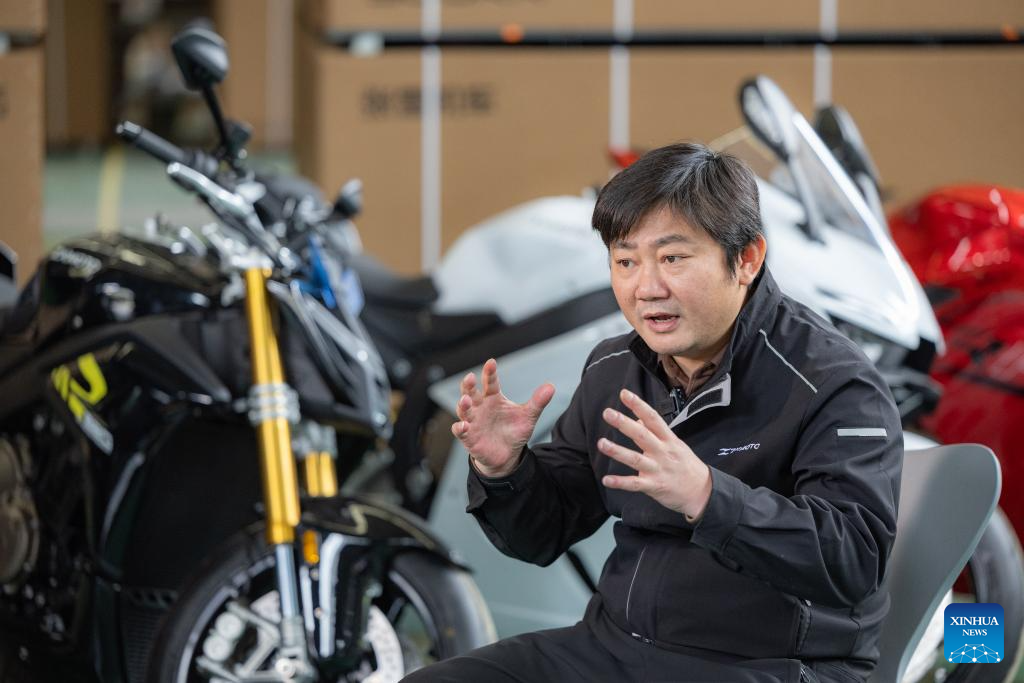

(SINGAPORE, April 7, 2026) — A blunt remark by China’s most celebrated motorcycle entrepreneur, Zhang Xue, recently ignited a heated debate. According to Chinese media, his words have prompted a discussion over “how the government should support businesses.” Behind the statement lies the story of an intrepid entrepreneur, China’s broader policies on business support, and the complex question of “who deserves credit after a company’s success.”
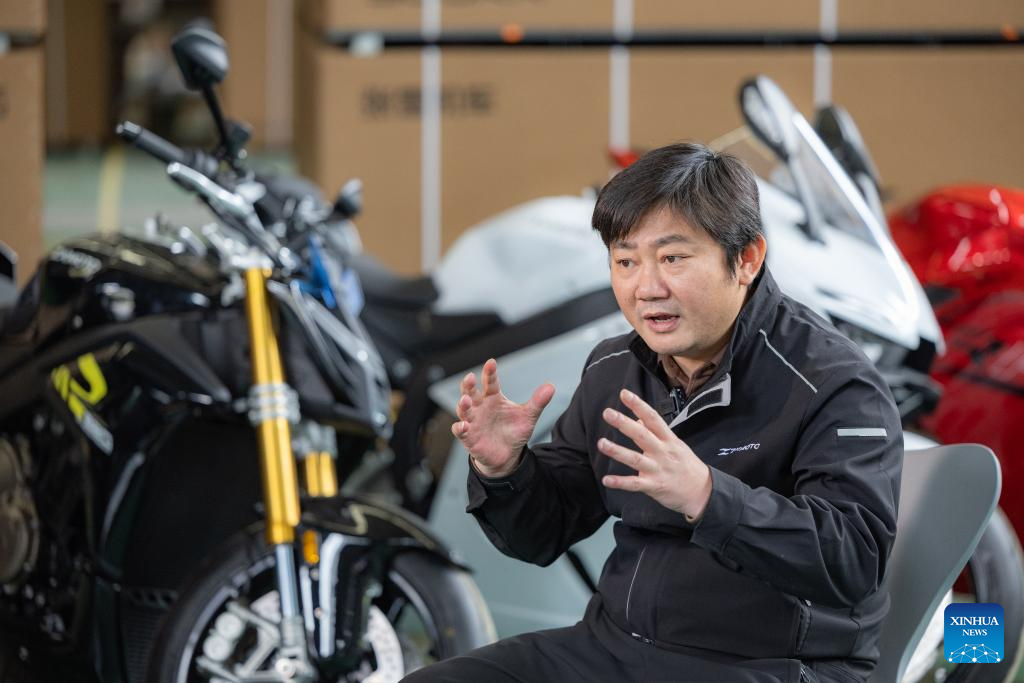
On March 28, at the Portugal round of the World Superbike Championship (WSBK), Chinese brand Zhangxue Motorcycles (张雪机车) won the Supersport (SSP) race by nearly four seconds. It was a historic first: no Chinese manufacturer had ever beaten established names like Ducati, Yamaha, Kawasaki, and Honda since the championship began in 1988.
At a WSBK viewing event held on Guangyang (广阳) Island in Chongqing (重庆), Zhang Xue (张雪), 39, the founder of the company, waved a red flag and wept tears of joy. Fascinated by motorcycles since childhood, Zhang left school in 2003 because his family could no longer afford his education. He worked as an apprentice at a motorcycle repair shop in his hometown of Huaihua (怀化), Hunan province, and by age 17 had opened his own repair business.
At 19, in 2006, he became a professional motorcycle racer—but quickly realized racing could not provide a stable income. Over the next two decades, his life revolved entirely around motorcycles. He joined a motorcycle company at an entry-level position, and through talent and hard work, became an engineer within three years.
In 2017, Zhang co-founded Kove (凯越) Motorcycles, where he insisted on developing high-revving three-cylinder engines for peak performance. Within three years, Kove sold nearly 600,000 units. The 500X and 321 series, in particular, propelled the brand into China’s second-tier market.
Zhang stepped down at Kove’s height in 2024 to pursue a new engine design, founding his own brand, Zhangxue Motorcycles, in Chongqing. By 2025, China’s motorcycle sales rebounded to 7.857 million units, with large-displacement bikes over 250cc surging 44.68%—a moment finally for Zhang.
Then came his April 30 remark during a post-WSBK media interview. When asked whether Chongqing’s local government had supported his journey, Zhang said simply: “Nothing. Not a single penny.”
The candid statement went viral. Some celebrated his authenticity in highlighting himself as an example of bootstrapping in China; others criticized him for embarrassing Chongqing, suggesting the city had failed to identify and support a local champion.
China’s flagship newspaper, People’s Daily, weighed in, noting that government support in China has never been mere “blood transfusion” — meaning financial aid. Instead, it has “evolved into a comprehensive innovation ecosystem, combining broad nurturing measures with precise, targeted assistance.”
“It includes not only direct support—funding, policy incentives, and government procurement—but also indirect support such as improved infrastructure, optimized business environments, and a thriving industrial ecosystem,” the commentary explained.
“Chongqing has built the most complete motorcycle industry chain, aiming to become China’s ‘Motorcycle Capital.’ From engine cylinders to precision gears, frame welding to chassis tuning, everything needed to build a high-performance motorcycle can be sourced within a few dozen kilometers of a factory,” the article continued.
The report also cited what Zhang had allegedly said: “Chongqing has not only provided me the foundation to build motorcycles but also the confidence to build them well.” Interestingly, this quote did not appear in initial reports on March 30 but surfaced on April 1 after journalists retrieved it from their notes.
The commentary concluded: “The success of a company—or even an entire industry—cannot be narrowly judged from a single region. Only by looking at China’s national market can we truly understand the deeper reasons behind Zhangxue Motorcycles’ breakthrough success.”
Responding to the controversy, Zhang posted a video on April 4. He admitted he had “wanted to show off a bit,” wanting to stress, “Look, I can do something this cool on my own.” He clarified that when he said he had “received nothing,” he meant he had not taken any direct government subsidies. But he acknowledged Chongqing’s industrial chain and talent pool were crucial to his success.
A commentary on China’s Zhihu (知乎) information platform observed, “Is financial support the only form of assistance? Certainly not—entrepreneurs also benefit from favorable local policies.” But it quipped, “Still, some financial help during the toughest times is always valuable.”
Chinese analysts compared Zhang’s path to Jack Ma’s, noting that while Ma bootstrapped in a relatively bare ecosystem with only regulatory support, Zhang’s success had rested on a stable industrial base. His statement about no direct funding is accurate, yet the government’s indirect support was significant.
Anyway, while Chongqing provided Zhang the “soil,” capital from Zhejiang province supplied the “fertilizer.” In January 2026, Zhejiang Venture Capital (浙江创投) invested 90 million yuan (≈S$16.7 million) into Zhangxue Motorcycles, giving the company a post-money valuation of 1.09 billion yuan. At that time, the company had recorded a 22.78-million-yuan loss in 2025.
Cheng Junhua (程俊华), general manager of Zhejiang Venture, bet on Zhang’s relentless pursuit of technical excellence and his unique ability to “improve an engine just by listening to it.” The investment was hailed as a strategic masterstroke and sparked broad discussion about the business environments of both Chongqing and Zhejiang.