























(SINGAPORE 2026.1.29) Recent data on China’s consumer spending shows mounting pressure on multiple business sectors, including food and beverage, as households tighten their budgets. This economic backdrop helps explain why price hikes have become a precarious move in China, with companies caught between rising costs and softening demand.
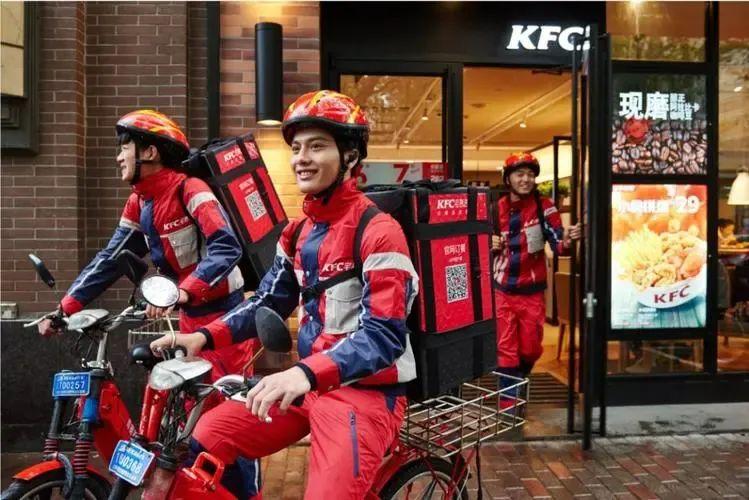
Against this backdrop, KFC’s (Kentucky Fried Chicken) decision to raise prices on delivery items by an average of about 0.8 yuan (S$0.15) on January 26 — while keeping dine-in prices unchanged — has drawn attention and sparked discussion among industry analysts.
Markets for traditional food and beverage — particularly processed and packaged foods — are seeing sluggish growth, while that of high-end segment such as alcohol have either contracted or slowed significantly. In contrast, snacks and casual foods continue to benefit from frequent purchases and a large market base, reflecting evolving lifestyle trends in China. KFC is generally considered part of this latter segment.
Within the restaurant industry, the price war continues, making KFC China’s increase feel abrupt and surprising. However, for Yum China, the parent company of KFC in China, this move is not merely a response to inflation; it coincides with a historic shift in which delivery revenue has surpassed 50% of total sales, reshaping the company’s profit model.
In its drive to reach 20,000 outlets by 2026, KFC China is balancing large-scale expansion, new sales channel development, and shareholder returns, according to Chinese business news platform Yongliu Shangye (涌流商业). Weak consumption is just one factor in the calculation.
As of the third quarter of 2025, delivery accounted for 51% of KFC China’s revenue, signaling a fundamental shift from a primarily dine-in model to a dual-engine business driven by both in-store and off-premises sales. However, while delivery has generated substantial additional revenue, it has also increased labor costs, which reached 26.2% of revenue, up 101 basis points year-on-year. The rise primarily reflects higher delivery rider costs due to surging takeout orders.
Delivery customers typically prioritize convenience, making them accepting of the 0.8 yuan price increase. KFC China has also maintained high-value traffic drivers such as “Crazy Thursday,” a weekly promotion offering heavily discounted meals or combos, to retain price-sensitive consumers.
The decision to raise prices is also rooted in Yum China’s assessment of the competitive fast-food landscape. Management believes that the subsidy wars among food delivery platforms such as Meituan and Ele.me are unsustainable in the long run. By adjusting prices slightly upwards, KFC China can test consumer loyalty while preemptively establishing its own “sustainable pricing mechanism,” reducing dependence on volatile platform discounts.
Beyond pricing, Yum China’s RGM 3.0 strategy — Resilience, Growth, and Moat — focuses on operational efficiency through technology as the main profit engine. A key initiative is the Mega RGM (“Super Store Manager”) model, under which nearly half of restaurant managers now oversee multiple locations. AI-assisted decision-making, automated inventory management, and digital scheduling allow managers to supervise a broader network without being physically present at each store, enhancing scalability. Moat refers to a durable competitive edge, such as strong brand recognition.
Supply chain optimization has also improved profitability. Despite labor costs, KFC China’s restaurant-level profit margins rebounded to 17.3% in Q3 2025, aided by economies of scale in procurement and more efficient rental structures, which reduced rent and other operating expenses by 100 basis points year-on-year.
KFC China has reaffirmed its growth targets: 20,000 stores by 2026, 25,000 by 2028, and over 30,000 by 2030. To sustain expansion while preserving margins, the company is shifting from a wholly-owned store model to a hybrid mix of company-operated and franchised outlets. In the first three quarters of 2025, 41% of new openings were franchises, and the company plans to maintain 40–50% franchise proportion between 2026 and 2028, focusing on lower-tier cities and venues such as universities, hospitals, and tourist attractions.
In markets of small towns, KFC China has introduced a low-investment store model requiring only 500,000–700,000 yuan, shortening payback periods to 2–3 years. By leveraging franchisee capital, KFC China also mitigates rental pressures of higher-tier cities and finds new ways to grow total sales across all its restaurants such as menu innovation.
Traditionally, high growth, strong margins, and shareholder returns form an “impossible trinity” difficult to achieve simultaneously. But Yum China aims to overcome this challenge through sophisticated financial modeling. Its target is to make KFC the first chain restaurant brand in China to achieve an operating profit of 10 billion yuan by 2028, maintaining long-term restaurant-level margins of at least 17.3%. The delivery price increase contributes to safeguarding these margins.
The company expects to return approximately 1.5 billion yuan annually to shareholders in 2025 and 2026, as it did in 2024. From 2027 onward, Yum China plans to return 100% of free cash flow — the money remaining after all operating expenses and capital expenditures — to shareholders.
Although a 0.8 yuan increase may appear minor, it represents a calculated effort to protect KFC China’s competitive edge amid macroeconomic uncertainty. Meanwhile, China’s food consumption is underperforming relative to pre-Covid levels and the anticipated growth of the emerging middle class.
KFC China, in essence, aims to balance cost pressures and subdued demand with a measured, loyalty-driven pricing strategy, positioning itself as a resilient market leader even as overall consumption slows, concluded Yongliu Shangye.