




















(SINGAPORE 2026.3.5) Macau’s gaming industry is gradually emerging from decade-long doldrums while traditional old-school casinos lose influence to large integrated resorts. The region is shifting from its former “casino city” identity to becoming a comprehensive tourism and leisure destination, though significant structural challenges remain.
During the recent Lunar New Year, Macau saw a surge in both tourism and casino traffic. Gaming halls were packed, generating bonuses for about 100,000 industry workers and boosting the local economy. The city welcomed more than 1.55 million inbound visitors during the period, averaging 173,000 per day — a 5.5% increase over last year and a new historical record. This contrasts sharply with two or three years ago, when visitor numbers were low and the industry struggled.
Macau’s gaming revenue peaked in 2013, driven by VIP gamblers from mainland China. But Beijing’s 2014 anti-corruption campaign targeting officials sharply reduced this key revenue source. The 2020 to 2021 Covid pandemic further crippled the sector through travel restrictions and lockdowns.
With travel resuming after 2022, casinos began to recover, but the industry’s structure and leadership have shifted. The traditional powerhouse – the late casino king Stanley Ho’s SJM (澳博) – has declined, while new players such as Hong Kong-owned Galaxy (银河) and the joint venture MGM (美高梅) have risen. Competition between local and foreign operators has intensified, according to the finance-focused 19th Lab (19 号商研社) column in China’s Time Weekly.
Non-gaming revenue is rising, with operators investing more in hotels, entertainment, and convention centres, reflecting Macau government’s goal of transforming the city from a “gaming hub” into a global tourism destination. Yet challenges persist: overnight visitor proportions are falling, hotels maintain high occupancy but have to charge low room rates, and the disappearance of VIP rooms has kept away high-spending customers.
The closure of satellite casinos—small venues located in the old district, not the resorts-heavy Cotai Strip (路氹城大道), and licensed under major concessionaires —has also affected the industry. By the end of 2025, government-ordered shutdowns of more than a dozen such gambling houses signalled the accelerated end of Macau’s era of sprawling, loosely-run casinos.
The biggest challenge is gambling remains Macau’s economic pillar, and industrial diversification is far from complete. In 2025, total gaming revenue reached 247.4 billion patacas (S$41.3 billion), an 18.7% increase year-on-year, while visitor arrivals exceeded 40 million for the first time. Among the six gaming operators, the four locals made notable gains. So had Wynn Macau (永利澳门) and Sands China (金沙中国), the two foreign-owned.
Galaxy Entertainment, founded by Hong Kong businessman Lui Che-woo (吕志和)—the “Hotel King”—reported net revenue of HK$49.2 billion (S$8.86 billion) in 2025, up 13% year-on-year. Its luxury resort, Galaxy Macau, built with over HK$10 billion in investment, contributed HK$41 billion in net revenue. This marked the best performance in years for the Lui family, while Stanley Ho’s family lost its former dominance.
SJM once monopolized Macau’s gaming sector with Ho’s exclusive licence. The 2002 issuance of additional gaming licenses brought in new operators such as Galaxy, Sands China, and Wynn Macau, ending Ho’s decades-long stranglehold and driving gaming revenues to over 360 billion patacas by 2013. Luxury resorts like Sands Cotai, Galaxy Macau, and Wynn Palace gradually caused SJM’s market share to erode. Today, SJM is under the control of Ho’s second wife’s Angela Leong (梁安琪 ) and daughter Daisy Ho (何超凤). It posted HK$21.6 billion revenue in the first three quarters of 2025, but a net loss of HK$173 million. Stanley passed away in 2020.
Ho’s son Ho Yau Lung (何猷龙) leads Melco Resorts & Entertainment (新濠博亚娱乐), which operates City of Dreams (新濠天地), Studio City (新濠影汇), and Altira Macau (澳门新濠锋). In 2025, the company recorded US$5.2 billion (S$7 billion) in revenue and net income of US$185 million, turning a profit. Pansy Ho (何超琼), another of Stanley Ho’s daughters, leads MGM China, founded in 2005 with the American MGM Group. Last year, MGM China reported net revenue of US$4.4 billion, up about 11%, surpassing pre-pandemic revenue and leading the industry in recovery.
SJM represents Macau’s traditional gaming sector, while Galaxy, MGM China, and Sands lead in economic diversification, according to an industry insider cited by China’s financial news platform Times Finance.
Macau’s entertainment scene is also diversifying. In 2025, concerts featuring artistes from Hong Kong, Taiwan, South Korea, Europe, and the US sold out repeatedly, illuminating the nights of Cotai Strip alongside casinos. International sports events, including the NBA China Games hosted by Sands China, have also increased. “There’s basically a concert, music show, or theatre performance every week,” said frequent visitor Ho Hao, noting a stronger investment in large-scale leisure, cultural, and sports activities.
Non-gaming revenue now makes up 15 to 20% for Macau’s major operators, with Galaxy’s reaching nearly 20% in 2025. Macau hosted more than 1,800 conventions and exhibitions that year, generating 6.28 billion patacas, up 16.4%.
Casino operators are also investing in the undersupplied hotel sector to encourage longer stays, following the integrated resort model pioneered in Las Vegas. Yet hurdles remain: 23.5 million of 40 million visitors in 2025 did not stay overnight, limiting the average length of stay and keeping hotels in a high-occupancy, low-yield situation. Revenue per available room at Wynn Palace fell 28%, and MGM Macau’s dropped 7% year-on-year.
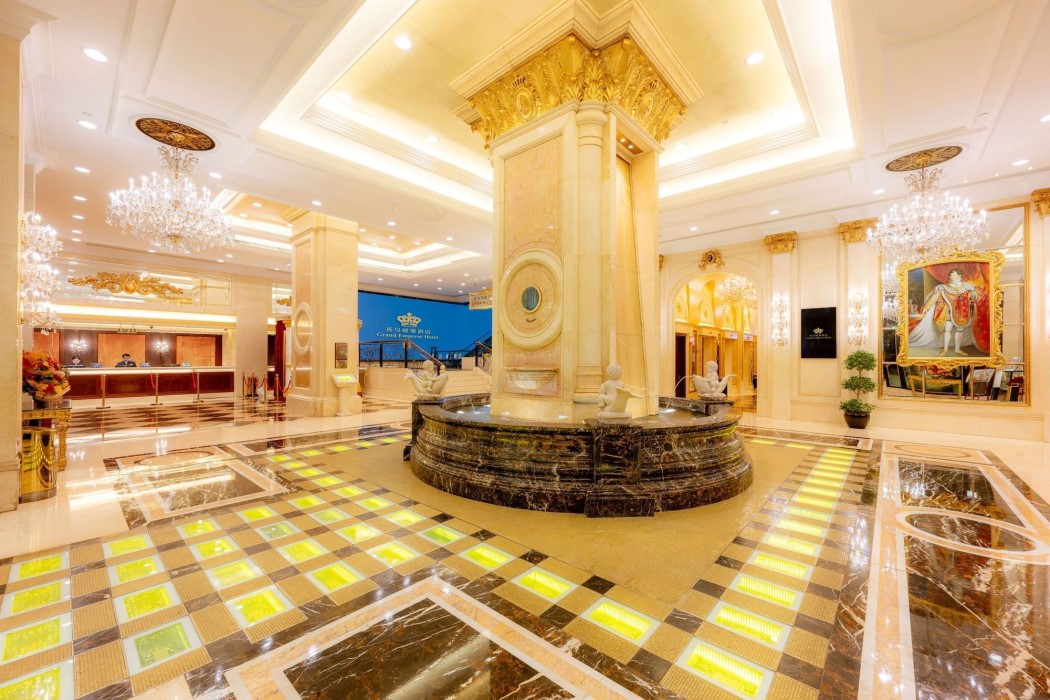
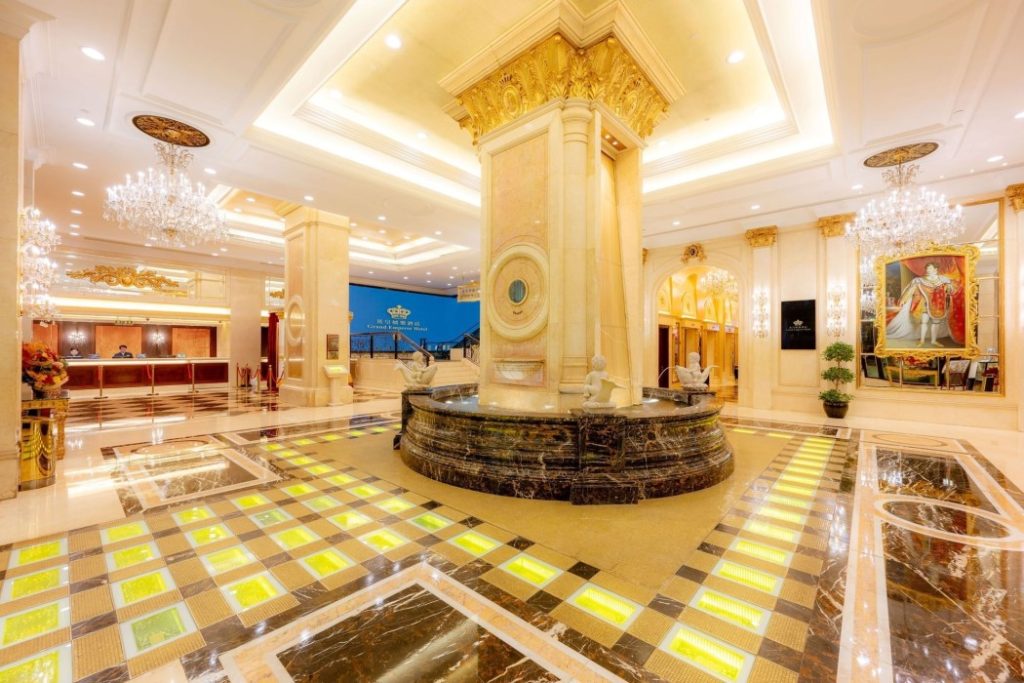
Regulations and the scrapping of VIP-driven gambling have also reshaped the market. By December 31, 2025, all 11 remaining satellite casinos had closed, including Emperor Palace (英皇宫殿), famous for the 79 kilograms of gold covering the lobby floor of the hotel Grand Palace where it was housed. Hotels on the old Macau Peninsula (澳门半岛) district that depended on these small casinos are now struggling while integrated resorts at Cotai compete with lower prices and heavy promotions to attract visitors. Macau Peninsula is the city’s original urban centre. This area has a high population density and a traditional “old town” feel.
From satellite closures to resort discounts, and from a “casino-first” focus to diversified visitor engagement, Macau is leaving behind its past growth model. Yet from the old Peninsula to the new Cotai Strip, the city is still in metamorphosis.