











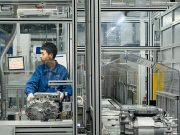
















(SINGAPORE 6.1.2026) Europe is committing €584 billion (about S$877 billion) to expand its power grid, yet progress is slowed by a critical bottleneck: a lack of transformers. In India, vast solar farms sit idle under bright skies, unable to transmit electricity because too few transformers are available.

In the United States, shortages of power and distribution transformers have surged since 2019—up 116% and 41% respectively. Demand is accelerating far faster than supply, and the tech industry warns that these gaps are already constraining power infrastructure and slowing the rollout of AI systems.
If there is a clear winner in this global transformer crunch, it is China. The country produces about 60% of the world’s transformers. Ironically, after previously imposing tariffs of up to 104% on Chinese transformers, the US is now quietly easing restrictions, according to the financial and business media outlet Huashang Taolue (华商韬略).
China’s transformer capacity is being snapped up even before factory lines start rolling. Major Chinese manufacturers report an “order boom.” Chengdu Xidian Electric (成都西电中特), for example, began production immediately for exports to Canada and Indonesia after completing orders for Sweden and Saudi Arabia.
Order backlogs at many Chinese firms now stretch well into the year. Some European buyers are willing to pay premiums of up to 20% to secure supply. As a result, the average export price of Chinese transformers has risen to about US$20,800 (S$26,370) per unit. In the first eight months of 2025, China’s total transformer exports reached 29.711 billion yuan (S$5.44 billion), with shipments to Asia up 65.4%, Africa up 28.0%, and exports to Europe surging more than 138%.
Transformers are a grid’s essential “voltage regulators,” stepping electricity up or down as needed. They range from tiny units in phone chargers that convert 220 V to 5 V, to massive ultra-high-voltage (UHV) converter transformers weighing hundreds of tons. Present at every stage of a power network, transformers form the backbone of modern electricity systems.
A September 2025 Goldman Sachs report noted that most European grid infrastructure has been operating for 40–50 years. Bank of America data shows that 31% of US transmission equipment and 46% of distribution assets have exceeded their designed lifespans. In response, the EU plans to invest €1.2 trillion over the next decade to modernize its grid, while the US aims to spend US$1.1 trillion over the next five years— all placing transformers at the center of the upgrades.
Rising demand from new industries is adding further pressure. Training a large ChatGPT-class language model for just three days consumes enough electricity to power 3,000 Teslas for a combined 320,000 km. A single medium-sized Meta data center requires hundreds of step-down transformers.
The transition to green energy amplifies this need. Large solar, wind, and hydropower projects require significantly more transformers than traditional thermal plants; a solar farm, for instance, needs roughly 1.8 times as many transformers as a comparable fossil-fuel facility.
Taken together, these forces make a global transformer shortage almost inevitable. International energy analysis firm United Markets estimates the global transformer market will reach US$103 billion by 2031, nearly doubling from US$58.6 billion in 2021.
Meanwhile, China has spent years building an elite transformer industry. In 2021, China Electric Equipment Group (中国电气装备集团) was formed by integrating industry leaders such as Xidian Electric, Baobian Electric (保变电气), and Shandong Electric (山东电工) into a national “A team.” Xidian Electric leads in UHV technology and participates in all major national strategic projects, while Baobian Electric specializes in high-voltage, high-capacity equipment exported to more than 40 countries.
Private firms are just as competitive. Xinjiang Tebian Electric (新疆特变电) tops China’s electrical equipment companies, producing 420 million kVA (kilovolt-ampere ) of transformers and reactors annually. Jiangsu Huapeng Electric (江苏华鹏电力) is the only Chinese firm among North America’s top ten transformer brands and the world’s largest exporter of renewable-energy transformers. Foshan Igor Electric (佛山伊戈尔电气) dominates the global market for step-up transformers used in solar and energy-storage projects.
This ecosystem allows China to control about 60% of global transformer capacity and dominate the entire supply chain, from raw materials to finished products.
In November 2025, China became the first country to record a trade surplus exceeding US$1 trillion. In the energy sector, it reached a similar milestone when monthly electricity generation surpassed one trillion kilowatt-hours in July 2025—enough to power Japan for a year. British media dubbed China the world’s first “power empire”, Huashang Taolue pointed out.
China’s dominance in transformers stems from scale, government backing, integrated supply chains, strong domestic demand, advanced technology, and competitive pricing. It does not just manufacture large volumes—it does so efficiently and cheaply.
By contrast, many transformer factories in the US and Europe closed or downsized over the past three to four decades as high costs, weak domestic demand, cheap imports, and high investment risks made production unattractive. This left Western countries heavily dependent on imports for large, high-voltage transformers, making shortages especially acute when global demand surged.
The skilled workforce is also shrinking. With much Western equipment now 40–50 years old, factories focus more on maintenance than large-scale new production. India faces its own constraints, relying on a limited number of domestic manufacturers whose facilities are stretched by both local and export demand.