
























(Singapore, 17.12.2025)U.S. President Donald Trump has ordered what he described as a “total and complete blockade” of all sanctioned oil tankers entering or leaving Venezuela, sharply escalating Washington’s pressure campaign against President Nicolas Maduro’s government and injecting fresh uncertainty into global oil markets.
The announcement, made late Tuesday on Trump’s Truth Social platform, targets Venezuela’s oil trade, which remains the country’s main source of income. Trump accused the Venezuelan government of a range of crimes, including terrorism, drug smuggling and human trafficking, and said these actions justified designating the Maduro administration as a foreign terrorist organization.
“Therefore, today, I am ordering a total and complete blockade of all sanctioned oil tankers going into, and out of, Venezuela,” Trump wrote.
The Venezuelan government swiftly rejected the move, calling it a “grotesque threat” and accusing Washington of imperial ambitions aimed at seizing control of the country’s vast natural resources.
Unclear Enforcement, Rising Tensions
While the language used by Trump was dramatic, major questions remain about how the blockade would be enforced in practice. U.S. officials have not provided details on whether the Coast Guard or the U.S. Navy would be tasked with stopping or seizing vessels at sea, or how broadly the action would be applied.
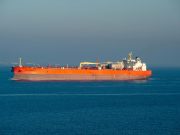
In recent weeks, however, the United States has significantly increased its military presence in the region, deploying thousands of troops and nearly a dozen warships, including an aircraft carrier. Last week, U.S. authorities seized a sanctioned oil tanker off Venezuela’s coast, an action that has already discouraged other vessels from leaving Venezuelan waters.
As a result, several oil tankers carrying millions of barrels of crude have remained anchored offshore rather than risk interception. Venezuelan oil exports have fallen sharply since the seizure, a decline worsened by a recent cyberattack that disrupted administrative systems at state oil company PDVSA.
Trump’s declaration has also triggered debate in Washington over presidential authority and international law. Legal experts note that blockades have traditionally been treated as acts associated with wartime operations, raising questions about whether such a move can be ordered without congressional approval.
Elena Chachko, an international law scholar at the University of California, Berkeley, said Trump’s order represents a new test of executive power. While U.S. presidents have broad discretion to deploy forces abroad, she noted there are “serious questions” under both domestic and international law.
U.S. Representative Joaquin Castro, a Democrat from Texas, was more direct, calling the blockade “unquestionably an act of war” that Congress has not authorized and that Americans do not want.
Immediate Impact on Oil Prices
Oil markets reacted quickly to the news. Crude prices rose more than 1% in Asian trading on Wednesday as traders weighed the possibility of reduced Venezuelan supply.
Brent crude climbed to around $59.70 a barrel, while U.S. West Texas Intermediate rose to about $56.00 a barrel. The gains followed a sharp drop in prices a day earlier, when crude settled near five-year lows amid optimism over Russia-Ukraine peace talks that could eventually ease sanctions on Moscow and increase global supply.
Market participants said the rebound was driven partly by bargain buying after prices dipped below $60 a barrel, but Venezuela-related uncertainty also played a role.
Analysts estimate that a full enforcement of the blockade could disrupt between 400,000 and 500,000 barrels of oil per day in the near term. Others warn that if nearly a million barrels per day of Venezuelan supply were eventually removed from the market, prices could rise more sharply.
David Goldwyn, a former U.S. State Department energy diplomat, said oil prices could increase by as much as $5 to $8 per barrel if lost Venezuelan exports are not offset by spare capacity from OPEC producers. He also warned of broader consequences, including soaring inflation inside Venezuela and a potential surge in migration to neighboring countries.
China, Chevron and the “Shadow Fleet”
Despite years of U.S. sanctions, Venezuela continues to export oil using a complex network of buyers and transporters. China is the country’s largest customer, accounting for roughly 4% of its crude imports. Shipments to China in December were on track to average more than 600,000 barrels per day, according to analysts.
Not all tankers carrying Venezuelan oil are sanctioned. Some vessels transporting crude linked to Iran or Russia remain unsanctioned, while U.S. oil major Chevron continues to move Venezuelan oil to the United States under a special authorization granted by Washington.
Since energy sanctions were first imposed in 2019, traders and refiners have increasingly relied on a so-called “shadow fleet” of tankers. These vessels often obscure their locations and ownership details and are frequently used to transport sanctioned oil from countries such as Iran, Russia and Venezuela.
Data compiled by TankerTrackers.com shows that more than 30 of the roughly 80 ships operating in or near Venezuelan waters last week were already under U.S. sanctions.
For now, analysts say the global oil market remains well supplied, with millions of barrels sitting in tankers offshore, particularly near China. That buffer could limit immediate price spikes.
However, if the blockade is enforced over a longer period, or if Venezuela or its allies respond with retaliatory actions that disrupt energy infrastructure elsewhere in the Americas, the impact could grow significantly.
“This is sentiment-driven for now,” one Asian oil trader said, noting that Venezuela’s exports are relatively small in the global context. “But if the disruption lasts, prices will eventually feel it.”
As Washington and Caracas trade increasingly hostile rhetoric, markets and governments alike are watching closely to see whether Trump’s order remains a political warning or becomes a defining flashpoint in an already volatile energy landscape.