
























(SINGAPORE 2026.3.26) Pop Mart (泡泡玛特), the Chinese company that turned its designer collectible toy Labubu (拉布布) into a global sensation, is now a cautionary tale. After a sharp drop in its shares, some commentators warn against mistaking hype for strength, luck for strategy, and rapid growth for sustainability.
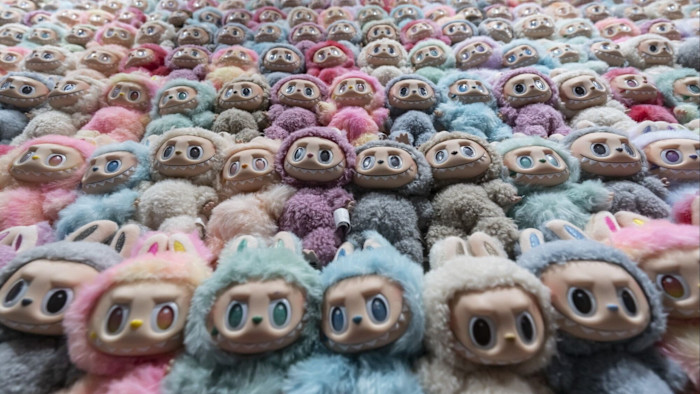
Besides, investors’ valuation of hype-driven businesses always swings between confidence and skepticism.
On Wednesday, Pop Mart released its 2025 financial report: revenue surged 185% year-on-year to 37.12 billion yuan (S$7.05 billion), and net profit jumped 307% to 12.8 billion yuan. These figures revealed Labubu has entered mainstream markets worldwide, delivering triple-digit growth.
Yet the stock market in Hong Kong reacted harshly. Pop Mart shares plunged over 22% following the earnings release and fell nearly another 10% the next day—a two-day drop of around 30%, the biggest decline since April 2025. Over recent months, its market cap has fallen more than 50%, from HK$450 billion to HK$200 billion (S$40.7 billion).
Why the plunge? asked the Capital Mirror (资本镜像) column in China’s business-focused media platform 36 Kr. While net profit beat expectations. Pop Mart’s revenue missed the 37.96 billion yuan forecast. Growth slowed in Q4 to 105.6% from over 300% in Q3, with domestic sales up only 75%.
More fundamentally, critics say the company’s success hinges almost entirely on Labubu. The collectible family generated 14.16 billion yuan—40% of Pop Mart’s revenue—while other IPs like Monsters, Skullpanda, Molly, and Crybaby underperformed. A single hit can become a liability if it stifles diversification.
In creative industries, longevity comes from patience, originality, and cultural depth. Iconic IPs like Mickey Mouse and Hello Kitty took decades to achieve global and enduring recognition. Pop Mart itself spent over 20 years across multiple IPs before Labubu’s breakout, which was largely unexpected. Designed in 2015 by Kasing Lung (龙家升), Labubu only exploded globally after a social media post by Thai singer BLACKPINK’s Lisa—engineered by Pop Mart—went viral in 2020.
From the day it was born, Pop Mart’s IP has faced market skepticism for being “hollow,” with Disney often held up as the benchmark. Unlike Pop Mart’s visually driven IP, Disney follows a classic storytelling approach, turning each movie into a retail cash machine that keeps generating revenue for years, remarked another 36 Kr column Zimubang (字母榜).
Pop Mart has since tried to replicate Labubu’s “proven” formula—blind boxes, scarcity, and cute design—but luck cannot be systematized. Scaling supply of blind boxes from 10 million to 50 million units led to falling resale prices while celebrity-driven demand faded. “Real value comes from enduring emotional connection and cultural meaning,” Capital Mirror noted.
Blind box is the strategy of selling toys in mystery packaging to lure repeat purchases by customers; scarcity works by limiting blind supply to heighten perceived value; and cute design is about making products visually appealing.
Besides, a strong IP should speak for itself. Hiring a celebrity to endorse it might give it a quick spike in attention, but in the long run, it actually narrows the business. Just imagine if Hello Kitty had a single global spokesperson—suddenly, the character would feel off, Captial Mirror remarked.
The charm of an IP lies in its neutrality and openness—people can project themselves onto it. Once it is tied to a celebrity’s persona, its appeal would be limited. What was once for “everyone” becomes “just this celebrity’s fans, it added.
Pop Mart’s recent pivot into producing small home appliances like Labubu rice cooker underscores the challenge of building multiple successful IPs. Ironically founder Wang Ning (王宁) previously emphasized that designer toys should be “useless by design,” and functional products risk eroding their emotional appeal. Now entering fiercely competitive spaces like rice cookers raises questions about Pop Mart’s direction and long-term focus.
Meanwhile, the secondary market already signaled trouble. Labubu 4.0 was launched at peak hype, but resale prices for standard editions already fell below retail. Investors have lost faith amid Pop Mart’s slowing growth, excess inventory, scattered ventures, and doubts over the sustainability of its hype-driven business model.
The surge of imitators— QuarkSong Group ( 量子之歌 ) which originally focused on online education for seniors; Miniso (名创优品) a retail brand that sells affordable everyday products like cosmetics and stationery ; Bluco Block (布鲁可), a construction toys company ; 52TOYS, an IP-driven toy company; and others—highlights a common industry mistake: copying the formula (plush + blind box + quirky design) while overlooking the decade-long IP ecosystem, designer network, and cultural resonance that Pop Mart built. Treating randomness as inevitability can lead to failure.
Ultimately, a lasting IP must answer: when the hype fades and the celebrities are gone, why should people still care? Even Pop Mart faces this question with Labubu. For fast followers chasing “the next Labubu,” the risk is even greater—copy first, crash midway, concluded Capital Mirror.