








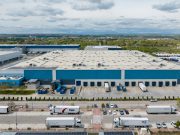















(Singapore, 4.12.2025)In 2025, Southeast Asia—particularly countries nearest China—is experiencing a surge in industrial park construction as manufacturers relocate or expand operations from the world’s second-largest economy to counter rising costs, US tariffs, and supply-chain diversification pressures.
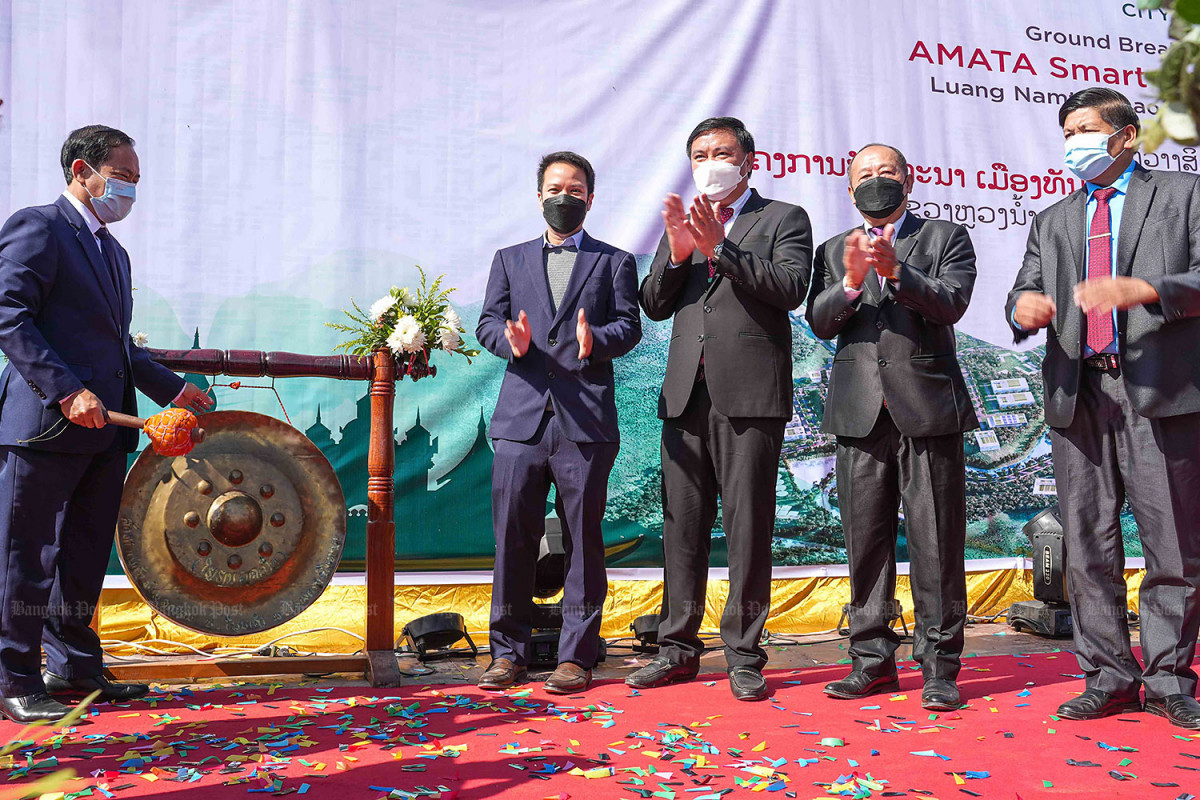
One example is Thai developer Amata Corporation, which has embarked on a US$1 billion (about S$1.29 billion) investment to build and pre-sell a second industrial park in Laos starting in 2025. As factory relocations from China accelerate amid Beijing’s trade frictions with the US and Europe, landlocked Laos—bordering China—is positioning itself to capture part of the flow.

Amata founder Vikrom Kromadit told Japanese-owned Chinese-language media Nikkei Asia that the company has secured about 200 sq km of land in Namor, northern Laos, and will begin building basic infrastructure, including power and water, within this year. Pre-sales are under way, with delivery scheduled upon completion. The company is also negotiating with Vientiane for an additional 200 sq km, with a decision expected within months.
The new park will target companies, foreign and Chinee, moving production out of China. Located just 50 km from the Chinese border and along the Laos–China railway opened in 2021; the site offers direct logistical access to China.
This year, Chinese home appliance maker Hisense has committed a 4.7 billion‑baht (about S$190 million) investment to build a refrigerator plant in Thailand’s Chonburi Province. Chinese data centre leader Beijing Haoyang is planning a hyperscale facility in Rayong Province, around 180 km east of Bangkok.
Founded in 1989, Amata built its business by acquiring large tracts of land across Thailand and Southeast Asia, developing infrastructure and selling industrial plots. By end-2024, it operated and developed 12 industrial parks of more than 100 sq km each, mainly in Thailand and Vietnam, while holding about 700 sq km of undeveloped land—roughly the size of Singapore. Its revenue for the year ended 2024 jumped 54% to 14.9 billion baht, 2.4 times its 2019 level.
But competition is intensifying. Thai rival WHA Group plans to invest 33 billion baht by 2028 to build eight new industrial parks in Thailand and Vietnam, with Indonesia also in view. WHA Group CEO Jareeporn Jarukornsakul told Nikkei Asia that demand for alternative production bases, led by Chinese firms, remains strong.
In Thailand, Saha Group and TCC Group—the conglomerate behind the famous Chang beer—are also speeding up on industrial park development, betting on continued factory transfers from China.
In Vietnam, Hanoi has approved 14 new industrial park projects across the country this year. These cover a total area of over 4,000 hectares. Government reports also reveal that Chinese manufacturers are investing billions of dollars to set up new assembly lines in both the northern and southern regions of the country.
A 2025 report indicates that Indonesia established nine new industrial parks over the past year. While many of Indonesia’s industrial parks aim to attract manufacturers leaving China, their primary purpose is supply-chain diversification rather than fully replacing Chinese operations. Notably, some parks were developed in partnership with Chinese companies.
By the end of last year, Cambodia had set up 20 new industrial parks. One news report highlighted a furniture factory relocating from China to a Cambodian park specifically to sidestep US tariffs. In Laos, aside from the Amata Smart & Eco City Namor, the Moding Mohan Economic Cooperation Zone—also on the China–Laos border—is reportedly fast-tracking the development of a large “processing and manufacturing industrial park” that was launched this year.
The overall trend suggests that Southeast Asia is solidifying its role as a major alternative global manufacturing hub, drawing not only cost-sensitive production but also increasingly advanced and “green” industries from China and other countries.
In other words, although US tariffs may have curbed China’s direct export growth, the primary beneficiaries have not been American industrial workers. Instead, production has migrated to areas on the periphery of China’s economy, frequently accompanied by Chinese investment and technology.”
For investors, the industrial real estate and logistics markets in these countries are well-positioned for growth and likely to offer steady, long-term returns. Meanwhile, Chinese suppliers could benefit from more robust and stable business if demand for their automation equipment spans multiple regions.
A recent Reuters report found that while China’s domestic factory growth may be slowing, the country continues to shape global manufacturing trends through its overseas investments and automation technologies.