























(Photo: WEF Website)

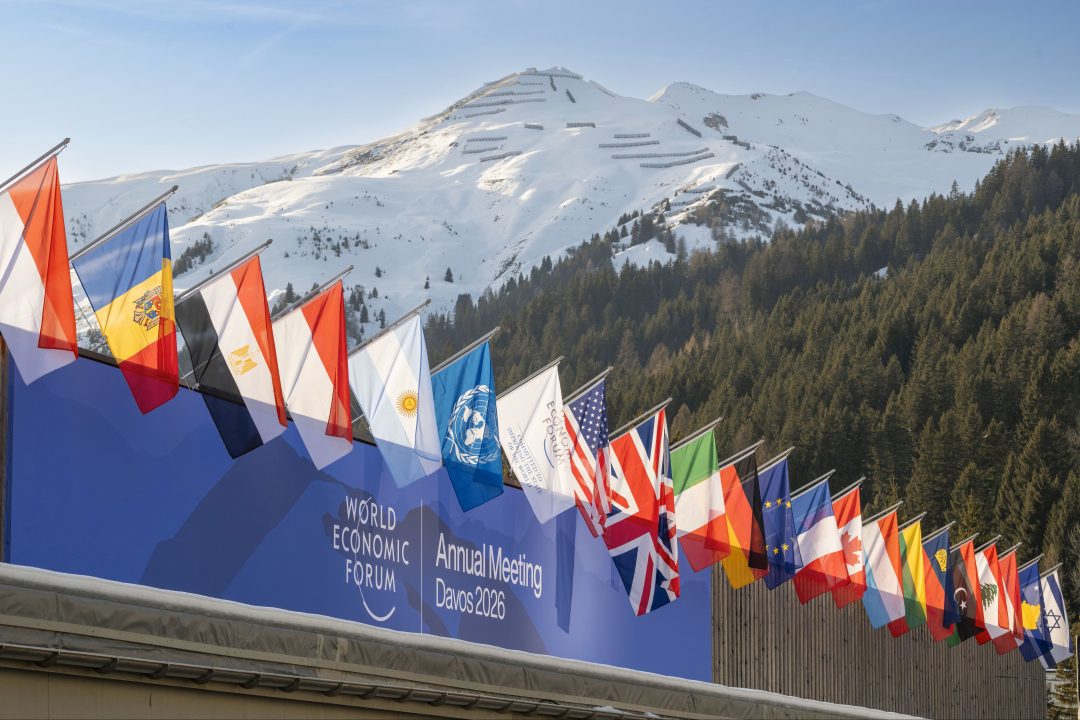
(Singapore, 21.01.2026)U.S. President Donald Trump arrived in the Swiss resort town of Davos on Wednesday after a brief flight delay, seeking to promote U.S. economic strength at the annual World Economic Forum (WEF). However, his appearance has been quickly overshadowed by growing investor unease and diplomatic tension in Europe over his renewed push to acquire Greenland, a move critics warn could disrupt trade ties and long-standing transatlantic economic cooperation.
Trump’s arrival came several hours later than planned after Air Force One was forced to turn back shortly after takeoff from Washington due to what the White House described as a minor electrical issue. The president and his delegation later continued the journey on a smaller aircraft and landed safely in Switzerland. While the delay added drama to the trip, it did little to distract from the political and economic controversy awaiting him in Davos.
The president’s visit was originally intended to focus on economic messaging. The White House has said Trump plans to highlight U.S. growth, job creation, and competitiveness at a time when many global economies are struggling with weak expansion, high debt, and geopolitical uncertainty. Yet his increasingly forceful rhetoric over Greenland has dominated conversations among diplomats, investors, and business leaders attending the summit.
In recent days, Trump has repeatedly argued that the United States “needs Greenland” for national security reasons, describing the Arctic island as a strategic guardpost against Russia and China. He has also warned that European opposition could be met with trade retaliation, raising concerns about the potential impact on transatlantic commerce and supply chains.
European leaders have reacted with disbelief and frustration. Denmark and Greenland’s local government have firmly rejected the idea of a sale, while offering alternative arrangements that would allow an expanded U.S. military and economic presence on the island. Those proposals have so far failed to satisfy Trump, who has shown little sign of backing down.
The dispute has triggered what many officials describe as the most serious strain in relations between the United States and Europe in decades. Senior figures within NATO have privately warned that Trump’s approach risks undermining trust within the alliance, particularly as members attempt to present a united front on security and defense.
Trump has added to the controversy by posting a digitally altered image on social media showing himself planting an American flag on Greenland. The image was widely criticised across Europe as provocative and inappropriate, further souring the mood ahead of his Davos speech.
In another unusual move, Trump publicly released the contents of a private message he received from French President Emmanuel Macron, who questioned Trump’s focus on Greenland and suggested follow-up talks with other G7 leaders after the forum. Trump dismissed the proposal, saying he did not see the value in additional discussions.
Despite the backlash, Trump has expressed confidence that a deal could eventually be reached. Speaking to reporters before leaving Washington, he said he believed an outcome was possible that would satisfy both the United States and its NATO partners. Asked how far he was willing to go to secure Greenland, Trump declined to elaborate, saying only: “You’ll find out.”
Behind the scenes, sources familiar with the matter say Trump views Greenland as part of a broader legacy ambition to expand U.S. territory in a way not seen since Alaska and Hawaii became states in 1959. The issue has also been linked by allies to Trump’s long-standing frustration over not having received a Nobel Peace Prize.
While politics has taken center stage, Trump is still expected to use his keynote address to outline domestic economic initiatives. According to the White House, he will unveil a proposal aimed at easing housing affordability by allowing Americans to use funds from their 401(k) retirement savings for home down payments.
“President Trump will unveil initiatives to drive down housing costs, tout his economic agenda that has propelled the United States to lead the world in economic growth, and emphasize that the United States and Europe must move beyond economic stagnation,” a White House official said.
However, even senior aides acknowledge that Trump often departs from prepared remarks. Observers in Davos expect that his speech could touch on tariffs, Europe’s economic policies, Greenland, and his broader critique of multilateral institutions.
During his stay, Trump is scheduled to hold bilateral meetings with the leaders of Switzerland, Poland, and Egypt. On Thursday, he is also due to preside over a ceremony marking the launch of the “Board of Peace,” a body he established to oversee redevelopment efforts in Gaza following a fragile ceasefire between Israel and Hamas.
The initiative has raised concerns among U.S. allies after Trump suggested the board could eventually take on global crises beyond Gaza — a role traditionally handled by the United Nations. Trump has said he supports the UN but believes it has failed to reach its full potential.
With cold and foggy conditions in Davos, the political atmosphere inside the summit venue was equally chilly. Trump’s confrontational tone, combined with threats of tariffs and territorial expansion, has cast a shadow over a gathering meant to focus on economic cooperation.
Trump is expected to return to Washington late Thursday, leaving behind a Davos summit marked less by consensus on growth and more by uncertainty over the future of transatlantic relations.