
























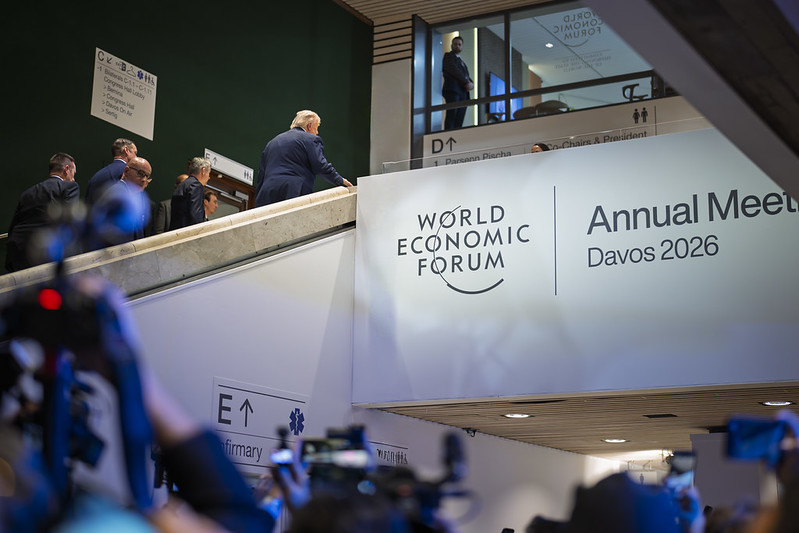

(Singapore, 22.01.2026)US President Donald Trump used the global stage of the World Economic Forum in Davos on Thursday to officially launch his controversial new initiative, the “Board of Peace,” just a day after retreating from threats that had unsettled Europe and other close allies.
(Photo: WEF website)
Trump’s announcement followed a sudden shift in tone on two sensitive issues. On Wednesday, he scrapped proposed tariffs on Europe and ruled out military action to take Greenland from Denmark, partially easing a diplomatic crisis that had overshadowed the annual gathering of political and business leaders in Switzerland.
With tensions cooling, Trump moved quickly to promote the Board of Peace, holding a signing ceremony to bring its charter into force and declaring it an official international organization. He described the board as a powerful new platform to resolve global conflicts, arguing that existing institutions have failed to prevent wars or bring lasting peace.
“I think it’s the greatest board ever formed,” Trump said during meetings on the sidelines of the forum.
The Board of Peace comes with a steep cost of entry. According to its charter, countries seeking permanent membership are expected to contribute at least US$1 billion. Trump will serve as the board’s inaugural chairman while also acting separately as the representative of the United States. The charter states that the chairman can only be replaced through voluntary resignation or incapacity, a clause that has already raised concerns among diplomats.
Trump has invited dozens of leaders to join, including Russia’s Vladimir Putin, Israel’s Benjamin Netanyahu, and Hungary’s Viktor Orban. He said Egyptian President Abdel-Fattah el-Sisi has already agreed to take part.
Several leaders and representatives joined Trump on stage in Davos, including Argentina’s President Javier Milei and officials from Saudi Arabia, Turkey, the United Arab Emirates, Pakistan, Azerbaijan and other countries. The White House said around 35 nations have committed so far, out of roughly 50 to 60 invitations sent.
The board was originally proposed as part of Trump’s plan to manage the aftermath of the war between Israel and Hamas, with a focus on maintaining a ceasefire and overseeing Gaza’s reconstruction. However, draft versions of the charter show a much broader mandate, allowing the board to intervene in regions “affected or threatened by conflict.”
That expanded role has alarmed many US allies, who worry the Board of Peace could rival or weaken the United Nations. Some European officials said they support efforts to stabilize Gaza but are uneasy about creating a new body that could sideline existing international mechanisms.
Trump sought to address those concerns in Davos, saying the board would work “in conjunction with the United Nations,” even as he repeated his criticism that the UN has failed to resolve major conflicts. UN officials later clarified that the Security Council’s earlier endorsement applied only to Gaza-related efforts, not to a wider global role.
Allies hesitate, critics push back
Despite Trump’s confidence, several key allies have declined to participate so far. France, the United Kingdom, Sweden, Norway, Germany, the Netherlands and Canada have either rejected the invitation or said they are not ready to sign on. European leaders have also questioned the inclusion of Putin while Russia’s war in Ukraine continues. The Kremlin has said it is still reviewing the invitation, despite Trump’s claim that Putin has agreed to join.
Canada’s Prime Minister Mark Carney said he is open to the idea in principle but stressed that any such body should remain narrowly focused on Gaza rather than evolving into a global peace authority.
The launch of the board was nearly overshadowed by Trump’s earlier comments on Greenland, which sparked backlash across Europe. Trump had threatened steep tariffs on Denmark while pressing for US control of the Arctic island, before backing down late Wednesday and saying a “framework of a future deal” had been reached.
Trump has made clear that the Board of Peace is central to how he wants his presidency to be remembered. He has repeatedly expressed frustration at not receiving a Nobel Peace Prize, despite claiming credit for ending or preventing several conflicts — claims that critics dispute.
For now, the Board of Peace remains one of the most ambitious and divisive initiatives unveiled at Davos this year. Supporters see it as a bold attempt to reshape global diplomacy, while critics warn it concentrates too much power and risks undermining the existing international order. Whether it becomes a lasting force or a short-lived experiment will depend largely on who ultimately joins and how much authority they are willing to give it.