


























(SINGAPORE 20264.14) Vietnam is seeking to move forward with its long-planned North–South high-speed railway, but constrained by financial and technological limitations, it is reportedly trying to attract China as a partner by leveraging another railway project as a bargaining tool, according to Chinese media.
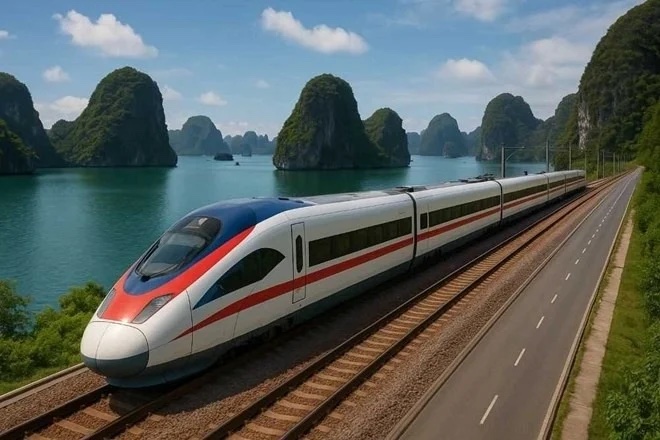
That “pilot” project is the country’s first inter-regional high-speed railway—the Hanoi–Quang Ninh (广宁) line—which officially broke ground on April 12. Scheduled for completion by the end of 2028, it will span 120.2 kilometers, connecting Hanoi with Bac Ninh (北宁) province, Hai Phong (海防) city, and Quang Ninh province. Quang Ninh borders Fangchenggang (防城港) in China’s Guangxi Zhuang Autonomous Region.
The line is planned as a double-track, fully electrified railway capable of speeds up to 350 km/h. In contrast to Vietnam’s typically used narrow-gauge system, this high-speed corridor will use the standard 1,435 mm gauge, making it compatible with China’s rail network if connections are established.
After unsuccessful negotiations with multiple potential partners for this project, Vietnam turned to Germany, adopting a collaboration model in which VinSpeed, Vietnam’s domestic railway investment and development company, serves as the primary investor, with Siemens acting as the technology provider.
The project’s total investment is estimated at about 147.37 trillion Vietnamese dong (around S$7.719 billion), excluding 10.27 trillion dong in land acquisition costs, which will be funded by the government. VinSpeed is expected to contribute about 22.11 trillion dong, while the remaining 125 trillion dong—about 85% of the total investment—will be raised through various financing sources.
As outlined in the plan, Siemens will provide rolling stock as well as signaling, communications, and related systems, while progressively transferring relevant technologies to VinSpeed. This arrangement effectively establishes Siemens’s presence in Vietnam’s high-speed rail sector, potentially strengthening its position for future collaboration on the country’s planned North–South high-speed railway project.
According to a column on China’s technology-focused news platform 36Kr, once completed, the railway is expected to deliver both economic and technological breakthroughs for Vietnam. Economically, it will link the capital, Hanoi, more closely with its northern industrial hubs and the Ha Long Bay (海龙湾) tourism area, cutting travel time from around two hours to about 23 minutes. This connectivity is likely to strengthen regional integration and could spur a new wave of urbanization and investment along the corridor.
From a technological perspective, Vietnam’s adoption of Siemens’ trains and signaling systems, along with its technology transfer agreements with the company, would help it develop a domestic high-speed rail ecosystem and lay a foundation for the future North–South rail projects, the Redianweiping (热点微评) column noted.
But more importantly, this railway project supports a broader strategic objective. To begin with, Vietnam faces major financial constraints in developing the large-scale North-South high-speed railway. Its projected 2025 GDP is expected to be smaller than that of Shenzhen alone, while national fiscal revenue—around 655.5 billion yuan (about S$121 billion)—remains lower than Guangxi’s public budget expenditure.
Meanwhile, Vingroup, the parent company of VinSpeed, is concurrently advancing several major developments, including two high-speed rail projects and the Hanoi Olympic Sports City, which are placing considerable financial strain on the conglomerate. Consequently, it has temporarily put on hold its most significant long-term initiative—the North–South high-speed railway linking Hanoi and Ho Chi Minh City.
This brings in Vietnam’s primary target partner, China, which has extensive experience in high-speed rail and could financially manage a gigantic project, Redianweiping pointed out. Vietnam had earlier approached Japan to take on the project, but Japan ultimately declined due to the high investment costs and associated risks.
According to Redianweiping, China has incurred losses in several overseas high-speed rail projects. For example, ventures in Turkey and the Mecca–Medina high-speed railway in Saudi Arabia were reportedly linked to substantial financial losses. These experiences have provided China with valuable lessons.
Beyond financial concerns, another key expectation for Vietnam is potential access to Chinese technology. In earlier negotiations, Vietnam was reported to have imposed strict conditions, requiring China to contribute at least 80% of the investment, provide technology and equipment, manage construction, extend loans, supply complete technology packages, support operations and training, and even cede a degree of project control.
Such conditions—extensive technology transfer requirements, ultra-low-interest loans, and limited profit-sharing—combined with Vietnam’s strategy of encouraging competition among major powers, have led Chinese firms to regard the North–South project as highly risky. Against this backdrop, Vietnam’s cooperation with Germany on the Hanoi-Quang Ninh Line may re-stimulate China’s interest, thereby creating leverage for future negotiations on the North–South railway.
For Vietnam, according to Redianweiping, the overriding and long-standing concern remains the North–South railway. As instability grows in the Gulf and US President Donald Trump intensifies tariff conflicts, Vietnam has increasingly recognized that dependence on maritime and overland routes alone is insufficient. At the same time, it seeks to leverage China’s Belt and Road Initiative, using the China–Vietnam railway as a direct link to northwest China, and from there extending connectivity to Central Asia and Europe. This envisaged overland “sea–rail intermodal artery” has now become Vietnam’s vital lifeline.
Some time ago, outgoing Vietnamese Prime Minister Pham Minh Chinh (范明政)reportedly conveyed in private to China’s ambassador in Vietnam that Vietnam would fully phase out its century-old meter-gauge railway network and instead adopt China’s standard-gauge system, to coordinate with China on a long-term railway development plan spanning the next century.
Cross-border railways are long-term, highly complex megaprojects that can stretch over decades. The fact that the Vietnamese Prime Minister, who stepped down last week, elevated railway integration with China to a strategic priority indicates that has become a high-level consensus within Vietnam’s leadership, driven by a strong sense of urgency, speculated Redianweiping.
However, the planned North–South high-speed railway would be over 1,500 kilometers long and estimated to cost around US$67 billion—an amount substantial enough to give many mid-sized countries pause.
It is worth noting that most exports from China’s Guangdong province to Vietnam consist of high value-added products, particularly electronic components, which are relatively small in volume but high in value. In contrast, Vietnam’s exports to China are largely agricultural goods with lower value-added content, requiring much larger volumes to achieve comparable returns. As a result, maintaining different rail gauges would always place Vetnam at a greater disadvantage. With the gauges aligned, Vietnam’s overall economy will be much stabler.
In short, Vietnam has begun its high-speed rail ambitions through cooperation with Germany, but it is eyeing China’s partnership on the core North–South railway project, concluded Redianweiping.