

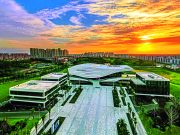























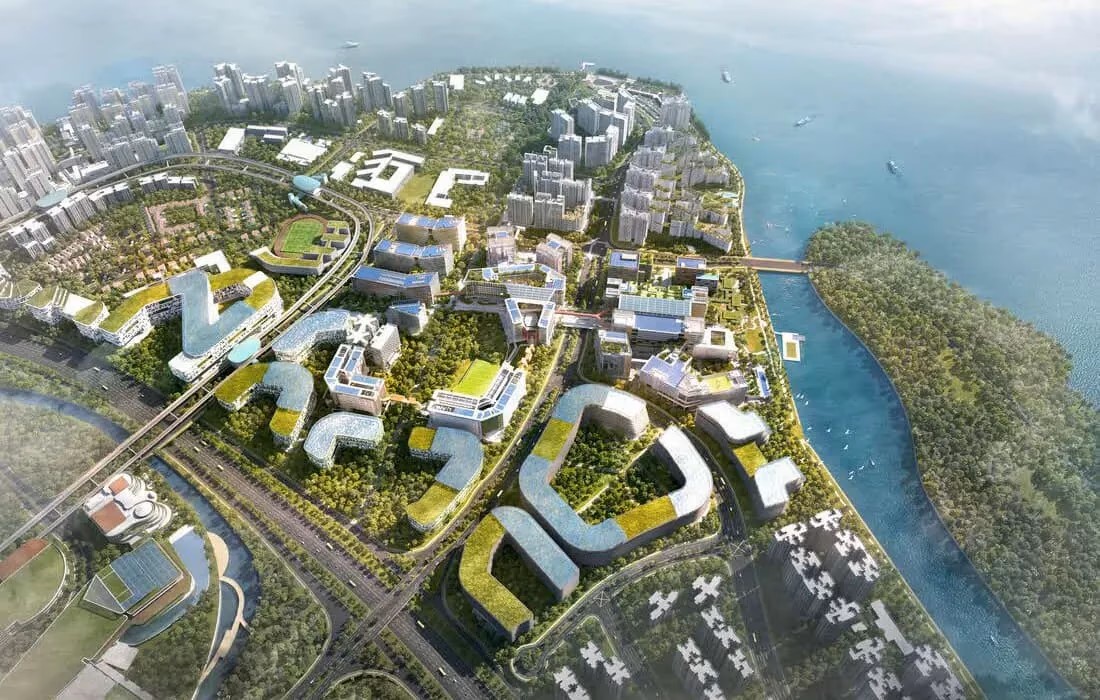
(SINGAPORE, April 16, 2026) — Six years after breaking ground, Singapore’s Punggol Digital District (PDD) has moved from blueprint to a live testbed for the country’s ambition in AI-driven urban development.
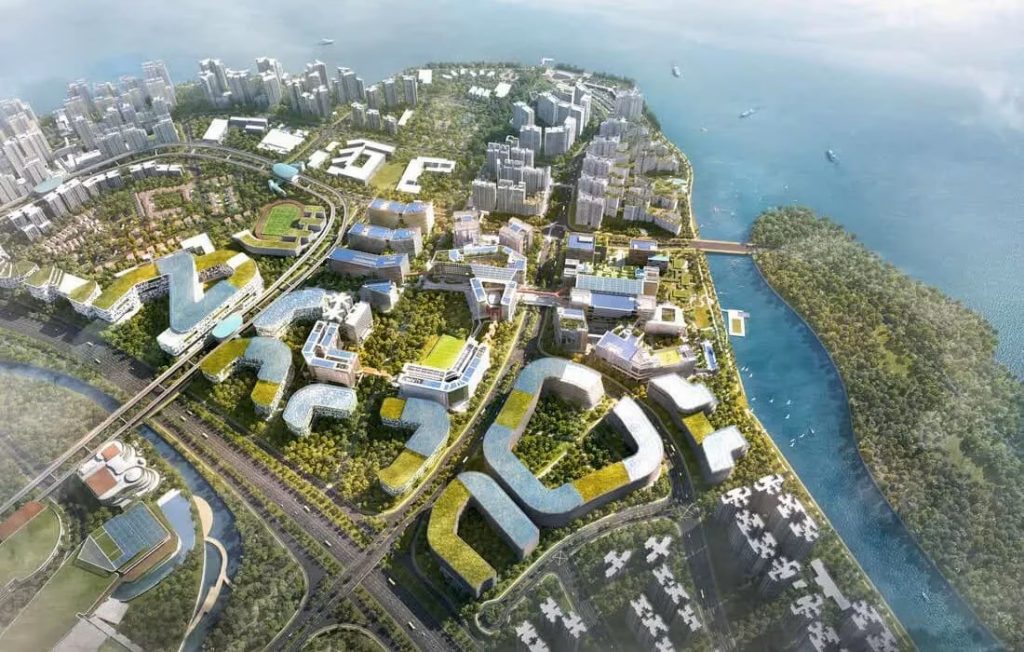
By tightly integrating infrastructure, data systems, and industry within a single planned ecosystem, the district raises a broader question: whether innovation can truly be engineered by design, as attempted here, or whether it still depends on more organic conditions that gave rise to places like Silicon Valley—a dynamic the project does not explicitly seek to replicate, the prominent Chinese tech-focused 36 Kr website implicitly suggests.
Silicon Valley’s success rests on decades of capital accumulation, talent mobility, and a strong tolerance for failure. The Punggol model, by contrast, prioritises controllability and system integration. One is an open-ended evolutionary process; the other more closely resembles a managed urban experiment, the 36Kr commentary notes.
The district spans 50 hectares within Punggol town and is conceived as a purpose-built “district-within-a-town.” Construction began in January 2020, with phased openings starting in Q3 2024 as buildings, infrastructure, and tenants progressively came online. A key anchor tenant is the Singapore Institute of Technology (SIT), which began relocating to its Punggol address in September 2024, with the campus officially opening a year later.
Earlier this month, Chinese autonomous driving company WeRide(文远知行)and Singapore-based ride-hailing platform Grab launched a real-world robotaxi service for selected routes in Punggol. It is Singapore’s first autonomous public transport deployment in a residential estate, the column noted.
Punggol’s suitability for such trials stems from its still being a relatively new town under development. Its residents are generally young and more receptive to new technologies. While traffic and pedestrian conditions are less complex than in the city centre, the town still features public housing, MRT stations, and office buildings—providing a realistic environment to test the Robotaxi GXR.
“The Singapore government wants to develop Punggol Digital District into an AI-driven, AI-focused district. Autonomous driving fits very well into the AI narrative here,” said a WeRide staff member.
On investment attraction, the district is targeting not only local firms but also multinational corporations. Among the first four MNCs announced are Delta Electronics International (Singapore) (台达电子), the local subsidiary of Taiwan-based Delta Electronics; robotics firm Boston Dynamics; Russia-origin cybersecurity company Group-IB; and Wanxiang (万向), a Chinese blockchain-related company.
While Silicon Valley is anchored by institutions such as Stanford University, Punggol’sacademic counterpart is the SIT. To strengthen industry–academia linkages, the district’s design includes interconnected walkways linking the campus directly to the district at large.
A senior official from Singapore’s Ministry of Digital Development and Information (MDDI) told 36Kr that PDD is positioned to become “Singapore’s first smart town.” In this context, a smart town refers to an urban environment where buildings, roads, utilities, and public services are connected through a central digital layer—an Open Digital Platform. This system aggregates sensor data across the district and transforms it into dashboards, maps, and analytics that allow operators to monitor urban activity in real time.
Sustainability is also embedded into the district’s design, including rooftop solar panels, rainwater purification systems, and food-waste-to-fertiliser conversion—reflecting Singapore’s broader green urban agenda.
For Singapore, a city-state of around six million people, talent attraction remains central to its AI strategy. Global technology firms such as Meta, OpenAI, and Google maintain significant operations in the country. A growing number of Chinese AI-related companies have also established a presence in Singapore.
PDD is part of a broader global wave of “planned smart districts” or “greenfield smart cities”—developments designed from the ground up where digital infrastructure and urban systems are integrated from inception rather than retrofitted later.
Among the closest parallels is South Korea’s Songdo International Business District, built on reclaimed land near Incheon. Often described as a “living lab” for smart-city technologies, Songdo was designed with extensive sensor networks and centralised building automation. It is still evolving more than two decades after conception.
Other comparisons include the United Arab Emirates’ Masdar City, an eco-city project focused primarily on sustainability, more like China’s Tianjin Eco-city which Singapore helped develop; and Russia’s Skolkovo Innovation Centre near Moscow, which functions more as an innovation park than a fully integrated urban district.
As London-based international media Monocle observes, sustained state backing played a crucial role in the early development of Silicon Valley. Singapore is similarly investing heavily in PDD to position it for long-term innovation success, even as the result remains to be seen.
“It will be a smart and sustainable district,” David Tan, assistant chief executive of JTC Corporation, the government agency overseeing the district’s development told Monocle. “In the past we used to install digital infrastructure after physical infrastructure, but at Punggol, both were implemented in parallel.”
“We believe the future will be more like the Punggol Digital District,” said Chinn Lim, CEO of robotics firm DConstruct. To encourage risk-taking among younger Singaporeans, JTC has partnered SIT to connect undergraduates with companies in the district.
The Xiong’an New Area (雄安新区) —one of China’s most ambitious state-planned “future city” projects—offers another point of comparison. Located about 110 km from Beijing and closely associated with President Xi Jinping and China’s central leadership, it is designed as a digitally governed, AI-enabled urban zone intended to absorb functions from the capital. In scale and state-led ambition, it is arguably the closest analogue to Punggol’s planning logic. However, close observers often distinguish the two: Xiong’an functions more as a national administrative megaproject, while Punggol operates as a managed public–private innovation cluster.
In Xiong’an, innovations are expected to emerge through the co-location of state-backed institutions and industries. In Punggol, by contrast, they are intended to arise from a “living lab” model—where residents, students, and firms actively test and iterate technologies in everyday urban conditions