




























(Singapore, 01.04.2026)Governance quality, infrastructure, and public trust are more important than technology alone in determining whether a city is truly “smart”, according to the IMD Smart City Index 2026 released by the IMD World Competitiveness Center.
The report, titled “The Quest for Trust and Transparency,” evaluates 148 cities worldwide and added five new cities this year: Tianjin and Zhuhai in China, Hafar Al Batin and Hail in Saudi Arabia, and San Salvador in El Salvador.
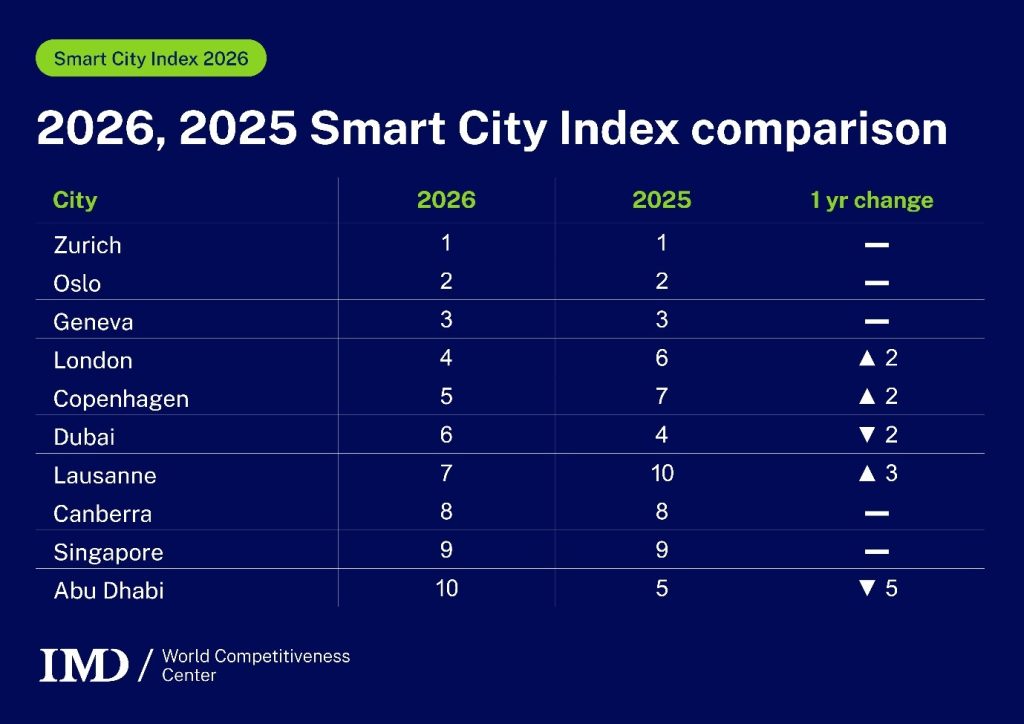
European Cities Continue to Lead
Zurich retained its position as the world’s smartest city for the seventh consecutive year, followed by Oslo and Geneva. London and Copenhagen entered the top five, ranking fourth and fifth respectively.
According to the report, top-performing cities tend to be those where governance, infrastructure, and public trust are strong, even if their technology scores are not the highest. In fact, the report finds that the “structures” pillar — which includes institutions, infrastructure, and governance — is a stronger and more consistent predictor of overall smart city performance than technology indicators.
Arturo Bris, Director of the IMD World Competitiveness Center, said the most advanced and happiest cities are not necessarily those with the most futuristic skylines or the most advanced sensor networks, but those that successfully align governance, sustainability priorities, public investment, and citizen trust.
Dubai and Abu Dhabi ranked sixth and tenth respectively, demonstrating that the Gulf model of state-led digital investment can generate strong civic confidence when public service delivery is efficient and of high quality.
Some cities saw major movements in the rankings this year. AlUla rose 27 places, while Washington DC gained 23 places. Bordeaux and Lyon each dropped 19 places, while Ottawa and Shenzhen fell 18 places.
Hanoi (97th) and Ho Chi Minh City (105th) recorded technology scores comparable to many European capitals and ranked among the highest globally in trust in online government services, highlighting the role of digital government in strengthening public confidence.
Technology Alone Does Not Make a Smart City
The report notes that many cities with strong technology capabilities still rank low overall due to weaker governance and citizen participation. Indian cities such as Mumbai, Bengaluru, and Hyderabad scored highly in technology but remain in the lower third of the index because governance and participation scores lag behind their digital economy development.
Among the bottom-ranked cities — including Rome, Athens, São Paulo, Amman, and Nairobi — almost all have higher technology scores than governance and institutional scores, indicating that the main gap lies in governance rather than technology.
Athens (139th) and Rome (143rd), for example, recorded anti-corruption scores below 0.25 and citizen participation levels lower than many Sub-Saharan African cities.
A distinctive feature of the IMD Smart City Index is that it focuses on residents’ perceptions rather than relying only on hard data. About 400 residents in each city are surveyed to measure liveability, and cities are grouped according to their Subnational Human Development Index to ensure fair comparisons.
The IMD World Competitiveness Center defines a smart city as one that balances economic performance, technology adoption, environmental sustainability, and social inclusiveness to improve the quality of life for its citizens.