























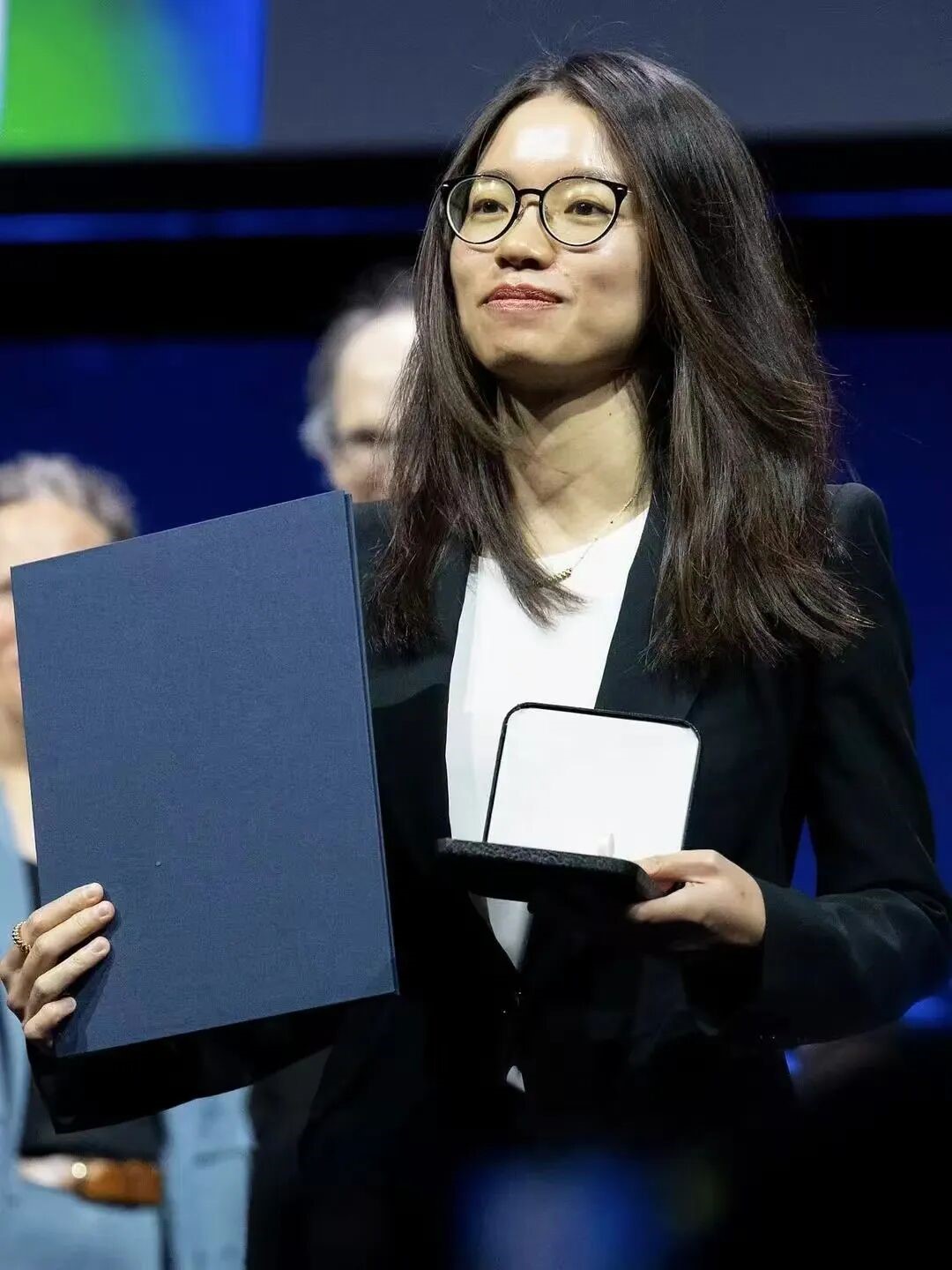
(Singapore, 30.07.2026) When Wang Hong (王虹) stepped onto the stage at the International Congress of Mathematicians in Philadelphia on July 23 to receive the Fields Medal (菲尔兹奖), it was a historic moment.
The 35-year-old Wang and fellow awardee Deng Yu (邓煜) became the first Chinese nationals to win what is widely regarded as mathematics’ highest honour. The award to Wang recognised her joint proof of the three-dimensional Kakeya conjecture( 挂谷猜想 )with American collaborator Joshua Zahl—a century-old problem whose solution has been described by fellow mathematicians as a breakthrough capable of reshaping the entire field of harmonic analysis.
China celebrated.
Then, almost immediately, another story began spreading, lamented a column in China’s Sohu (搜狐) news and commentary platform.
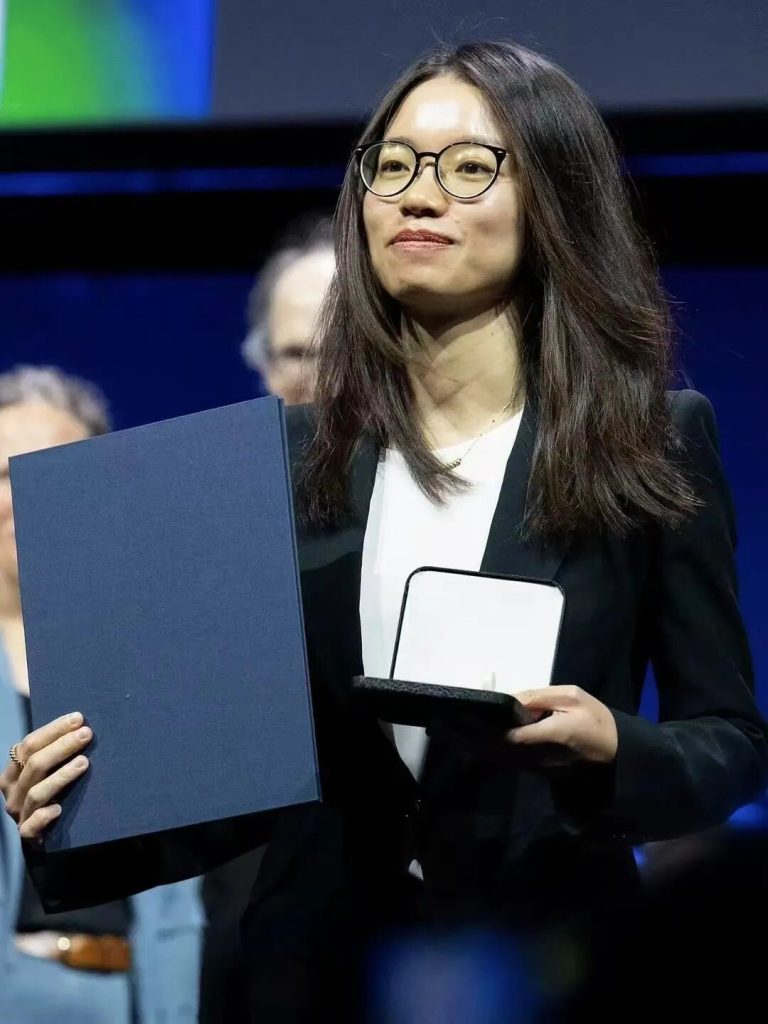
According to countless posts across Chinese social media, Wang’s success was a definitive proof of one thing: she had achieved that feat only because she had left China.
The narrative was irresistible.
Peking University, China’s most prestigious university, had supposedly failed to recognise her talent. She was said to have ranked near the bottom of her class; failed to qualify for the university’s graduate school recommendation programme (baoyan, 保研) which exempts top students from the national postgraduate entrance examination; been refused recommendation letters by the mathematics department which could smooth her way into the programme; skipped her graduation photograph because of her poor relationship with the faculty, and ultimately left for France because China had given up on her.
It was a perfect underdog story: An overlooked genius. An uncaring institution. Vindication abroad.
Within days, the story had become one of the biggest discussions surrounding China’s first Fields Medal. There was only one problem. Much of it simply isn’t true.
Yet the rumours themselves reveal something perhaps more interesting than the facts they distorted. They expose how readily people embrace narratives of unjust failure over stories of quiet mentorship, gradual growth and shared success.
Ironically, Wang Hong’s real journey is far richer than the myth that replaced it.
Four Years of Feeling Ordinary
To outsiders, Wang appeared to embody every Chinese parent’s dream.
Born in Guilin of Guangxi province in 1991, she sailed through China’s notoriously competitive gaokao (高考, China’s national university entrance examination), entered Peking University at just 16 years old, and initially enrolled in the School of Earth and Space Sciences before transferring to the School of Mathematical Sciences a year later.
Everything seemed to point towards brilliance, recounted connect_yourself (第六个人), a column dedicated to topics of marketing rules and self-development in the Chinese tech-focused media platform 36 Kr.
Inside, however, she felt almost the opposite, continued the column.
Years later she would recall that her four undergraduate years were among the most discouraging of her life.
At Peking University she was surrounded by classmates who seemed effortlessly gifted. Many had won national Olympiads. Others solved problems with astonishing ease. For perhaps the first time in her life, Wang no longer felt exceptional.
The relentless pressure eroded her confidence. She questioned not only whether she was talented enough to become a mathematician, but whether mathematics was even the right path at all.
This part of the story is genuine. She struggled. She doubted herself. She often felt invisible.
But emotional struggle is very different from institutional rejection. Online retellings by others would later erase that distinction entirely.
After graduating, Wang travelled to France. This was not the triumphant escape imagined by Chinese social media. It was simply the next step in her education.
She enrolled simultaneously at École Polytechnique and Paris-Sud University, pursuing engineering and advanced mathematics at the same time. It was an unusual decision.
Most aspiring mathematicians specialise as early as possible. Instead, Wang deliberately broadened her education.
Engineering exposed her to physics, mechanics, computer science and economics, while France immersed her in one of the world’s greatest mathematical traditions. The combination would later prove unexpectedly valuable.
More importantly, France gave her something she had never allowed herself before. Space to stop striving and ask what she truly wanted.
Walking Away From Mathematics
After arriving in France, the disappointments she had carried from Peking University about herself finally caught up with her. She stopped doing mathematics. For almost six months she immersed herself in architecture instead.
She attended architecture courses. She later interned at a French architectural firm. This was not an impulsive escape. It was an attempt to answer a question she had never dared ask honestly. Did she actually love mathematics?
Architecture fascinated her. It combined beauty, engineering, creativity, and design. Yet working inside an architectural office taught her something unexpected. Beautiful ideas alone were not enough.
Every project depended on persuading clients, negotiating compromises and balancing commercial realities.
Mathematics, by contrast, demands only one thing. Truth.
Eventually she returned. Not because anyone told her to. Not because she had no alternatives. But because she realised mathematics remained the one discipline in which she genuinely wanted to spend her life.
Years later she reflected that those months away from mathematics were essential. Sometimes certainty comes only after leaving something behind.
After Wang received the Fields Medal, however, online retellings began to reshape this period of uncertainty into a far more dramatic story.
Social media rewrote her biography. Posts claimed she had ranked near the bottom of her class in Peking University. Others alleged that Peking University’s mathematics department had refused to write recommendation letters for her, forcing a former professor from another faculty to rescue her application. And blah blah blah. Individually, each allegation sounded plausible.
Together they formed an emotionally compelling narrative. China had failed to recognise a genius. The West had.
Millions accepted it without asking whether any of it was true.
As the rumours spread, former dean of Peking University’s School of Mathematical Sciences Chen Dayue(陈大岳)responded publicly. His account dismantled almost every major claim.
Far from refusing to endorse Wang, three mathematics professors—Wang Fuzheng (王福政), Tian Qingchun(田青春), and Wang Lizhong(王礼中)— actually wrote recommendation letters for her overseas applications.
Professor Wang Lizhong had supervised her undergraduate research. Another recommendation came from Lei Jun (雷军), her former adviser in the School of Earth and Space Sciences. The two letters complemented each other.
The graduation photograph? She appears clearly in the official 2011 class picture, seated in the front row.
The baoyan claim? According to Chen, Wang fully qualified based on her academic performance.
Students intending to pursue graduate studies overseas generally did not participate in the domestic recommendation programme. It was a choice, not a rejection.
University records also show that Wang graduated with distinction. Among 269 bachelor’s, master’s and doctoral graduates from the School of Mathematical Sciences that year, she was one of only 49 named Outstanding Graduates.
The evidence painted a picture almost opposite to the viral narrative. She was supported. She was recognised. She graduated with honours.
But France introduced Wang to people who would shape the rest of her career. During a research internship at Massachusetts Institute of Technology (MIT) she met American mathematician Larry Guth. He immediately recognised her unusual talent and introduced her to harmonic analysis.
Another mentor, Yvan Martel, helped her navigate life in France and later the American academic world. Eventually Wang entered MIT’s PhD programme. Later she joined New York University. Then came collaboration with Joshua Zahl.
By then Wang had developed expertise across three seemingly different mathematical disciplines: harmonic analysis, geometric measure theory, and additive combinatorics. Most researchers specialised in only one. Wang began connecting all three.
Those connections eventually unlocked one of modern mathematics’ most famous unsolved problems.
Solving Kakeya
The three-dimensional Kakeya conjecture had beat mathematicians for generations. Its importance extended far beyond one isolated theorem. It underpinned entire branches of harmonic analysis.
Earlier mathematicians, including Terence Tao (陶哲轩) and Nets Katz, both Americans, had laid much of the groundwork but left one crucial obstacle unresolved. Building on their programme, Wang and Zahl finally completed the proof.
What made the breakthrough remarkable was not simply technical brilliance. It was Wang’s ability to see relationships where others saw separate subjects. She borrowed tools from additive combinatorics to solve geometric problems, then used those geometric insights to answer questions in harmonic analysis.
Instead of speaking one mathematical language, she became fluent in three.
That broader perspective was the product of years spent crossing intellectual boundaries rather than remaining inside one narrow discipline
The rumours in China and among overseas Chinese persisted despite abundant evidence because they satisfied several psychological needs, commented the Sohu column.
First, they told a dramatic underdog story. An overlooked genius triumphing over institutional failure is far more emotionally satisfying than the quieter reality of decades of steady education, mentorship and perseverance.
Second, they encouraged a false binary. Either China produced Wang Hong. Or France and America did. Reality is more complicated. Her education was cumulative.
Peking University built her foundations. France broadened her thinking. MIT sharpened her research. International collaboration made the final breakthrough possible. None of these stages cancels the others.
Finally, Wang herself became a symbol in debates much larger than mathematics. For critics of China’s education system, her story offered a convenient metaphor. Whether the details were accurate became almost irrelevant. The symbolism mattered more than the facts.
Perhaps the most revealing voice throughout the controversy has been Wang’s own. She has never claimed that Peking University failed her. Quite the opposite.
Returning to campus in 2023 for celebrations marking the 110th anniversary of Peking University’s mathematics programme, she reflected on her undergraduate years.
“I received tremendous training at Peking University,” she said. “There were simply so many outstanding classmates that I sometimes forgot that I was one of them.”
The remark captures something important. Feeling ordinary among extraordinary peers is not evidence of institutional neglect. It is often the price of joining an exceptional community.
On July 28, just days after receiving the Fields Medal, Wang attended a Peking University mathematics alumni gathering in Philadelphia. Back in Beijing, the university illuminated the iconic Boya Pagoda (博雅塔) in the campus in honour of Wang and fellow Fields Medalist Deng Yu.
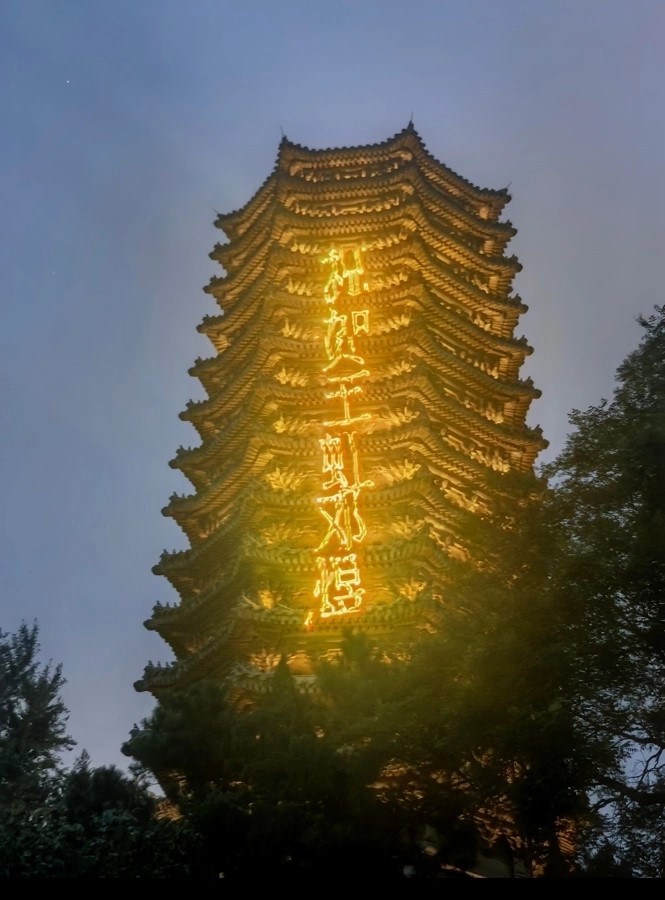
The relationship between Wang and her alma mater had never fractured in the way the internet imagined.
Beyond Either-Or
So could Wang Hong have become a Fields Medalist had she remained in China? No one can answer that counterfactual. History offers only one version of events.
What it does show is something both simpler and more profound. Wang’s journey was never one of escape. It was one of accumulation. From Guilin to Peking University. From Paris to MIT. From New York University to IHÉS (Institute of Advanced Scientific Studies). Each stage built upon the one before it.
Currently she is a Permanent Professor at IHÉS jointly appointed by New York University’s Courant Institute of Mathematical Sciences.
To erase Peking University from that story is no more accurate than erasing France or MIT. Scientific greatness is rarely the work of a single institution, a single country or a single turning point.
It emerges from years of education, mentors who recognise potential, opportunities seized across borders, and a mind willing to question itself before finding its own direction.
The internet preferred the story of a genius rejected by her homeland. Wang Hong’s own life tells a different story. Not of rejection. But of guidance, persistence and the quiet amassing of knowledge across continents.
In the end, that story may be less dramatic.
It is also much closer to the truth.