













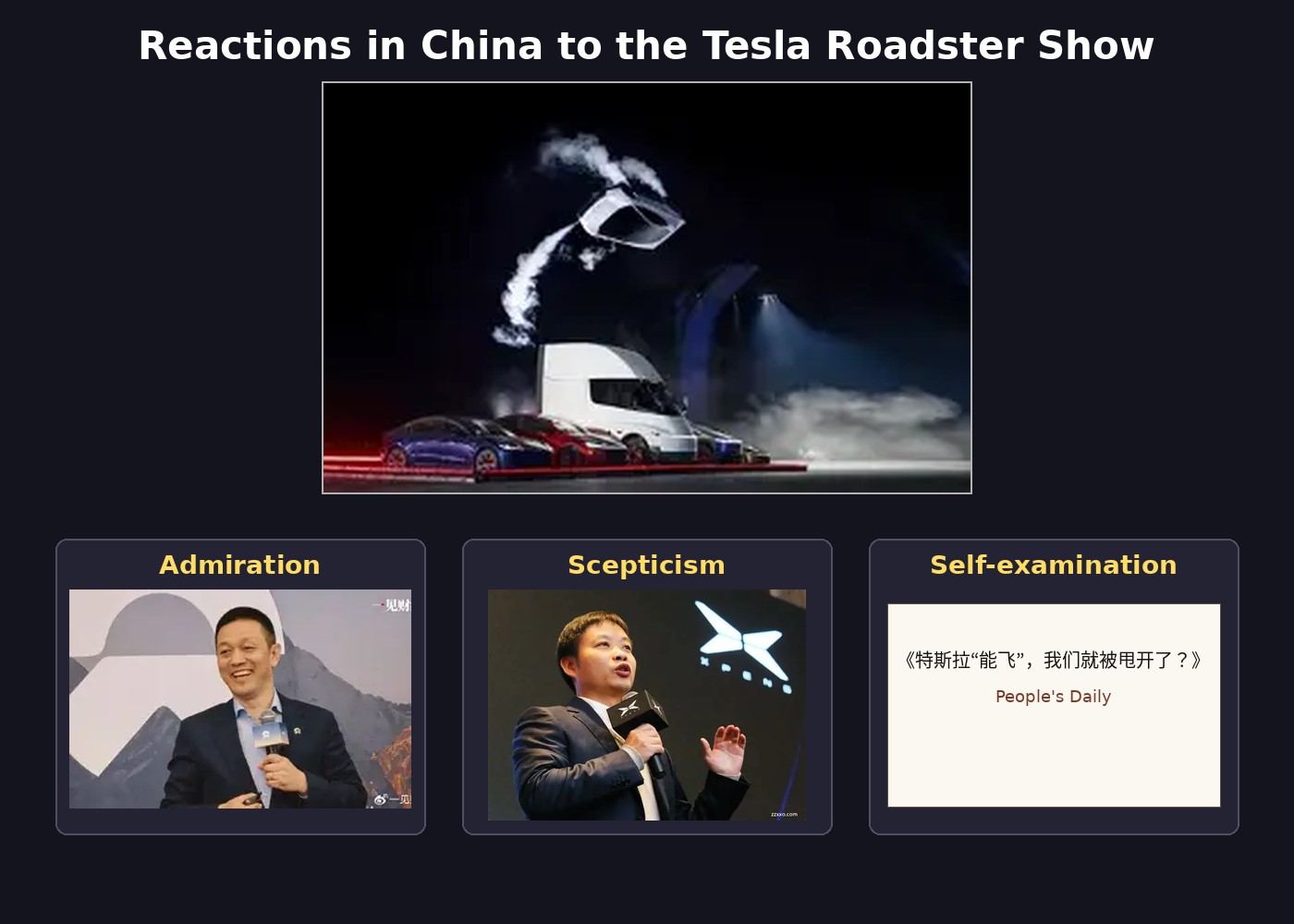
(SINGAPORE 2026.10.22)Tesla’s latest Roadster demonstration has prompted a debate in China: after making major strides in electric vehicles and intelligent driving, are Chinese automakers still pushing technological boundaries, or becoming too comfortable with their existing strengths?
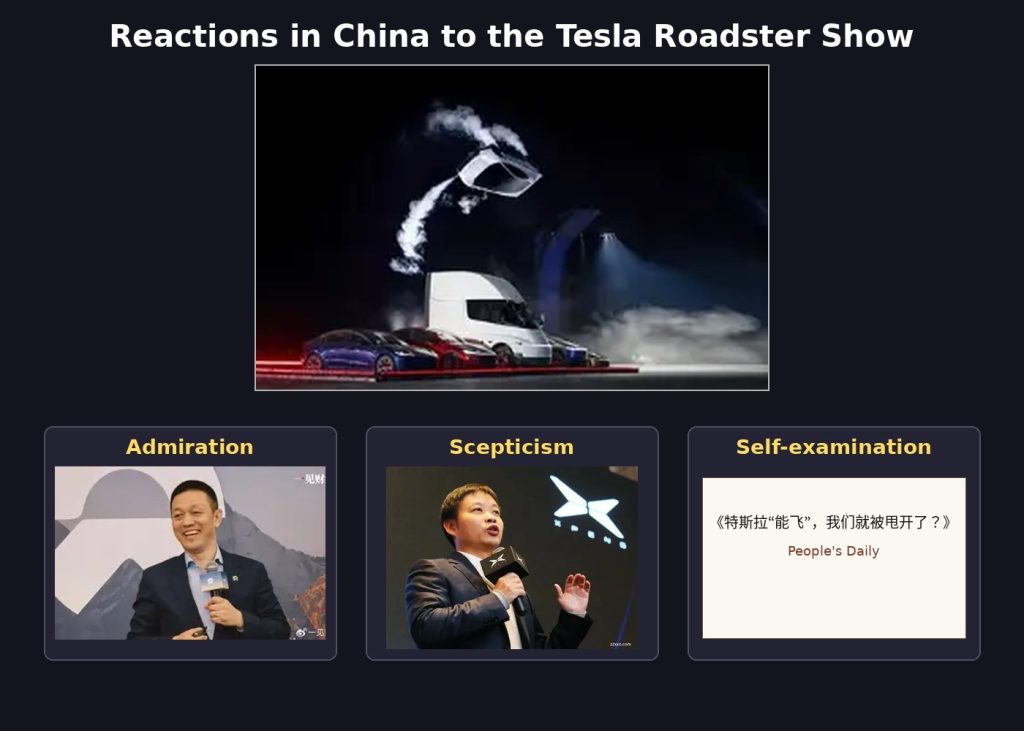
A commentary published yesterday in China’s flagship People’s Daily sought to temper the debate. Titled “Tesla Can Fly. Does That Mean We’ve Been Left Behind?”, it criticised both those who declared China’s auto industry behind the curve and those who dismissed Tesla’s achievement as little more than “an oversized toy that can jump”. Neither reaction, it said, was justified. Chinese automakers should recognise their progress without dismissing rivals’ experiments.
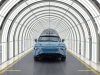
The debate centres on Tesla’s second-generation Roadster, demonstrated in Texas on Oct 15 local time. Equipped with cold-gas thrusters developed in collaboration with SpaceX, the sports car was shown suspended upside down on a ramp before performing a mid-air flip and landing intact. Tesla chief executive Elon Musk said production was planned to begin in 2028.
For China, the spectacle touches a nerve. Over the past decade, domestic automakers have moved from chasing foreign competitors to building strong positions in EV production, supply chains, charging and intelligent driving. The challenge is to carry that momentum into the next phase of innovation.
The admirers: Tesla pushes the boundaries
The National Business Daily (每日经济新闻)reported on Oct 16 that Chinese EV entrepreneurs William Li (李斌), founder and chairman of Nio (蔚来), and He Xiaopeng (何小鹏), chairman of Xpeng (小鹏), had responded to the Roadster display.
He called it “a very cool form of flying car”. Li reposted a video on Weibo, writing: “Amazing! This is something we really don’t have. Thumbs up to Tesla.”
Li’s response was notable given his earlier confidence in Nio’s ability to compete with Tesla. Around 2018, he famously said: “Everything Tesla has, I have; some things I have, Tesla doesn’t.”
The remark reflected the ambition of a Chinese automaker seeking to compete globally. It has since resurfaced online alongside Li’s praise for Tesla’s latest experiment.
Chinese online automotive news outlet Sina Auto (新浪汽车)reported on Oct 17 that Li acknowledged, with a degree of self-deprecation, that Nio lacked comparable technology. Some netizens joked that the pressure was now on him, while others praised his willingness to recognise a rival’s achievement rather than talk it down.
Yet the episode also revived a debate over priorities. Have some Chinese automakers become too preoccupied with cosmetic features and marketing at the expense of engineering breakthroughs?
Chinese EVs are increasingly being marketed as mobile living spaces, with fold-out tables, refrigerators, entertainment screens and other amenities. Some experimental concepts have even explored incorporating toilets. Such additions can appeal to buyers, but critics question whether the pursuit of luxury and entertainment is diverting attention from safety, reliability and core engineering.
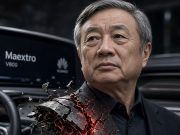
The controversy surrounding the Maextro (尊界)V800 has brought the issue into sharper focus.
Maextro, a luxury brand jointly developed by Huawei (华为)and JAC Motors (江淮汽车), came under scrutiny after Chinese automotive platform Dongchedi (懂车帝)published test videos on Oct 8 showing the brake-pedal brackets breaking on three V800 vehicles during emergency braking tests from 100km/h to a standstill. The repeated failures raised questions about component design, quality control and safety testing. Priced at 766,000 yuan to 1.016 million yuan (about S$146,600 to S$194,500), the vehicle’s premium positioning made the incidents all the more embarrassing.
On Oct 15, Chinese authorities announced a joint investigation with Huawei. The cause of the failures has yet to be conclusively established.
Some Chinese netizens mocked the country’s automotive progress, saying that while Chinese auto experts were still bickering over whether Maextro’s brakes had failed under excessive or normal braking force, Tesla had already demonstrated a flying vehicle.
The sceptics: Jumping is not flying
Other Chinese observers contend that the Roadster’s performance, however spectacular, does not establish that it can achieve meaningful flight.
Automotive commentator Chen Zhen (陈震)said the technology was challenging but questioned its practical value. Fellow commentator Chang Yan (常岩)highlighted the difficulty of securing vehicle registration and regulatory approval in China and Europe. Their remarks were reported by City Express (都市快报)on Oct 16 and in subsequent syndicated coverage.
Their doubts are reasonable. Briefly lifting off the ground is not the same as sustained flight. Even if the propulsion system works as shown, the vehicle would still have to demonstrate that it could operate safely on public roads and satisfy aviation requirements.
He Xiaopeng has also highlighted challenges involving flight safety, range and airworthiness certification. People’s Commentary similarly noted that these issues remain unresolved, describing the display as closer to a concept show than a vehicle ready for everyday use.
The central hurdle is translating the showcase into a vehicle that can be manufactured, approved and used safely at a viable cost.
Some Chinese netizens dismissed the Tesla Roadster 2 as a toy with little practical value beside China’s advanced EVs.
Confidence without complacency
Some response goes beyond admiration and ridicule. These observers regard the Roadster as an experiment that could expand the scope of automotive engineering, even if its immediate practical value remains limited.
The Oct 21 People’s Daily commentary cited the extreme-speed performance of BYD’s Yangwang (仰望)U9 Xtreme, ultra-fast-charging batteries developed by CATL (宁德时代), and intelligent-driving advances by companies including Huawei and Li Auto (理想). It said China’s auto industry had seized substantial competitive advantages.
But the article cautioned against dismissing foreign experiments simply because domestic manufacturers had made considerable progress. It cited Tesla’s entry into Shanghai in 2018 as an example of the “catfish effect” (鲶鱼效应), in which a strong competitor spurs local players to innovate. Chinese companies, it said, should remain open to rivals’ latest efforts.
China is also developing flying cars, primarily Xpeng AeroHT’s (小鹏汇天)“Land Aircraft Carrier” (陆地航母). But this differs from Tesla’s attempt to make a sports car briefly airborne. Some Chinese netizens describe it as a large drone rather than a flying car. The flying module does not transform the road vehicle itself into an aircraft; instead, it separates from the vehicle and flies independently. The concept is therefore less like a car sprouting wings and taking off, and more like carrying a compact aircraft on a specialised road vehicle.
The Roadster’s display does not automatically put Tesla ahead of Chinese manufacturers. Its technology must prove viable in a vehicle that meets safety and regulatory requirements. The planned 2028 production date is a target, not evidence that these hurdles have been cleared.
Chinese automakers deserve recognition for their advances in electrification and intelligent driving, but those gains do not exempt them from scrutiny over product quality or marketing claims.
The shift in China’s auto market is significant. Consumers once looked to foreign brands because domestic manufacturers fell behind in core technologies. Chinese companies have since built strong market positions, making a high-profile experiment from abroad all the more unsettling and difficult to ignore.
The Maextro case reinforces the need to match ambition with rigorous testing and sound execution. Leadership cannot be measured by a car’s amenities or the showmanship it creates at a launch event.
William Li’s response offers a useful perspective. Acknowledging a rival’s strength in one area is not an admission of overall defeat. It recognises that dominance in one stage of an industry’s development does not guarantee leadership in the next.
Chinese automakers need not copy every Tesla experiment or abandon features that buyers value. They do, however, need to keep advancing the capabilities that distinguish their vehicles, rather than competing to add more cosmetics to them.