
























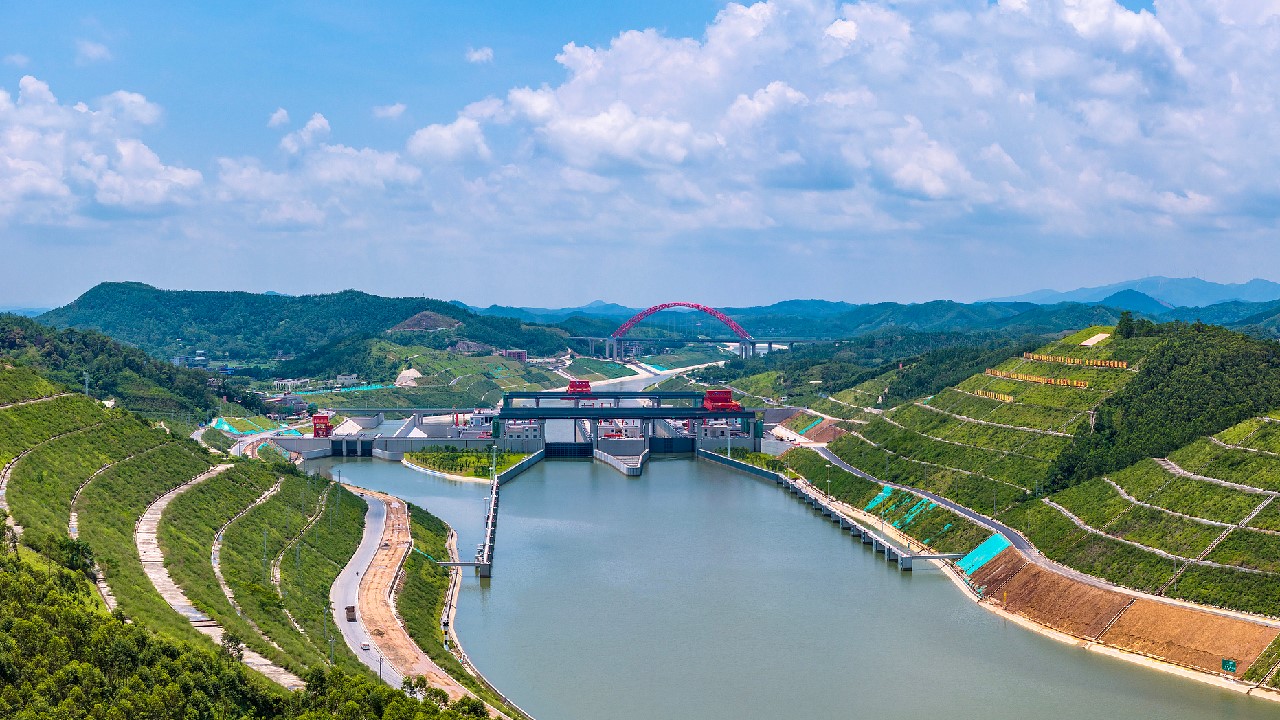
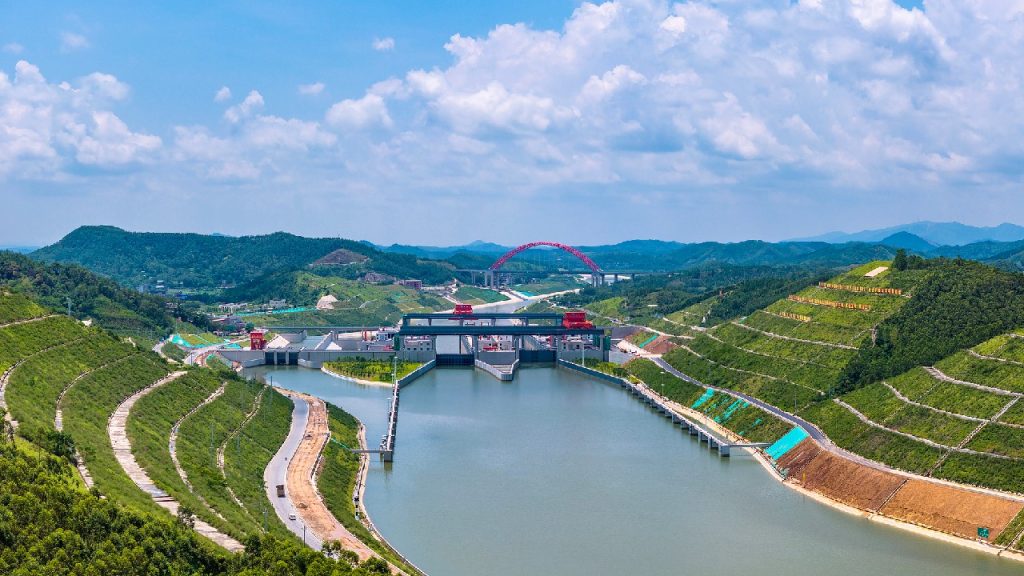
(SINGAPORE 2026.9.17) China’s opening of the Pinglu Canal (平陆运河)yesterday has inscribed more than a line on the country’s transport map. The 134.2-kilometre waterway has created a new southbound route from China’s southwestern hinterland to the sea — and potentially a more direct commercial link between inland China and Southeast Asia.
For decades, cargo from Guangxi and other parts of southwestern China generally had to move eastward through Guangdong and Shanghai before reaching the coast. Pinglu now links the Xi River (西江) shipping system directly to the Beibu Gulf (北部湾), allowing goods to travel south through Guangxi to reach the sea more quickly.
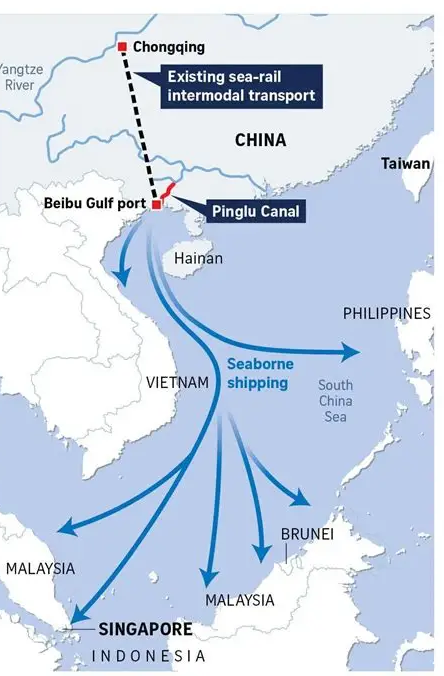
The immediate gains are substantial. The canal can cut more than 560 km of inland waterway travel compared with traditional routes, while logistics costs are expected to fall by 18 per cent to 30 per cent. It can handle vessels of up to 5,000 tonnes.
But those figures measure what China has built. Whether the canal delivers on its promise is yet to be seen.
The bigger test is whether companies, ports and governments in Southeast Asia begin reorganising around the new geography.
The first signs came on the canal’s opening day. Guangxi’s Nanning Port (南宁港) launched a direct river-sea international freight route to Can Tho (芹苴) in Vietnam’s Mekong Delta, while a separate Nanning-Yangpu route also began operations. Yangpu (洋浦)is in Hainan. The new waterway carried its first domestic and international cargoes.
That makes the Southeast Asian connection real — but whether businesses will reorganise around it remains to be seen.
Pinglu is a major part of China’s New International Land-Sea Trade Corridor centred on Guangxi, connecting inland transport networks with the Beibu Gulf port system.
For companies, the significance is not simply that a shipment can travel fewer kilometres. A shorter route can change where a company chooses to manufacture, source, store or distribute goods.
A factory in southwestern China is no longer disadvantaged by its distance from the sea. At the same time, a Southeast Asian company looking for access to China’s interior has a new route to consider.
Chinese manufacturers are already testing the connection. On opening day, Dongfeng Liuzhou Motor (东风柳汽)sent vehicle knock-down kits through Pinglu to Beibu Gulf ports for shipment to Asean markets. The company said the route would make the supply chain from Liuzhou manufacturing sector run more efficiently through Pinglu and the Beibu Gulf to global markets.
If that advantage proves durable, the effects could extend beyond freight.
Lower logistics costs could make southwestern Chinese factories more competitive in Southeast Asian markets, potentially encouraging manufacturers to expand production or distribution. The flow could also run in the opposite direction, luring Southeast Asian agricultural and industrial products to move more easily into China’s interior.
Indonesian maritime analyst Siswanto Rusdi gave the example of coconuts. Indonesian agricultural products, he said, could move through the canal into China’s inland provinces for further processing, while Chinese products could travel in the opposite direction.
That two-way potential matters. Pinglu is not simply a cheaper export route for Chinese goods; it could become part of a broader trading system connecting China’s interior with Asean producers and consumers.
Southeast Asia sees opportunities — but the response is not uniform.
There has so far been no collective Asean response to Pinglu comparable to a formal regional endorsement. Reactions have instead come from academics, business and logistics figures, and media organisations.
Thai academic Suthiphand Chirathivat, founding executive director of the Asean Studies Centre at Chulalongkorn University, said the canal demonstrates China’s commitment to deeper regional integration and stronger connectivity.
Rusdi of Indonesia focused on the commercial side, saying the canal could offer companies a cheaper transit option and bring China and Asean markets closer together.
In Malaysia, Peter T. C. Chang (张彼得), a researcher with the Malaysia-China Friendship Association, said the canal could provide Asean goods with a faster route into southwestern China.
Singapore’s discussion has also extended beyond the movement of physical cargo.
Yu Hong (余虹), a senior research fellow at the National University of Singapore’s East Asian Institute, noted that the canal’s opening coincides with implementation of the upgraded China-Asean Free Trade Area 3.0. He said infrastructure and institutional changes could reinforce one another. He also described Pinglu as a potential test bed for green and digital shipping.
The different perspectives point to the same underlying issue: the canal creates an opportunity, but businesses still have to decide whether that opportunity is commercially worth pursuing.
For Southeast Asian ports, the most immediate consequence could be a change in the competitive position of the Beibu Gulf as a gateway into southwestern China.
That does not necessarily mean established regional hubs will simply lose cargo. Instead, ports may have to reconsider where they fit within a more interconnected network.
This creates competition not only for ocean freight, but also for transshipment, warehousing, processing, and distribution.
It could also encourage specialisation.
Some ports may focus on connecting Southeast Asian cargo to China’s interior. Others may concentrate on transshipment or regional distribution. Freight forwarders, customs brokers, warehouses, and industrial parks could become as important to the new corridor as the shipping lines themselves.
For Singapore in particular, the development does not automatically translate into a loss of its existing role. But it does add another route and gateway to the regional logistics system, creating new choices for cargo owners.
Building the canal solved a physical constraint. The next obstacles are more mundane: customs clearance, inspections, quarantine requirements, shipping schedules, and whether regular services can be maintained.
Rusdi said China and Asean should work together to improve customs clearance as well as inspection and quarantine procedures if businesses are to capture the full benefits of the corridor. Southeast Asian experts also called for greater promotion of the new routes so companies know they exist and can assess whether to use them.
This is where the difference between an infrastructure project and a functioning trade corridor becomes clear.
A canal can shorten a journey on paper, but companies will not necessarily abandon established supply chains for a route that lacks frequent sailings, reliable connections, efficient customs procedures or sufficient warehousing capacity.
The next phase therefore involves building the network around the canal: regular shipping services, port connections, distribution centres, customs coordination, digital systems, and potentially greener shipping arrangements.
Only when companies actually shift cargo will the projected reduction in logistics costs translate into a lasting change in trade patterns.
The intended reach of Pinglu is also expanding beyond Guangxi.
Yunnan is developing a route from Funing Port (福宁港) in Wenshan (文山)prefecture through the You River (右江)and Baise (百色) to the Pinglu Canal and then the Beibu Gulf. Chinese reports say this could give Yunnan a new connection to the Pacific and Asean.
That matters because it shows the canal is not being treated as an isolated waterway between one inland location and one coastal gateway.
The broader ambition is to pull a much larger southwestern hinterland towards the Beibu Gulf.
If successful, this could gradually make the economic geography of southwestern China more south-facing — with consequences that extend into Southeast Asia.
China has spent about 727 billion yuan (about S$138.2 billion) on the project since construction began in August 2022. The physical task is now complete.
But the economic achievement will be harder to measure.
Whether Pinglu becomes a real China-Asean trade corridor will depend on what happens next — and, crucially, on whether businesses and ports outside China begin changing their own networks to match the new route.