



























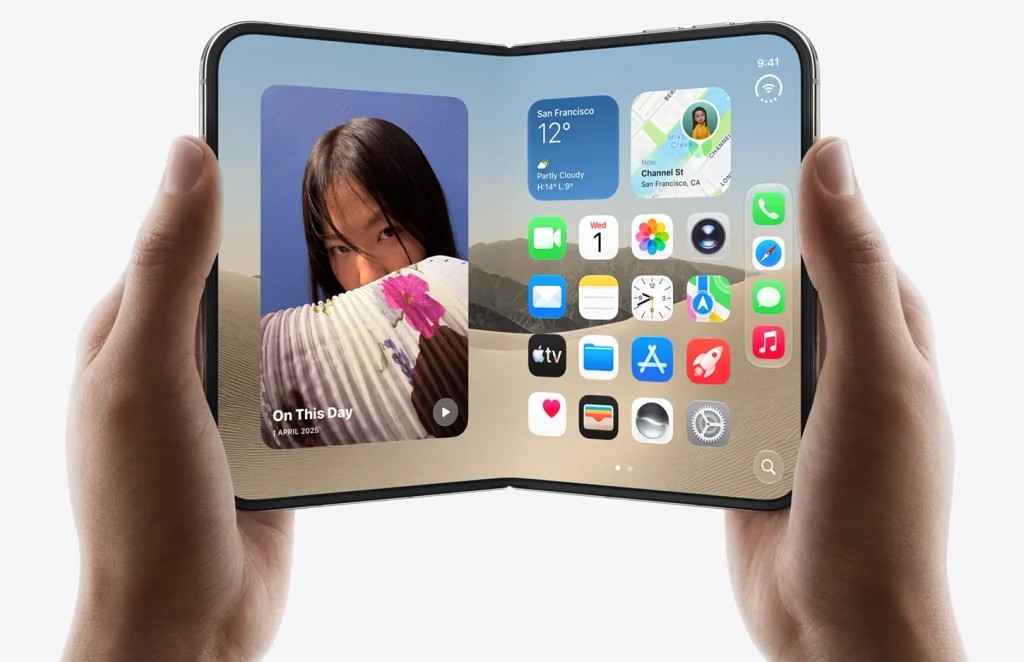
(SINGAPORE 2026.9.10) Apple has arrived late for the foldable-phone race. That may turn out to be precisely its biggest advantage, reported some Chinese media.
The company unveiled the iPhone Duo yesterday, becoming the last major smartphone maker to enter a market Samsung and Huawei have spent years developing. Samsung launched its first Galaxy Fold in 2019, the same year Huawei introduced its first foldable. Apple has taken about seven years to join them.
Yet the delay means Apple is entering a market far different from the one its rivals first encountered.
Samsung and Huawei were the first to make foldable phones work as everyday consumer devices. That forced them to tackle early problems such as fragile displays, visible creases, awkward software, short battery life, bulky bodies, and durability concerns. Samsung’s first Galaxy Fold launch became an early casualty when screen failures forced the company to postpone the event and recall review units.
Apple does not have to prove foldables work. It only has to convince consumers to buy Apple’s. That puts it in a stronger position from the outset.
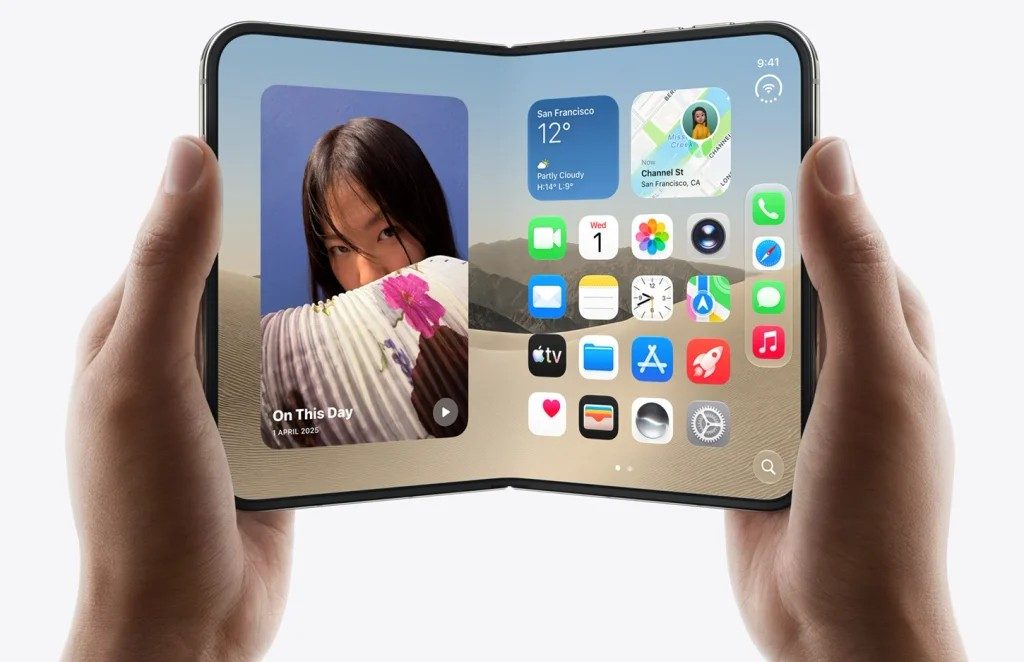
The iPhone Duo marks the biggest change to the iPhone’s basic form since 2007. Opened, it has a 7.6-inch inner screen; closed, a 5.4-inch outer display. Both share the same aspect ratio, letting content scale between them without requiring users to adapt to different screen formats.
Apple says the Duo is its thinnest iPhone when opened, with a redesigned precision hinge and dual-battery system.
The iPhone Duo starts at US$1999 (about S$2530), rising to US$3199 for 2TB. In China, the 256GB model costs 15,999 yuan, while the 2TB version is 26,499 yuan (about S$4996).
The prices immediately put Apple at the premium end of an already crowded market.
Days before Apple’s launch, Huawei unveiled the Mate XT2, its latest tri-fold phone, starting at 19,999 yuan. China’s Xiaomi (小米) also joined with the Xiaomi 18 Fold, priced from 10,999 yuan, offering a cheaper Chinese option.
The result is a striking new landscape: Apple, Huawei and Xiaomi are competing for China’s high-end foldable buyers, while Samsung remains the global leader.
The seven-year late start that Apple can now exploit
The irony is that early foldable makers may have done much of the costly consumer education for Apple.
Samsung spent years refining its book-style Fold series, slimming phones, improving hinges, and reducing screen creases. Huawei took a different path, moving to the tri-fold Mate XT, while Xiaomi, Honor (荣耀), Oppo, and vivo experimented with weight, thickness, battery life, and software.
The foldable-phone segment has moved beyond its experimental phase.
Hong Kong-based Counterpoint Research expects cumulative global foldable-phone shipments to exceed 100 million units by end-2026, with the market growing 21% this year and faster in 2027. It forecasts Apple taking 25% of first-year global shipments, behind Samsung at 38% and with Huawei at 22%.
Counterpoint projects up to 6 million foldable iPhone shipments in 2026, despite only a few months of sales.
Those numbers highlight Apple’s unusual position. Foldables remain a small share of global smartphone sales, held back by higher prices, weaker cameras, shorter battery life, and visible creases.
Apple’s opportunity, therefore, is not to invent a new foldable category, but to make its drawbacks far less noticeable to mainstream iPhone users.
Apple’s key edge may not be the hinge, screen, or processor, but the ecosystem around them.
The company has spent years building an environment across the iPhone, iPad, Mac, Apple Watch, AirPods and services. The Duo extends that platform into the new foldable form.
The company’s approach is visible in the software.
The Duo supports split-screen multitasking and a larger workspace, while content moves between its inner and outer displays. Apple is trying to make “phone” and “tablet” feel like one continuous experience.
That matters because the key question is no longer whether foldable screens can bend, but whether the larger display justifies the price and bulk of a thicker device.
Huawei has reached a similar fluidity, but through a different route.
Its Mate XT2 uses a tri-fold design, giving users a tablet-sized display that folds into a phone. HarmonyOS 7 supports multiple apps, desktop-style windows and PC apps, positioning the device as a mobile productivity tool. The model also adds a privacy display, which means a screen designed to prevent people nearby from easily seeing what is shown.
Huawei is therefore selling the foldable as a productivity machine. Apple is positioning it more as an extension of the Apple experience.
That distinction could become increasingly important.
Huawei has something Apple cannot easily replicate
Huawei has built a strong position in China’s foldable market. US-based Smart Analytics Global says it accounted for 68% of shipments in the country in the second quarter. Its strength matters most in premium foldables, where it combines hardware, HarmonyOS and strong domestic appeal.
The Mate XT2 shows how far Huawei has pushed the foldable form. Its tri-fold design moves between smartphone, large screen, and tablet-like modes.
The timing is also strategically significant. Huawei’s latest model uses its Kirin 9050 Pro processor, part of its push for technological self-reliance amid US semiconductor restrictions. Its LogicFolding architecture aims to boost computing performance while cutting power consumption.
That means the competition is not simply about who makes the thinnest foldable. For Huawei, the device is also a demonstration of how much technological independence it has developed.
Xiaomi’s role is different. The Xiaomi 18 Fold starts at 10,999 yuan, well below Apple’s and Huawei’s new foldables. At 219 grams and 5.02 mm thick unfolded, it emphasizes portability and efficiency. Its 6,000mAh battery tackles a key foldable complaint: large displays can hurt battery life.
Xiaomi is widening the premium foldable price range. That could make Apple’s pricing harder to defend.
This is where Apple’s second-mover advantage becomes powerful but risky. The company has had years to see what consumers want. But expectations are also much higher.
Samsung’s head start is still formidable
If Huawei is Apple’s biggest challenge in China, Samsung remains its key global benchmark. Samsung has refined foldables since 2019 and remains the world’s largest vendor. Counterpoint expects it to hold 38% of the global market in 2026 despite Apple’s entry.
The Galaxy Z Fold line reflects years of experience. Each generation has improved its hinge, screen, thickness, software, and balance between phone and tablet. Samsung thus has something Apple cannot buy overnight: institutional knowledge of how consumers actually use foldables.
But Apple’s arrival changes the equation. Until now, Samsung could treat foldables as a premium category where it was the global reference point. Apple will force it to compete with a company uniquely able to turn premium technology into a mass-market product.
The original iPhone did exactly that with touchscreen smartphones. Apple did not invent touchscreens, mobile internet, apps, or capacitive displays. But it turned them into a mainstream consumer experience. Foldables now face the same possibility.
The real battle is no longer hardware
This is why Apple’s entry could matter even if the Duo is not the best foldable on every specification.
Counterpoint expects global foldable shipments to grow 21% in 2026, while the US-based IDC also sees foldables growing much faster than the overall smartphone market. Analysts say Apple could accelerate adoption by bringing huge visibility and a large premium customer base to the still-small category.
In other words, Apple does not necessarily have to take the entire market from Samsung or Huawei. It can make the market bigger.
That would benefit everyone — while simultaneously raising the standard everyone must meet. The competitive focus is likely to shift accordingly.
The first foldable phase was about whether the hardware could survive. The second was about how thin, light and crease-free it could get. The next may be about what users can do with the extra screen. That brings the competition back to ecosystems.
Apple has iOS, iPadOS, MacOS and its broader device platform. Samsung has Android, Galaxy AI and years of experience optimizing multitasking for large screens. Huawei has HarmonyOS and a self-contained Chinese technology ecosystem. Xiaomi has its rapidly expanding human-car-home link.
The key question may no longer be who has the best hinge. It may be who makes the foldable screen indispensable.
The first generation of foldables asked consumers to tolerate compromises for the sake of novelty. Apple’s first foldable has to ask for something else.
It has to persuade consumers that folding a phone is no longer a compromise at all — and that once they have experienced Apple’s version of it, going back to a conventional phone is the compromise.