

























(2026.9.3 QINZHOU) Singapore’s role in the New International Land-Sea Trade Corridor (ILSTC) has demonstrably expanded since its inception, with the island nation evolving from a founding partner of the project into a pivotal hub for its trade and finance.
Launched in 2017 as a Chongqing-Singapore connectivity initiative, the corridor was designed to provide landlocked western China with a more direct trade route to global markets primarily via Guangxi’s Beibu Gulf (北部湾) ports, recounted Mr Mo Zhongzhou (莫中洲), director of China Railway United International Container Guangxi Co.’s station operations department.
He was addressing a delegation of Southeast Asian journalists visiting Guangxi to cover the newly completed Pinglu Canal (平陆运河), which is set to open for navigation on September 15.
Mr Mo emphasized that the volume of goods shipped from Singapore to western China has increased annually as the corridor project broadens, reflecting the country’s critical function as an international transshipment hub.
This flow includes cargo arriving by ship to connect with China’s rail network, and goods traveling from China by rail to Singapore for global maritime distribution.
But he also noticed a new development: some cargo is now routed via the Hainan Free Trade Port. However, rather than diminishing Singapore’s role in the corridor, this diversion is generally viewed as part of a broader dynamic expansion in trade across the region, from which Singapore stands to benefit as the overall trade pie grows.
This momentum is now accelerating further with the launch of major infrastructure projects like the Pinglu Canal, which will shorten shipping distances to Singapore by up to 740 kilometers.
But Pinglu is far more than a waterway; it is a strategic channel that would rewrite the logistics map of southwest China by acting as a direct artery between the country’s interior and the global maritime trade network via the Beibu Gulf.
It is against this backdrop of deepening regional integration that Guangxi has unveiled a major logistical and transportation upgrade — it plans to deploy seagoing river vessels which would bypass cargo transfers at the canal’s mouth, namely Qinzhou (钦州)Port. This move represents a bold stride toward achieving seamless maritime-river connectivity.
“The details have not yet been finalized, and we still have no idea how large the fleet will be or where the ships will be headed. It is likely that these 5,000-tonne river vessels will intially be restricted to the Beibu Gulf or slightly beyond,” Mr Zhang Minghe (张铭和), deputy manager of Guangxi Qinzhou Bonded Port Honggang (宏桥) Terminal’s operations department, told the same group of journalists.
Western China is a mountainous region that is remotely cut off from the sea while its rivers are too shallow and its ports too small.
Now, with the Pinglu Canal approaching its official opening—having achieved full water connectivity this past June—a new chapter in trade and transportation is set to begin.
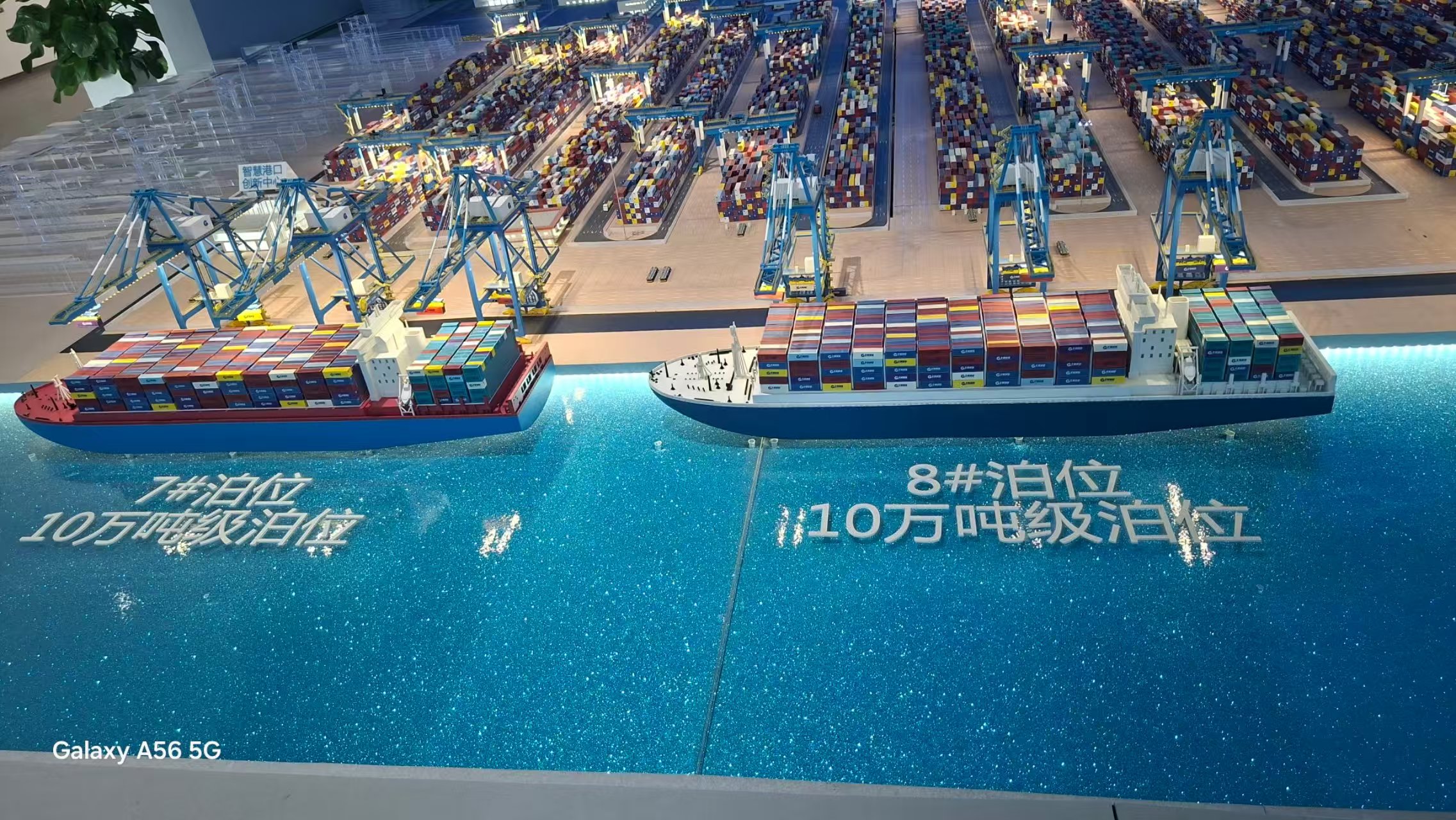
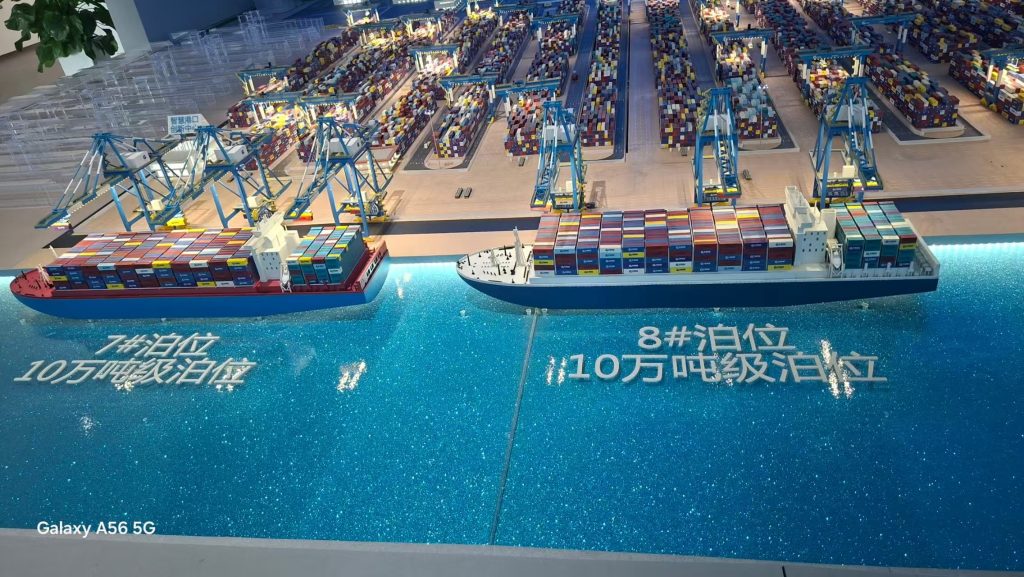
At the Qinzhou Automated Terminal, four massive berths designed for vessels of 100,000 tons and above are humming with activity.
But it is the smaller, uncompleted berths to the side that hold the true promise: five 5,000-ton river berths, still under construction until late 2027, will one day cradle the shallow-draft vessels that can navigate both river and sea. For now, though, the canal has to wait for that debut.
“Meanwhile, we also have other transport modes,” Mr Zhang explained, gesturing toward a model of rail lines and highways that “snake inland“. “The canal is an addition, not a total replacement.”
Some cargo from Yunnan and Guizhou still travel by truck or train to Qinzhou and they are transferred to giant gantry cranes operated by men stationed in air-conditioned rooms.
Previously the crane operators had to spend hours each working day bent double a hundred feet in the air. Now they work with joysticks and screens in comfortable settings on the ground, their necks and spines grateful for the change.
From southwestern Chinese provinces like Sichuan, a ship can now reach Thailand in far less time, thanks to the canal. One day, the seagoing river vessels will join in —and when they do, they will carry not only containers, but the full weight of Guangxi’s ambition.
Amid these sweeping logistical overhauls, perhaps the most symbolically charged structure along the canal—if only by virtue of its name—is the Qingnian (youth; 青年) Junction.
Situated at the lowest reaches of Pinglu among the three hubs—the others being Madao (马道)and Qishi (企石)—and serving as the final gateway before ships enter the Beibu Gulf, this junction is far more than an engineering triumph; it is a living monument to generational perseverance.
In the context of canals, the terms “hub” and “juncture” refer to ship locks where multiple systems converge and operate together.
The name “Qingnian” carries profound historical significance. In 1959, over 7,000 young laborers, armed with nothing but shoulder poles and baskets, built the Qingnian Watergate on this very site to irrigate farmland and generate power, thereby alleviating flooding and enhancing local agriculture.
Today, the newly built Qingnian Junction features a 300-meter-long ship lock and a pioneering water-saving system designed to manage 5,000-tonne vessels with smart technology.
Remarkably, 75% of the junction’s project team are under 35, and they have invited the original builders of the water gate to share their stories.
Bridging past and present, this stretch of the canal traces the advance from manual labor to digital visualization and smart robotics in China and specifically Guangxi. The message: the dedication to regional progress has never wavered.