



























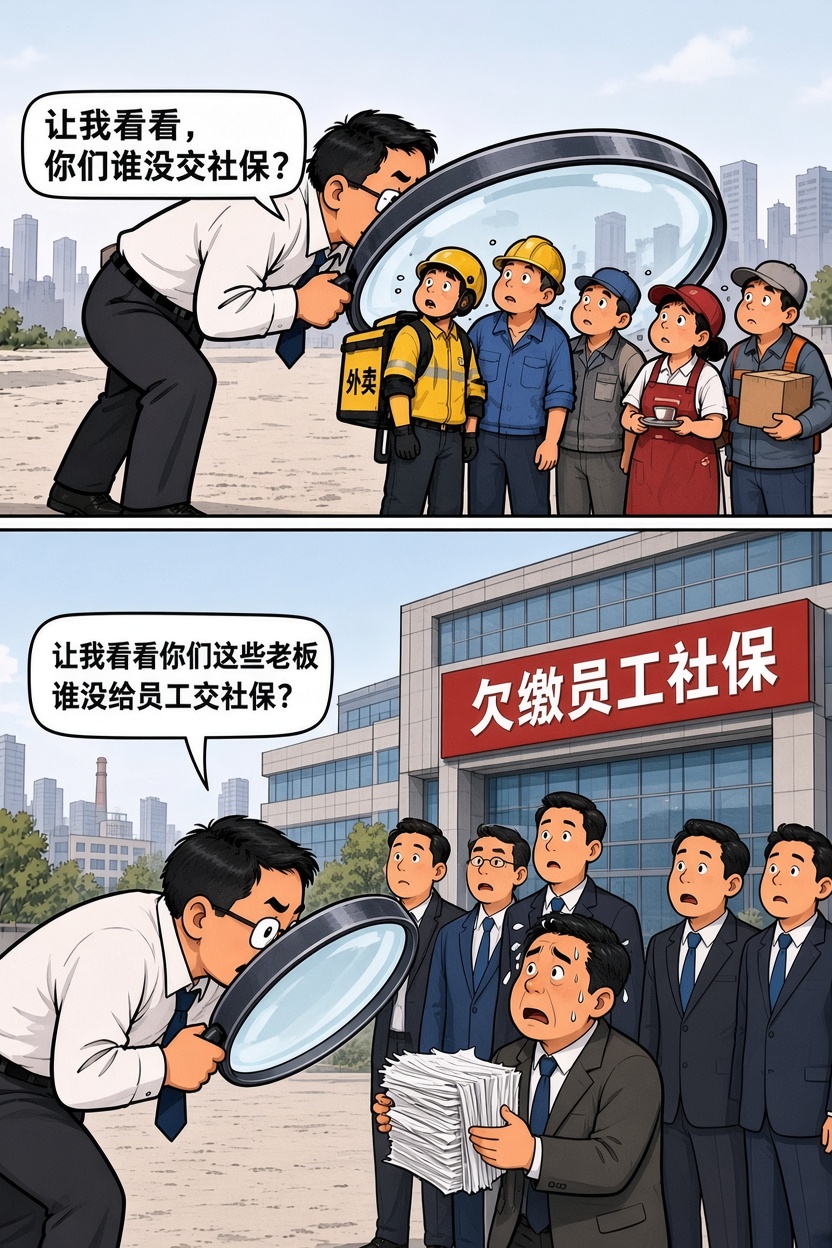
(2026.10.20 SINGAPORE) China’s drive to expand social security coverage (社保)to cover practically every worker is facing growing public resistance, exposing a conflict between the government’s ambition to strengthen retirement and medical protection and the financial pressures facing workers and businesses.
Today, Reuters reported that online criticism of social insurance contributions by workers had surged, with a Weibo hashtag about why young people opt out attracting at least 48 million views. The backlash comes as authorities prepare to standardise penalties from Nov 1 for employers who fail to make the required contributions, including fines of up to three times the overdue amount.
Many workers say their wages leave little room for additional deductions, while businesses struggling with weak demand fear that higher labour costs will further constrain hiring. The central question is whether China can broaden its social safety net without worsening the economic insecurity that makes participation difficult in the first place.
The latest dispute comes as China seeks to bring more workers into its social insurance system to support an ageing population and strengthen pension funding.
An interpretation by the Supreme People’s Court, effective Sept 1, 2025, of the Social Insurance Law《社会保险法》), adopted on Oct 28, 2010, clarified that employers and employees cannot legally agree to waive mandatory social insurance contributions. The rule covers social insurance generally, including pension, medical, unemployment, work-related injury and maternity insurance – called the five insurances – although the contribution requirements differ by scheme.
The judgment re-asserted existing obligations and closed a loophole rather than creating a new requirement. But it did not resolve why some workers and businesses had forged their waiver arrangements.
During a nationwide campaign from Oct 14 till today, the Ministry of Human Resources and Social Security promoted participation among migrant workers, flexible workers and people employed on digital platforms. The ministry has also said that expanding coverage and improving the system’s sustainability will be priorities during the 15th Five-Year Plan period from 2026 to 2030.
Official figures show that 1.079 billion people were enrolled in basic pension insurance at the end of September. A separate pilot occupational injury scheme for workers in new forms of employment, including food delivery couriers, ride-hailing drivers and local freight workers, had accumulated 37.27 million participants.
The scale of coverage is substantial, but enrolment does not necessarily mean that every worker contributes regularly or receives the same level of protection.
Why workers choose cash today
The latest enforcement drive is unfolding amid weak household spending, uncertain employment prospects and pressure on business profits. For low-income employees, the appeal of opting out is straightforward: the money saved can cover immediate living expenses.
Take pension insurance, the largest component of the “five social insurances and one housing fund” (五险一金)system, as an example. Employers are required to contribute 20% of an employee’s wages, while employees contribute another 8%. Under current rules, workers must make contributions for at least 15 years to qualify for a basic pension upon retirement. From 2030, the minimum contribution period will gradually increase from 15 to 20 years.
The one housing fund is a mandatory housing savings scheme for eligible employees. All the insurances and the fund are calculated and paid separately.
CNA previously reported the experience of Ao Xiang, who owns a tailoring shop in Nanchang, Jiangxi province. He said some employees preferred higher wages in hand to social insurance coverage.
Ao cited workers whose monthly take-home pay could fall to 2,500 yuan (about S$479) after contributions, compared with 3,500 yuan if they opted out. Although Ao paid contributions for his three full-time employees, he said many low-income workers placed greater value on cash they could use immediately.
The amounts illustrate why the debate cannot be reduced to a lack of awareness about retirement planning. When earnings barely cover food, housing and other essentials, contributions towards future benefits compete directly with present needs. The latest online reaction reflects the same concern.
For workers with stable jobs and predictable salaries, regular deductions may be manageable. The calculation is different for people whose hours and earnings fluctuate.
There is also a distinction between employees and the self-employed. Traditional employees generally share pension contributions with their employers. Flexible workers who join the employee pension scheme often have to pay the full contribution themselves.
China’s social insurance rules can add another complication: contributions are generally calculated using a prescribed wage base, subject to local minimum and maximum limits. Where the minimum contribution base exceeds a worker’s actual earnings, the worker’s social security contributions can take up a disproportionately large share of their income.”
Employers face a different calculation
Businesses have their own reasons to resist higher social insurance costs, particularly when revenue is weak and profit margins are thin.
The Financial Times reported last year that a manager at a Shenzhen restaurant specialising in luosifen (螺狮粉), a rice noodle dish from Guangxi, had closed two outlets amid rising labour costs and demands from local authorities to settle outstanding contributions for the second half of 2024.
The manager said the business planned to move its operations to Nanning, Guangxi’s capital, to reduce rent and labour expenses.
The FT also cited an auto parts manufacturer in Zhejiang province whose manager said additional monthly social insurance contributions amounted to 770 yuan per employee. With workers earning about 4,000 yuan a month, the extra employer cost was significant, while employees were reluctant to accept another 385 yuan in wage deductions.
Although these cases are from earlier reporting, they illustrate a problem that the latest enforcement measures do not remove: mandatory contributions raise costs for employers while reducing workers’ take-home pay.
A survey of 6,689 companies by social insurance services provider 51Shebao, cited by Chinese financial publication Caixin (财新), found that only 34.1% fully complied with requirements on the contribution base. The figure was however 5.7 percentage points higher than a year earlier, suggesting improvement but also widespread gaps in compliance.
The broader funding challenge is significant. According to FT calculations based on official data, only about one-third of China’s 734 million workers in 2024 were making full social insurance contributions. In the same year, revenue from contributions grew by 5.2%, while overall expenditure, including pension payments, rose by 7%.
The figures point to a structural problem: pension funding cannot rely indefinitely on a relatively narrow base of regular contributors while the number of retirees and the cost of benefits rise.
Weak demand complicates enforcement
China’s economic conditions make the dispute harder to resolve.
The economy grew 4.5% year on year in the third quarter of 2026, according to figures reported by Reuters yesterday. But exports remained a key source of support while domestic demand was subdued. The prolonged property downturn has also weakened household confidence and weighed on spending.
This matters because social insurance reform has two competing effects.
In the longer term, reliable pension and medical benefits could reduce the need for households to save against illness, unemployment and retirement. Greater confidence in social protection could encourage consumption, supporting a more balanced economy.
In the short term, however, contributions leave workers with less disposable income and employers with higher costs. If businesses respond by reducing recruitment, cutting wages or closing outlets, the policy could aggravate the very insecurity it is meant to address.
The latest public backlash also points to a broader employment concern. Reuters reported that some young people were linking their reluctance to contribute to low pay, job insecurity and uncertainty over the impact of artificial intelligence and automation on hiring.
China added 10.52 million urban jobs in the first nine months of 2026, meeting 87.7% of its annual target, the labour ministry said on Oct 10. The surveyed urban unemployment rate averaged 5.2% in the first eight months. These figures indicate continued job creation, but do not eliminate concerns about wage levels, job quality or the availability of stable employment.
Making the system workable
Three priorities emerge from the debate, although they would require further policy changes beyond simply enforcing existing rules.
First, China needs to address the affordability of social insurance for low-income workers. According to Financial Times, more flexible contributions and targeted subsidies are possible options, but would require safeguards to ensure that lower payments do not leave workers with inadequate retirement benefits.
Second, a February 2026 report by legislative representatives of China’s National People’s Congress called for platform companies to shoulder part of the contributions for flexible workers, with payment arrangements potentially linked to earnings or days worked.
Third, China needs to make social insurance easier to maintain when workers change jobs or move between provinces. Clearer explanations of contributions and future benefits would also help workers understand what they are paying for.