























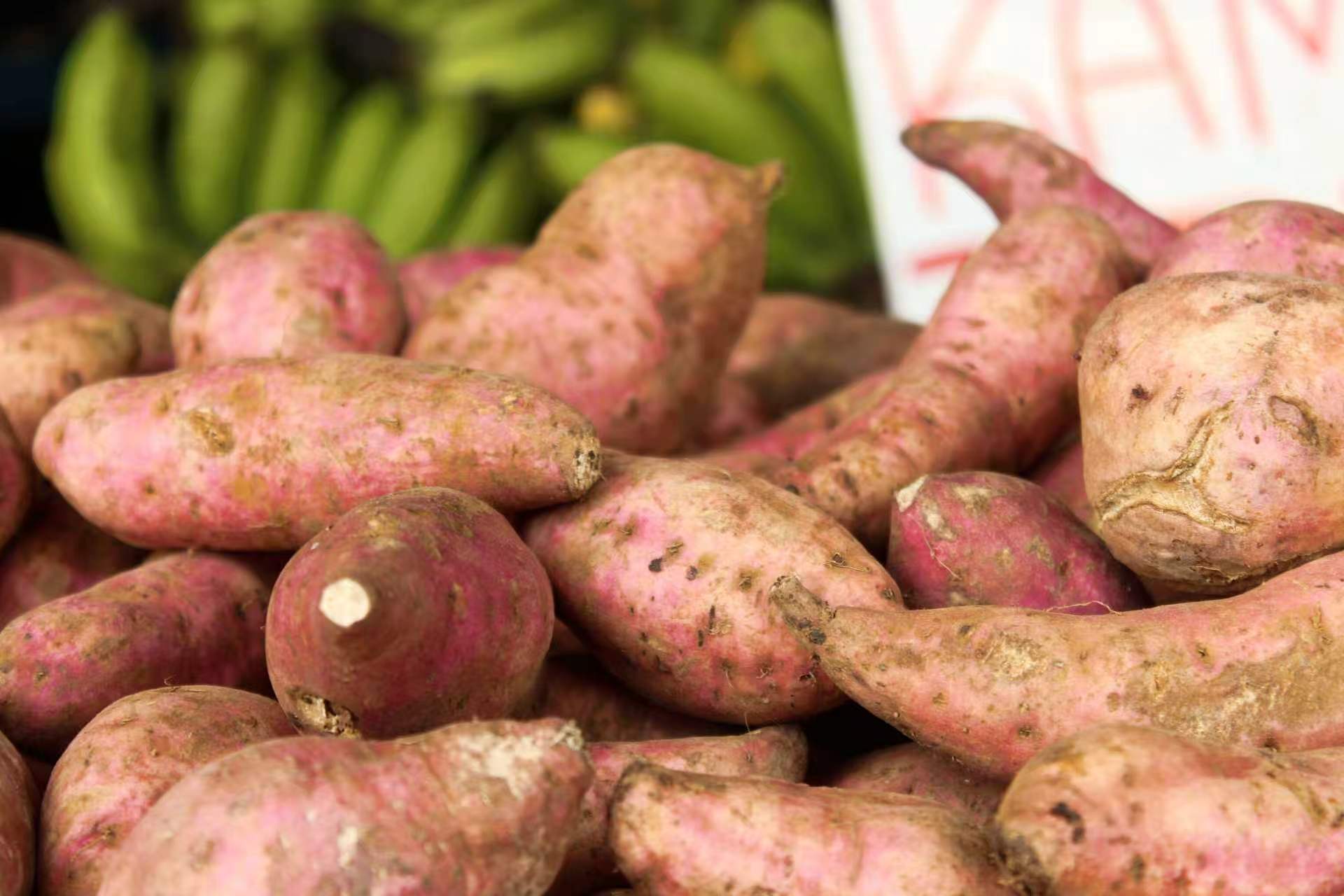
(SINGAPORE 2026.11.23) In Japan, the same kind of sweet potato can appear in two very different ways on the same day. At a convenience store, it may come in small packs as an easy-to-grab snack for an afternoon pick-me-up. At a department store, however, it may be packaged as a gift, with consumers paying greater attention to its presentation, place of origin and suitability as a present. The product itself may be much the same, but the reasons for buying it are quite different.
From 27 October, 7-Eleven stores across Japan began rolling out in their frozen dessert sections two new sweet potato desserts, developed in collaboration with Lapoppo Farm, a subsidiary of Japanese food manufacturer Hakucho, under its Seven Premium brand. One is a two-piece serving of smooth, creamy sweet potato dessert, priced at ¥429.84 (about S$3.47) inclusive of tax. The other is a roasted sweet potato crêpe, priced at ¥321.84 (about S$2.60). The latter combines roasted sweet potato, purple sweet potato cream, fresh cream, and custard in a multi-layered medley. Here, sweet potato is no longer relegated to a supporting role in a snack; it becomes the main attraction in a complex dessert.
Department stores, by contrast, operate on different pricing logic. In August, a “Super Honey” roasted sweet potato was priced at ¥962 (about S$7.77) in the basement food hall of Sogo Yokohama. From 18 to 23 November, Hakata Hankyu in Fukuoka is holding a sweet potato dessert fair featuring 38 shops, which would take turns to showcase their offerings.
Why does the same sweet potato snack sell well in one market but require a different pack size, price point or distribution channel in another? This arises from the underlyinginterplay of consumption settings, substitute products, and the costs of different retail channels.
Singapore-listed agribusiness Zixin Group Holdings has been in the sweet potato business for 17 years. Its executive chairman, Liang Chengwang, believes that the first question to address when entering a new market is not production capacity, but the local consumption context.
“The first thing I would look at is when people are likely to eat this snack and what alternative forms they might choose,” Mr Liang says. “In a Japanese convenience store, a small pack might work well as an afternoon snack. It should be easy to eat on the go and priced for an impulse purchase. In a department store, the same sweet potato might be better suited to gift-giving. Buyers are more likely to consider how it is presented, where it is grown and whether it is suitable for sharing. Each buying occasion gives consumers a different reason to make a purchase.”
But identifying the consumption occasion is not straightforward. It involves more than where a product is sold; it also depends on when it is consumed, who it is shared with, what alternatives consumers have, and how much they are willing to pay. Different occasions call for different product formats; available alternatives influence pricing; and purchase motivations determine the choice of sales channels. As Mr Liang points out, the key is to first identify the consumption occasion and then design the product accordingly.
Zixin’s response has been to develop three product lines, each tailored to a different consumption occasion. In April 2026, its wholly owned Singapore subsidiary, Zixin Enterprise (Singapore), launched NutriRootz, a consumer brand comprising three ranges: Crunch (sweet potato chips and fries), Go (additive-free, vacuum-packed steamed sweet potatoes ready to eat) and Raw (traceable fresh sweet potatoes). Each caters to a different use: snacking, convenient ready-to-eat consumption and use as a fresh ingredient. While all three draw on the same upstream supply and quality-control systems, they have distinct product formats, pricing strategies and distribution channels.
Whether these three product lines can be sustained depends on the company’s ability to secure a reliable upstream supply of sweet potatoes that meet the required specifications. According to Zixin’s FY2026 annual report, for the financial year ended 31 March 2026, revenue from fresh sweet potatoes amounted to RMB184.6 million (about S$35.6 million), up 84.6 per cent year on year. The main harvest at the company’s Liancheng base in Fujian took place between late August 2025 and early February 2026. To supplement its own supply, Zixin also sourced fresh sweet potatoes from Hainan and Yunnan. As a result, revenue from fresh sweet potatoes in the second half of FY2026 was more than double that in the first half.
In its FY2026 annual report, Zixin said that its control over upstream cultivation and midstream processing “strengthens our assurance of product traceability and gives us greater confidence in expanding into more distant markets”.
Capacity is another important factor. Zixin’s high-tech food processing facility in Liancheng occupies 83.6 mu (about 5.6 hectares) and is designed to achieve an annual production capacity of 35,000 tonnes upon full completion. Construction is being carried out in three phases, with the first phase’s three automated production lines having commenced operations in the second half of FY2026. The company says the pace of further expansion will depend on the performance of the first phase.
Singapore is Zixin’s starting point for testing overseas sales channels. On the one hand, the company is working with food and beverage operators to get its sweet potato products onto restaurant and café menus. On the other, its sweet potato crisps, produced in collaboration with third-party brand CoolShow, have also secured shelf space across all the outlets of one of Singapore’s three largest supermarket chains. In April, Zixin made its debut at Food & Hospitality Asia 2026 (FHA 2026. Around the same time, it launched its own e-commerce platform, which serves both as an online sales channel and a showcase for its brand and products.
Speaking about the ASEAN market in September, Mr Liang said the needs of local partners’ were shifting “from buying products and individual technologies to bringing the entire suite of capabilities required to develop an industry”. For Zixin, expanding overseas is not about replicating Chinese products in their original form. Rather it means rebuilding the cultivation, processing, warehousing and distribution capabilities it has developed in China to suit local markets.
The same sweet potato can be sold as a dessert in a convenience store and as a gift in a department store. The product has not changed; what changes is why consumers would buy it — when they would eat it, who they would buy it for and how it is presented to them. For agribusiness and food companies seeking to expand overseas, the real challenge may no longer be production capacity but understanding what would persuade consumers in each market to buy their products.