






















(Singapore, Nov 12, 2026)Japanese billionaire Masayoshi Son (孙正义) has long believed that the winners of technological revolutions are rarely the most cautious players, but those willing to make the biggest bets before everyone else.
But his SoftBank Group’s latest results are raising questions about whether this investment philosophy will still pay off in the age of artificial intelligence (AI).
For the second quarter of its financial year 2026, ended Sept 30, SoftBank reported a net loss of 1.1153 trillion yen (about S$9 billion), its first quarterly loss in seven quarters. Apart from a decline in the valuations of its investment portfolio, the group also booked a loss of 597.2 billion yen after revising its procurement plans for power-generation equipment intended for US AI data centres. Financial expenses also rose year on year to 461.9 billion yen.
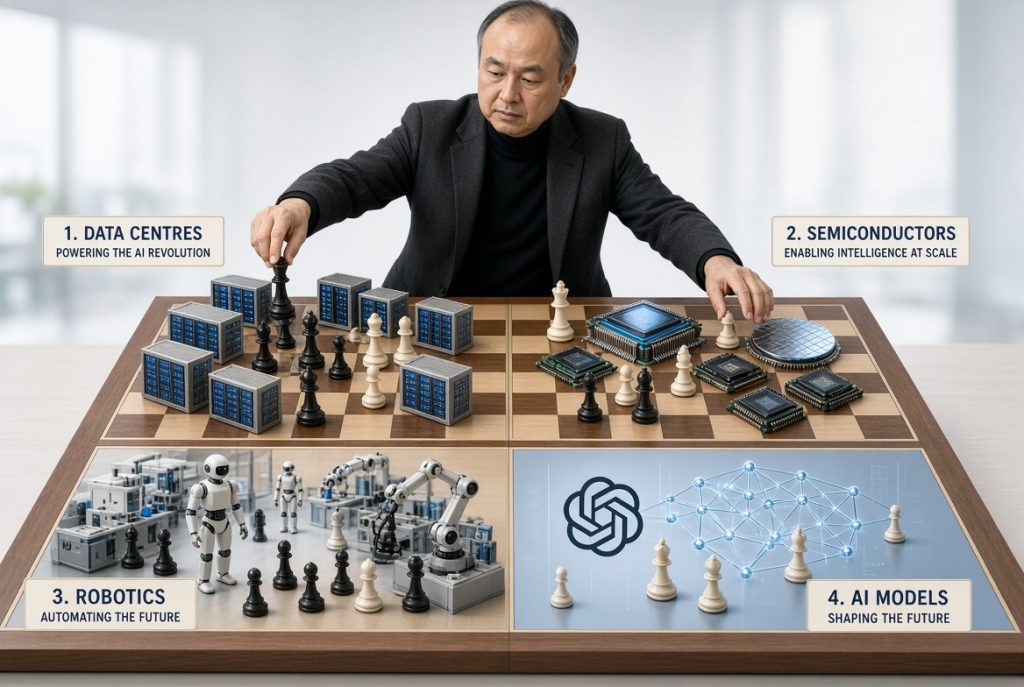
This is not simply a case of SoftBank backing the wrong company. Son is betting simultaneously on AI models, chips, data centres, power supplies and robotics, seeking to secure a position across the entire AI value chain. But when project scale, market demand and financing conditions change, the massive investments intended to give SoftBank an early advantage can just as easily become a heavy burden.
Son has built his reputation on making bold bets in pursuit of outsized returns, but his record also includes painful lessons in overexpansion. This time, the stakes are larger than in any of his previous gambles.
From pachinko parlours to a technology empire
A profile of Son’s investment career by Chinese technology publication 36Kr (36氪) traced his appetite for risk partly to his upbringing.
Born in Saga prefecture on the southern Japanese island of Kyushu, Son is descended from a family that migrated from the Korean peninsula to Japan. His father, Son Sam-heon ( 孙三宪 ), initially ran a pig-farming and home-brewed rice wine business before moving into pachinko, Japan’s popular pinball-style gambling business. At its peak, the family operated 56 parlours.
Growing up around the business, Son saw how a model built on probabilities could generate substantial profits: the occasional big win could more than compensate for numerous small losses.
That thinking would later become a defining feature of his investment strategy: move early to secure a position in an emerging industry, then wait for the market to mature. Even if most investments fail, a handful of exceptional winners can generate returns that far outweigh the losses.
In 2000, Son invested about US$20 million in Alibaba, then a relatively obscure Chinese e-commerce start-up. The investment eventually generated tens of billions of dollars in returns.
His approach to Japan’s telecommunications market was similarly audacious. In 2006, SoftBank acquired Vodafone Japan for about 1.75 trillion yen, laying the foundation for its subsequent expansion in mobile communications and the introduction of the iPhone to the Japanese market.
But not every gamble paid off. SoftBank poured more than US$10 billion into shared-office company WeWork, betting that its business model could disrupt the traditional office market. As problems with its operations came to light and its planned stock market listing collapsed, the investment became one of SoftBank’s most notorious failures.
A separate 36Kr analysis identified two defining characteristics of Son’s investment style: he moves quickly and commits large sums, often making decisions based on his personal convictions; and he tends to concentrate capital in a small number of sectors he believes in, before recycling funds through listings, share disposals and further fundraising to finance the next round of investments.
This approach produced the Alibaba legend, but also magnified the losses from WeWork.
Now, Son is applying the same playbook to AI.
From backing individual companies to betting on the entire AI ecosystem
This time, Son is not content with investing in a single AI company. He wants a stake in multiple critical parts of the industry’s value chain.
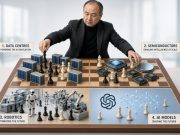
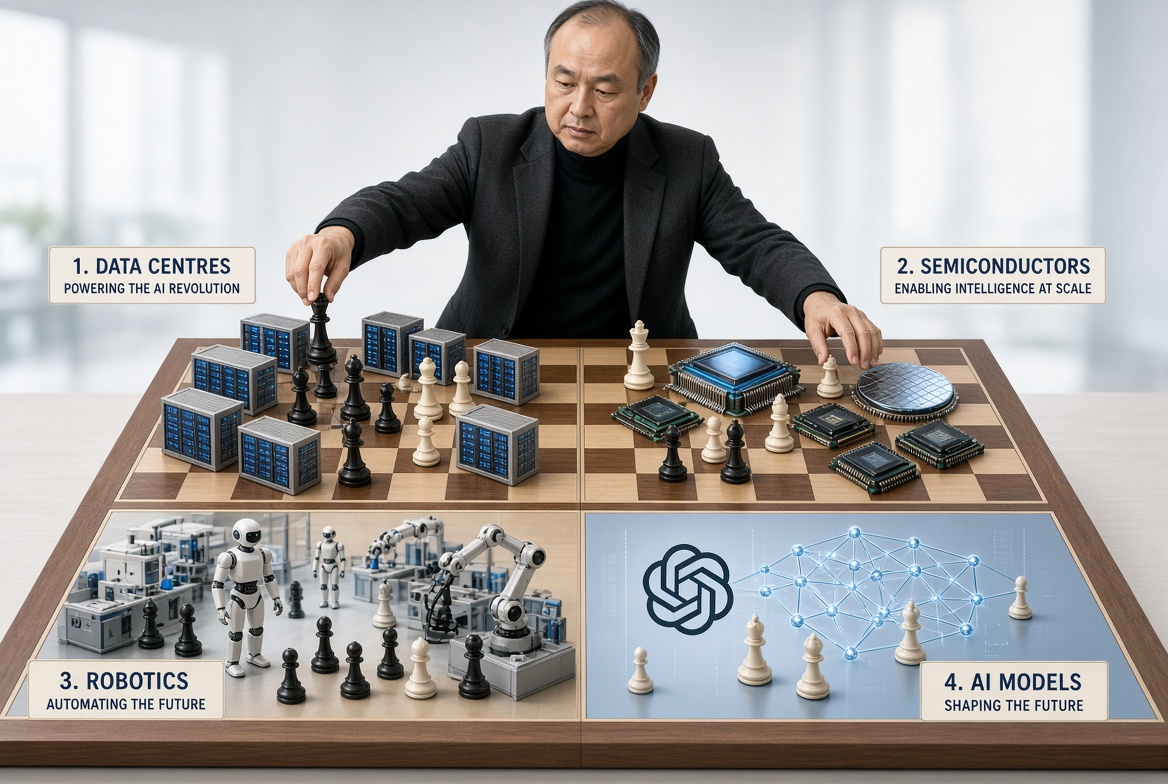
A report yesterday by 36Kr, republishing an analysis from Japan’s Nikkei Chinese, said SoftBank’s AI strategy revolves around four areas: AI models, with OpenAI at its centre; infrastructure such as data centres; semiconductor chips; and physical AI applications, including robotics.
Son wants to secure a position in all four corners of the board, much like a chess player positioning his pieces, in the hope of becoming a key platform provider in the AI era.
OpenAI represents his biggest bet. SoftBank has committed about US$64.6 billion to the company and holds an approximately 13 per cent stake, making it OpenAI’s second-largest outside shareholder. To fund the investment, SoftBank has even sold its entire Nvidia stake, alongside other asset disposals, to concentrate its resources on OpenAI.
On the infrastructure front, SoftBank is participating in the development of large-scale data centres in the US through its subsidiary SB Energy. It has also moved to secure gas turbines in advance to ensure sufficient electricity supplies for its future data centre campuses.
But this part of the strategy has already undergone a significant adjustment.
SoftBank had originally reserved large quantities of power-generation equipment for its US AI data centre projects. It subsequently found that some procurement commitments exceeded its actual project requirements and decided to revise the arrangements, resulting in the 597.2 billion yen loss.
Japanese broadcaster Tokyo Broadcasting System (TBS), in its CROSS DIG media platform operated with Bloomberg, reported that SoftBank updated its explanatory materials yesterday to clarify that the loss was unrelated to the PORTS-Pike project in Ohio. The existing US$6.6 billion equipment contract for that project remains intact.
The PORTS-Pike Technology Campus is a proposed multibillion-dollar AI data centre and energy complex in Pike County, southern Ohio. It is a major project involving SoftBank Group, SB Energy, OpenAI, and Nvidia. It is particularly significant because it combines three things: massive AI computing infrastructure, its own electricity generation and a redevelopment of a former nuclear-era industrial site.
In other words, SoftBank has not abandoned its data centre ambitions. It is instead scaling back excessive equipment commitments.
The episode also highlights another side of Son’s investment approach. He is willing to pay a premium to secure scarce resources ahead of competitors, but when the original deployment plans no longer make sense, he must be prepared to take losses and adjust course.
The bigger risk lies in financing
More concerning than the loss on equipment procurement is how SoftBank intends to finance its AI ambitions.
TBS CROSS DIG with Bloomberg, citing Junji Sakurada ( 桜田顺司 ), chief executive of Singapore-based Marina Bay Capital Advisors, reported on Monday that SoftBank is among the companies relying heavily on borrowing to fund its AI investments. A deterioration in credit conditions could make it difficult for the group to raise funds as planned.
SoftBank has raised the borrowing limit on a loan secured by its shares in British chip designer Arm to US$25 billion. It has also secured a US$40 billion bridge loan and raised funds through bond issuance.
Some of the dollar-denominated bonds it issued in September carried coupon rates as high as 9.75 per cent, underscoring the high cost of financing.
Investors are also demanding greater compensation for taking on SoftBank’s credit risk. Its five-year credit default swap (CDS) spread briefly climbed to about 466 basis points in November, its highest level since 2022. The increase indicates that the market perceives a greater risk of the company defaulting on its debt, making it more expensive for investors to obtain protection from a third party against such a default.
At the earnings briefing on Tuesday, however, SoftBank chief financial officer Yoshimitsu Goto ( 后藤芳光 ) stressed that the group was not in danger of default and that the value of its assets still provided a buffer against its borrowings.
He acknowledged that the current environment was not one in which SoftBank could expand its investments without restraint. The group would have to strike a careful balance between pursuing growth and exercising financial discipline.
Japanese technology publication ITmedia also reported that Goto rejected US trillionaire Elon Musk’s claims that SoftBank had defaulted on its gas turbine orders, describing the allegations as entirely unfounded.
The next test: Can OpenAI justify SoftBank’s massive bet?
Perhaps the biggest risk for Son is that he has placed so much of SoftBank’s future in OpenAI.
The Nikkei Chinese analysis noted that OpenAI’s planned stock market listing has been pushed back to 2027 or later. If the company’s growth or fundraising falls short of expectations, SoftBank may find it difficult to recoup its enormous investment through the IPO and the subsequent sale of shares.
Meanwhile, data centre development in the US faces obstacles ranging from local regulatory approvals and power constraints to project financing. Some of SoftBank’s planned facilities in Texas and Ohio have yet to break ground. Any delays would mean that capital committed upfront could remain tied up for much longer before generating returns.
SoftBank faces broadly two possible scenarios.
If OpenAI continues to grow and eventually goes public successfully, the value of SoftBank’s stake could rise substantially, giving Son an opportunity to repeat his Alibaba success.
But if the commercialisation of AI falls short of expectations while borrowing costs continue to climb, SoftBank could be forced to sell assets, scale back investments or pledge even more of its core shareholdings as collateral.
Son was once hailed as an investment visionary after his Alibaba bet, but his reputation has also taken hits from failures such as WeWork.
Now he has once again pushed SoftBank into a high-risk, high-reward gamble. The difference is that he is no longer betting on a single start-up, but on the future of an entire industry.
For Son, the greatest challenge may no longer be whether he can identify the next technological revolution, but whether SoftBank can remain financially strong enough to stay in the game until the returns finally materialise.