



























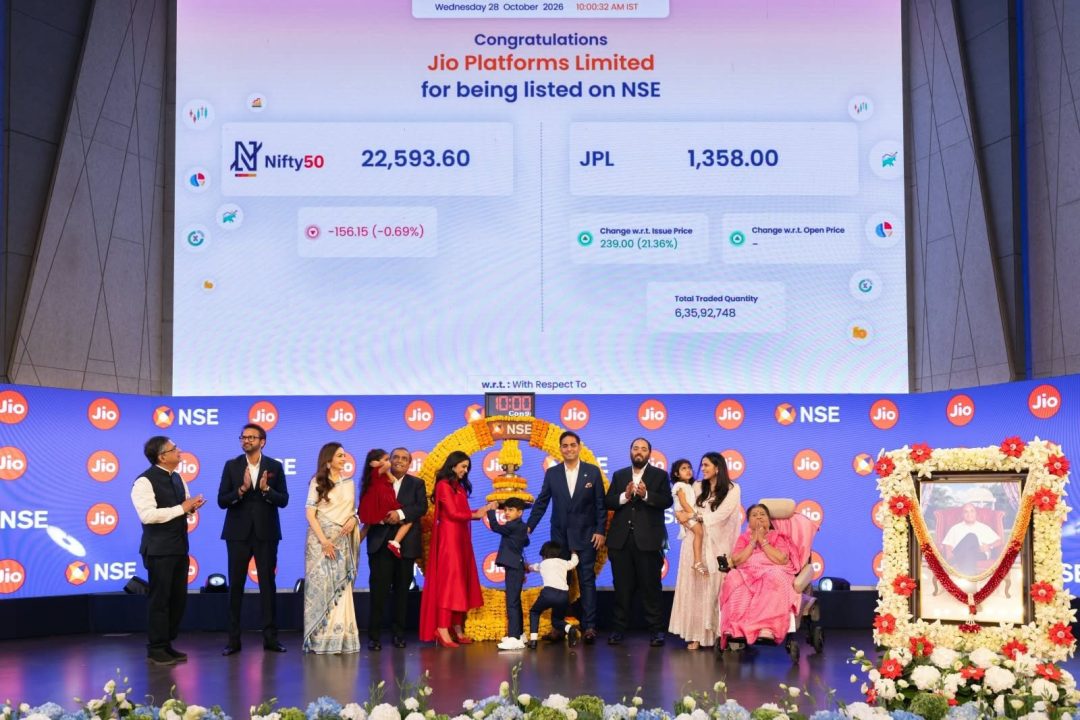
(Singapore, 28.10.2026)Jio Platforms made a strong stock market debut today, rising 27% after India’s largest initial public offering and lifting Mukesh Ambani’s Reliance Group above Tata Group as the country’s most valuable conglomerate.
Shares of the telecom and digital-services company closed at 1,417.5 rupees in Mumbai, giving Jio a market value of about US$137 billion and making it India’s second-most valuable listed company, behind parent Reliance Industries.
According to Bloomberg, the rally pushed the combined market capitalisation of Reliance Group’s listed businesses above 30.5 trillion rupees, surpassing Tata Group’s roughly 25 trillion rupees. Tata had held the leading position for most of the past decade.
The US$3.1 billion offering provided a bright spot in an otherwise difficult market, with Indian equities heading towards their first annual decline in 11 years as foreign investors withdraw record amounts from existing shares.
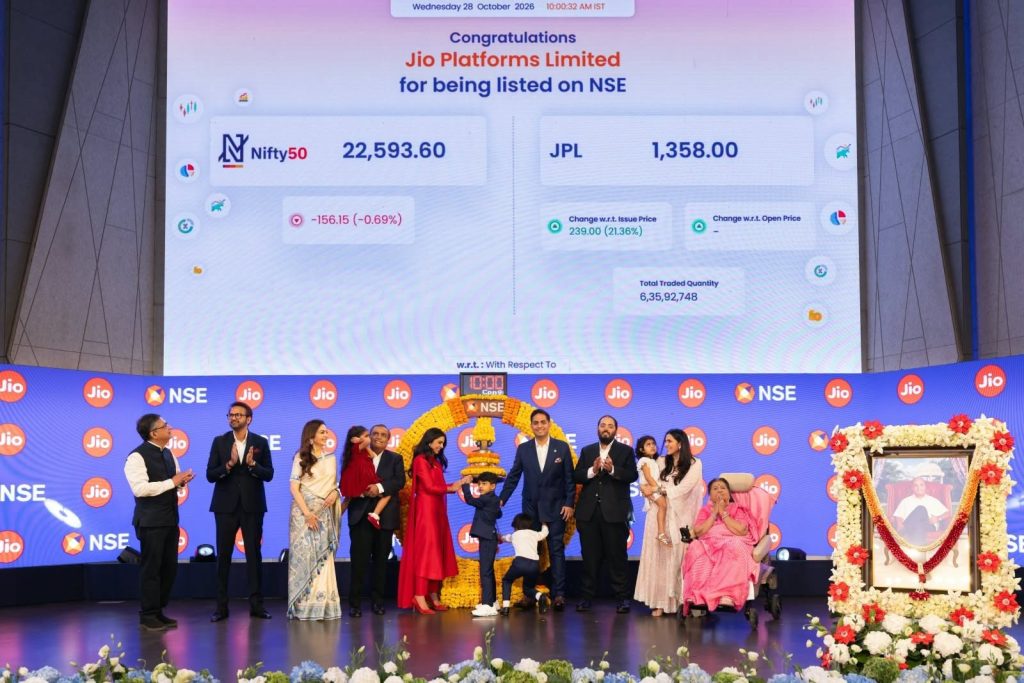
Jio’s debut also marked a milestone for the Ambani family, with four generations joining the bell-ringing ceremony, from Mukesh’s mother, Kokilaben, to his grandchildren. His eldest son, Akash, led the IPO process and investor roadshow, placing the next generation at the centre of one of the group’s biggest transactions.
Careful Preparation Meets Strong Investor Demand
The offering was fully subscribed in less than 100 minutes and ended about 22 times oversubscribed, attracting more than US$78 billion in bids and nearly 14 million applications.
Its first-day gain was the second strongest among Indian IPOs that raised at least 150 billion rupees, behind Coal India’s 40% debut surge in 2010, according to Bloomberg data.
That performance stood apart from the country’s recent record of blockbuster listings. The four IPOs that raised at least US$2 billion earlier this decade recorded a weighted-average first-day decline of 9.9%, while India’s five biggest previous offerings are now trading below their issue prices.
Reliance’s preparations helped Jio navigate that difficult backdrop, with the group adjusting the deal structure, lowering its valuation expectations, securing anchor investors and mobilising its extensive workforce to build interest
Deven Choksey, managing director of DRChoksey FinServ, said Reliance spent close to five years preparing the listing and waited until Jio was generating strong free cash flow before bringing public-market investors into the business.
The eventual valuation fell short of some earlier expectations, but the pricing helped balance a record fundraising with room for investors to make gains on debut.
The approach recalled Reliance’s ability to complete major transactions during earlier periods of uncertainty, including its 530 billion-rupee rights offering in 2020 as the pandemic unsettled global markets.
However, Jio’s successful launch did not lift the entire group. Reliance Industries, which holds about two-thirds of Jio, fell 3.2% on the day, its steepest decline in more than five months, while the broader market also declined.
A Premium Valuation Raises the Earnings Challenge
Attention now turns to whether Jio can translate its more than 500 million subscribers into stronger earnings and cash flow while expanding in broadband, cloud computing and artificial intelligence.
Executives presented the company to investors as a broader technology business rather than simply Reliance’s telecom arm, but its premium valuation increases the pressure to demonstrate that those ambitions can produce financial returns.
Nomura expects the listing to add pressure for steady tariff increases, potentially influencing rivals’ pricing, while Bloomberg Intelligence said Jio’s valuation sets a higher bar for monetisation and cash generation.
Jio’s average revenue per user still trails rival Bharti Airtel, making the amount earned from each customer an important measure of future progress.
Some analysts see its market leadership and improving cash generation as reasons for optimism, while others warn that a strong business can still disappoint investors if its shares are bought at too high a price.
Anurag Singh, founder of Ansid Capital, noted that Jio’s valuation was approaching major US telecom companies despite generating only a fraction of their revenue, highlighting the scale of growth already reflected in its share price.
Operational risks also remain, including dependence on telecom licences and spectrum, with approval delays, non-renewals or difficulty securing additional spectrum potentially affecting the business.
The listing meanwhile illustrates the increasingly selective nature of foreign investment in India. Global investors have committed about US$7 billion to the country’s primary market this year while withdrawing a record US$38 billion from cash equities.
Jio’s strong debut suggests that demand remains available for individual growth stories even as investors reduce wider market exposure, although sustained performance will depend on results beyond the listing-day rally.
The company will also have to wait several months before becoming eligible for benchmark indexes such as the Nifty 50, as exchanges first need to introduce derivatives products on its shares.