
























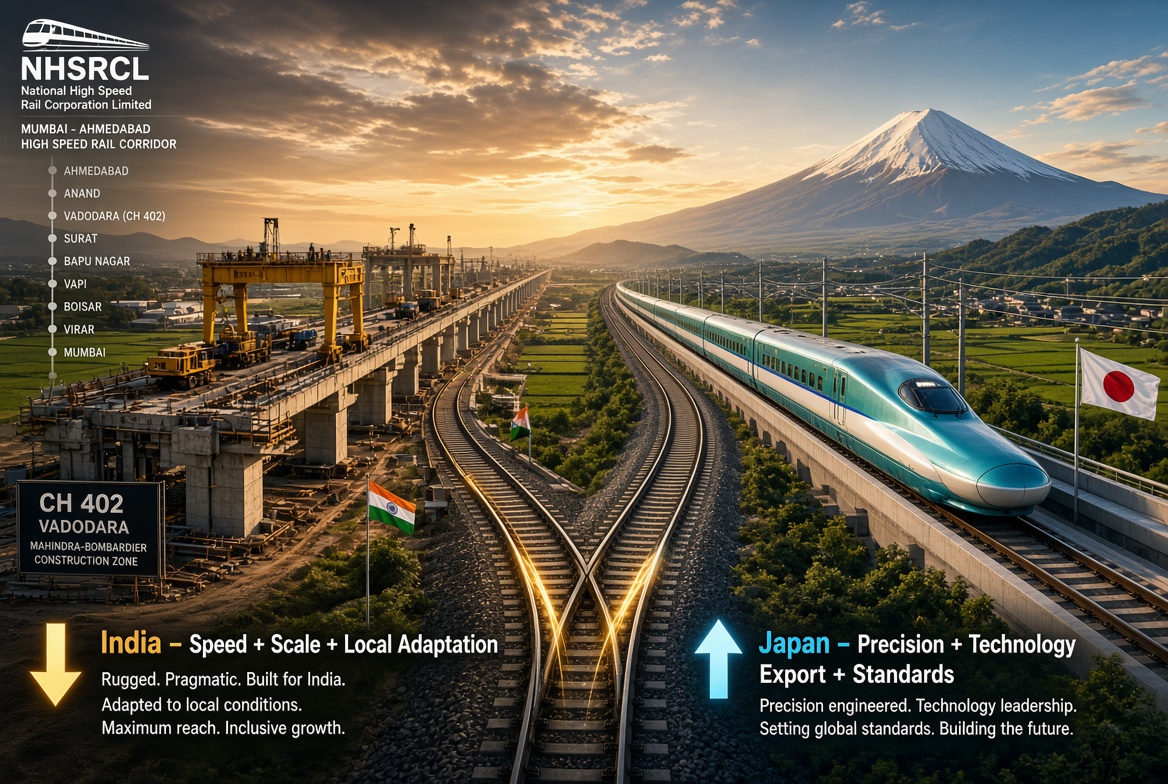
(SINGAPORE 2026.11.10)Japan offered India exceptionally cheap financing to build its first high-speed railway, hoping to showcase its Shinkansen trains, signaling systems, engineering expertise and maintenance services, following its first export to Taiwan in 2000s. Instead, Germany’s Siemens has won the signaling contract, India is developing its own bullet trains, and Japanese suppliers may have to wait until the early 2030s to introduce their next-generation trains.
The disagreements over the 508km Mumbai-Ahmedabad corridor expose fundamentally different expectations. Japan wanted to export an integrated railway system; India wanted foreign technology and financing while building an industry of its own.
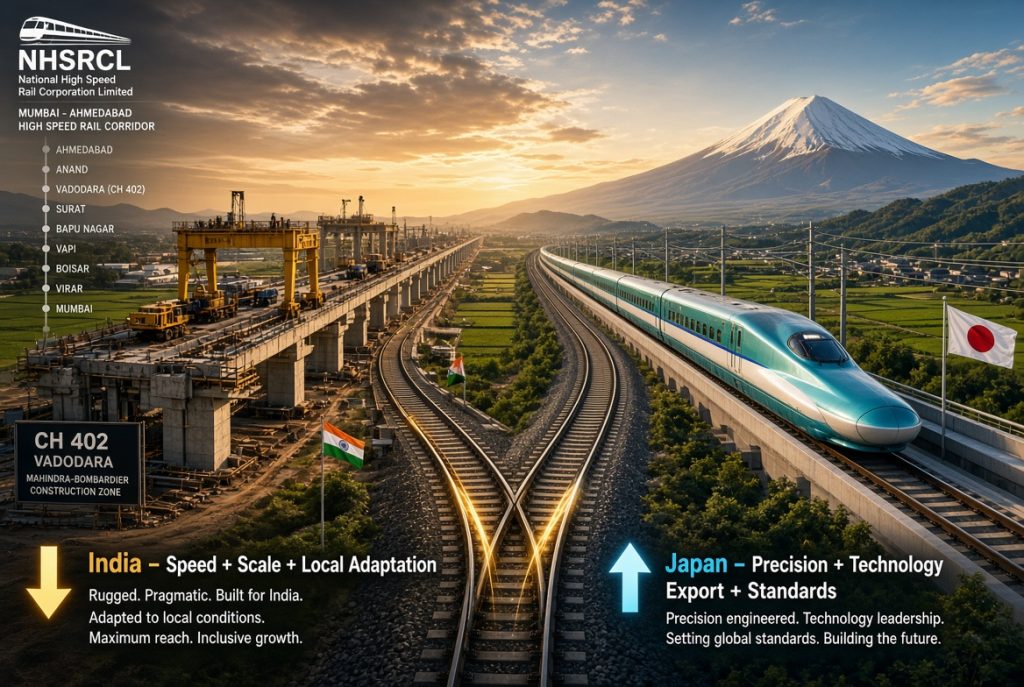
A report yesterday by Japan’s Kyodo News highlighted the growing differences. Japanese companies are frustrated at being unable to secure the complete Shinkansen package. One person involved in the project described negotiations between the two sides to Britain’s Financial Times as “a complete mess”.
Originally scheduled to begin operations in 2023, the railway is now expected to open its first section in 2027, although the entire line will take considerably longer.
Today Chinese technology media outlet 36Kr (36氪) offered a more pointed assessment, portraying Japan as an investor locked into a deal: reluctant to walk away but unable to realize its anticipated returns.
Its commentary is emotive and reflects a particular interpretation. But it raises an important commercial question: can Japan achieve its export ambitions when the country it is financing no longer intends to buy all the technology it hoped to supply?
Japan’s generous financing came with bigger commercial ambitions
The Mumbai-Ahmedabad line will connect India’s financial capital with Ahmedabad, a major commercial centre in Gujarat. Designed for speeds of up to 320kmh, it is expected to cut the journey to about two hours.
India and Japan agreed on the project in 2015, with construction beginning in 2017. Japan offered a loan covering about 81 per cent of the original estimated cost of 976.36 billion rupees (about S$13.4 billion), at an annual interest rate of just 0.1 per cent, repayable over 50 years with a 15-year grace period.
The financing reflected Japan’s infrastructure diplomacy: funding overseas projects to secure contracts, establish technical standards, and generate long-term demand for Japanese equipment and services.
For Japan, the Shinkansen is not simply a train. Its reputation for safety and reliability rests on an integrated system of rolling stock, dedicated tracks, signaling, train control, power supply and maintenance. Japan wanted to export this package rather than compete for individual equipment orders.
India’s first high-speed railway could also have become a showcase for other markets and given Japanese companies an advantage in subsequent Indian projects.
But the economics have changed. The original estimated cost has risen from about 980 billion rupees to approximately 2 trillion rupees. An August report by The Times of India put the revised estimate at about 2.1 trillion rupees.
The Indian government cited delays in land acquisition, inflation, currency fluctuations, taxes, resettlement and additional engineering requirements. One major change was to build the entire corridor on elevated viaducts instead of using embankments along much of the route, reducing land acquisition and avoiding the division of villages.
With expenditure more than doubling, India must reconsider how much public money to commit, particularly as not all additional costs necessarily fall under the original Japanese financing arrangement. The question is whether importing an entire system remains economical for India’s wider railway ambitions.
A decisive change came in June 2025, when a consortium comprising Germany’s Siemens and Indian infrastructure company Dineshchandra R Agrawal Infracon secured the signalling and train control contract.
Worth about 41.4 billion rupees, it covers the design, installation, testing and maintenance of the European Train Control System (ETCS) Level 2, telecommunications and the operations control centre.
This departed from Japan’s expectation that its Shinkansen signaling and train control technology would accompany its trains.
The concern goes beyond losing a contract. Combining Japanese infrastructure, European signaling and Indian-built trains requires careful technical integration. Differences in operating speeds, braking characteristics, communications protocols and safety procedures must be addressed.
Responsibility for faults must also be clearly allocated among train manufacturers, signalling suppliers and infrastructure operators, particularly when the railway enters decades of operation and maintenance.
India says Japan could not deliver the trains in time
India has its own explanation for changing the procurement arrangements.
The Japanese E10 Shinkansen, intended for the project, remains under development. India’s Ministry of External Affairs said in July that Japan would provide the trains only in the early 2030s.
An official told The Indian Express in July that India decided in 2024 to develop its own trains and adopt internationally recognized signaling standards after it became clear the E10 would not be available in time.
India wants to operate at least part of the railway rather than leave completed infrastructure unused while waiting for trains still under development.
It is developing the B28 high-speed train through state-owned Bharat Earth Movers Limited (BEML), in collaboration with the Integral Coach Factory. The train has a design speed of 280kmh and intended operating speed of 250kmh, below the Shinkansen system’s planned 320kmh.
The first prototype is targeted for completion in early 2027, followed by testing and certification.
This is more than a temporary procurement solution. It gives Indian manufacturers experience in high-speed train engineering, components and maintenance. India has already developed Vande Bharat trains for conventional services; the B28 is a more ambitious step into high-speed rail.
Even if Japanese E10 trains eventually enter the corridor, they may no longer be the only trains operating on it.
India’s decision becomes clearer against its longer-term railway plans.
The government announced seven proposed high-speed rail corridors in its 2026-27 Union Budget. It wants common designs, construction methods, components and maintenance procedures to make subsequent projects faster and cheaper.
In a July 2026 backgrounder, India’s Press Information Bureau said experience from Mumbai-Ahmedabad would help establish standards for future lines. Domestic manufacturers are also being encouraged to produce specialised components, construction equipment and track systems.
BEML’s expanding capabilities could eventually position it to compete for orders beyond the initial corridor.
India wants an industrial ecosystem spanning trains, components, engineering, testing and maintenance. Dependence on foreign suppliers would mean continued spending on imported equipment, spare parts and technical support, while limiting its control over costs and expansion.
Japanese concessional financing remains attractive, but does not necessarily outweigh India’s industrial ambitions.
Public criticism exposes a deeper breakdown in trust
The differences became unusually public in July.
Former Japanese justice minister Hideki Makihara accused India of being untrustworthy in a social media post, saying it frequently changes its position after making commitments and puts its own interests first. He blamed India entirely for the project’s lack of progress.
India’s foreign ministry spokesman Randhir Jaiswal dismissed the remarks as personal views considerably at variance with the facts, adding that discussions between the countries were progressing well.
The exchange reflects their contrasting interpretations. Japan sees India’s decisions as a retreat from earlier commitments. India regards them as necessary responses to delays in Japanese equipment availability and its construction timetable.
An October analysis by The Indian Express pointed to inadequate preparation and differences in business practices from the outset. An industry source familiar with the discussions said both sides had insufficiently understood each other’s objectives, operating environments and working methods.
Ambitious cost and completion targets were announced before procurement, approvals and implementation details were fully worked out, leaving both sides exposed when difficulties emerged.
36Kr similarly argued that Japan had underestimated India’s determination to prioritise its own interests and industrial development. Although more subjective than Japanese and Indian news reporting, its central point is pertinent: financing a project does not guarantee that the recipient will accept the supplier’s entire commercial package.
Spain’s train disaster highlights why integration matters
Japan’s concerns about combining different railway technologies also raise safety questions.
A collision between two high-speed trains in Spain’s Castilla-La Mancha region on Oct 28 killed at least 68 people. Preliminary accounts pointed to a signaling and communications failure, followed by an erroneous control-centre instruction that allowed a train to resume running. Investigations are continuing.
36Kr cited the accident to contend that high-speed rail safety depends on the entire operating system, not just the trains. The disaster underlines the importance of integrating signaling, communications, train control and operating procedures.
Neither country appears ready to abandon the project.
India still benefits from Japanese financing, engineering expertise and railway construction experience. Japan, meanwhile, has too much invested to walk away, particularly given its wider strategic relationship with India.
A mixed arrangement is therefore more likely. Indian trains could begin operating on the initial section using European-Indian signalling, while Japanese companies retain roles in infrastructure construction and technical supervision.
Japan could also supply E10 trains when they become available in the early 2030s, subject to agreement on deployment and compatibility.
An Oct 24 analysis by The Indian Express similarly suggested that both countries were moving towards a pragmatic compromise, with Japanese financing remaining in place despite changes in technology procurement.