














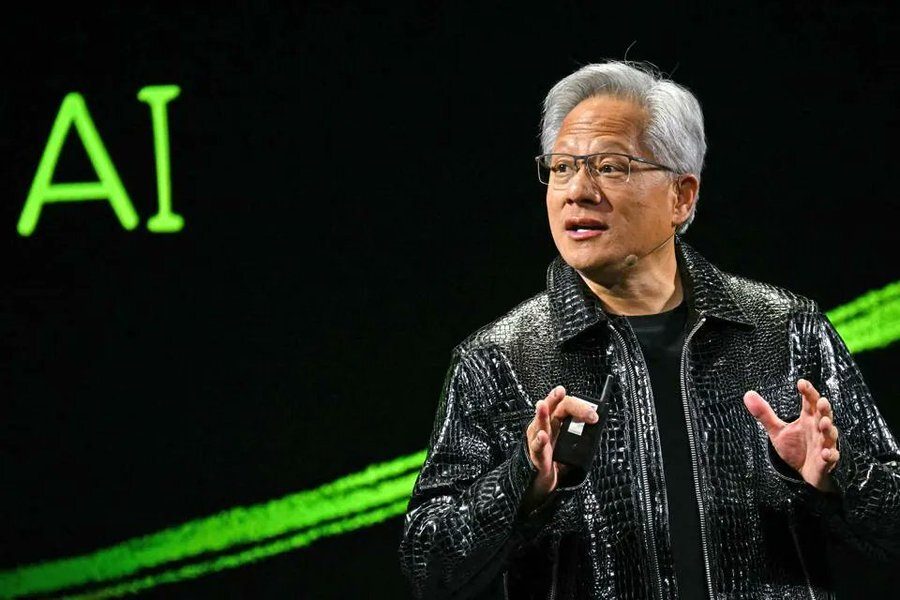
(Singapore, 13.05.2026)As US President Donald Trump heads to Beijing for a highly anticipated summit with Chinese President Xi Jinping, artificial intelligence and semiconductor technology have suddenly become central to the conversation following the surprise addition of Jensen Huang to the American delegation.
The last-minute decision for Huang to join the trip has drawn global attention because his company, Nvidia, sits at the center of the global AI race. The company’s advanced chips power many of today’s leading artificial intelligence systems, including models like ChatGPT.
Trump confirmed Huang’s participation shortly after the Nvidia chief executive was seen boarding Air Force One during a stop in Alaska. Posting on social media, Trump said he was honored to have Huang and several top American business leaders joining the delegation to China.
The summit marks Trump’s first visit to China since returning to the White House and comes at a sensitive moment in US China relations. Besides trade and tariffs, both sides are expected to discuss issues including Taiwan, technology restrictions, and the ongoing conflict involving Iran.
Among the other executives traveling with Trump are Tim Cook of Apple, Elon Musk of Tesla, Kelly Ortberg of Boeing, and David Solomon of Goldman Sachs.
In his message before arriving in Beijing, Trump said he would ask Xi to further “open up” China to American businesses.
“I will make that my very first request,” Trump wrote, praising the executives accompanying him and expressing hope that they could help elevate China’s economy through greater cooperation.
However, much of the attention is now focused on Nvidia’s efforts to sell its advanced H200 AI chips to Chinese customers.
The H200 chips are among Nvidia’s most powerful products and are widely used to train and operate advanced AI systems. For years, Washington restricted exports of such chips to China over concerns they could strengthen China’s military and technological capabilities.
Earlier this year, the Trump administration reportedly approved export licenses for some H200 sales to China, representing a major policy shift and a significant victory for Huang. But despite receiving US approval, Nvidia still faces challenges inside China itself.
Beijing has long criticized US export controls on advanced technology, yet at the same time China is aggressively promoting domestic semiconductor independence. Chinese authorities have been encouraging local companies to rely more heavily on homegrown technology champions such as Huawei.
Last year, China reportedly rejected imports of Nvidia’s less advanced H20 AI chips. Although Chinese firms later showed interest in purchasing H200 chips, some orders were reportedly delayed or halted because of regulatory uncertainty.
US Commerce Secretary Howard Lutnick said in April that no H200 chips had yet been delivered to Chinese buyers because China’s central government had not approved the purchases.
The uncertainty has raised questions over how much unsold inventory Nvidia may currently be holding.
Still, investors appear optimistic that Huang’s direct involvement in the Beijing summit could improve the situation. Nvidia shares rose more than 3% in after-hours trading following news of his participation.
The ripple effects were also felt in China’s stock market. Shares of several Chinese AI related companies surged on expectations that Chinese firms could eventually gain access to Nvidia’s high end chips.
Among the strongest gainers were MiniMax and Zhipu, both known for developing large language models and AI applications.
Market analysts said investors interpreted Huang’s attendance as a positive sign for future AI cooperation between the two countries.
Jian Shi Cortesi, a fund manager at Gam Investment Management, said traders were betting that Chinese AI developers may eventually gain access to more advanced Nvidia chips, strengthening China’s domestic AI industry.
Beyond AI, the summit itself carries major geopolitical importance.
Trump has indicated that trade will remain his top priority during talks with Xi, even as global tensions remain elevated because of the Iran conflict.
Speaking before departing Washington, Trump said the US and China would discuss many issues but emphasized that trade would dominate the agenda.
The two countries are currently operating under a fragile trade truce reached last year after months of escalating tariffs and economic tensions. As part of the agreement, Trump suspended some tariffs on Chinese goods, while Beijing eased restrictions on exports of rare earth materials critical to industries ranging from electric vehicles to defense manufacturing.
US officials are reportedly hoping the summit can produce new agreements involving American agriculture, energy exports, and aircraft sales to China. Beijing, meanwhile, wants Washington to further ease restrictions on advanced semiconductors and chipmaking technology.
Despite the high-level diplomacy, analysts note that Trump may enter the talks under increasing domestic pressure. The ongoing Iran conflict has contributed to rising inflation concerns in the United States, while legal challenges have weakened parts of Trump’s tariff strategy.
China, by contrast, is seen as facing less immediate political pressure ahead of the summit.
Even so, many Chinese citizens remain cautiously hopeful that the meeting could help stabilize relations between the world’s two largest economies.
Speaking to Reuters in Beijing, some residents said they hoped the visit would lead to better trade policies and reduced tensions, although others questioned whether the US approach toward China had fundamentally changed.
Huang’s unexpected appearance has also placed artificial intelligence, semiconductor technology, and advanced chip access firmly at the center of the Trump Xi summit, highlighting how competition and cooperation in AI are becoming increasingly tied to the broader US China relationship.