


























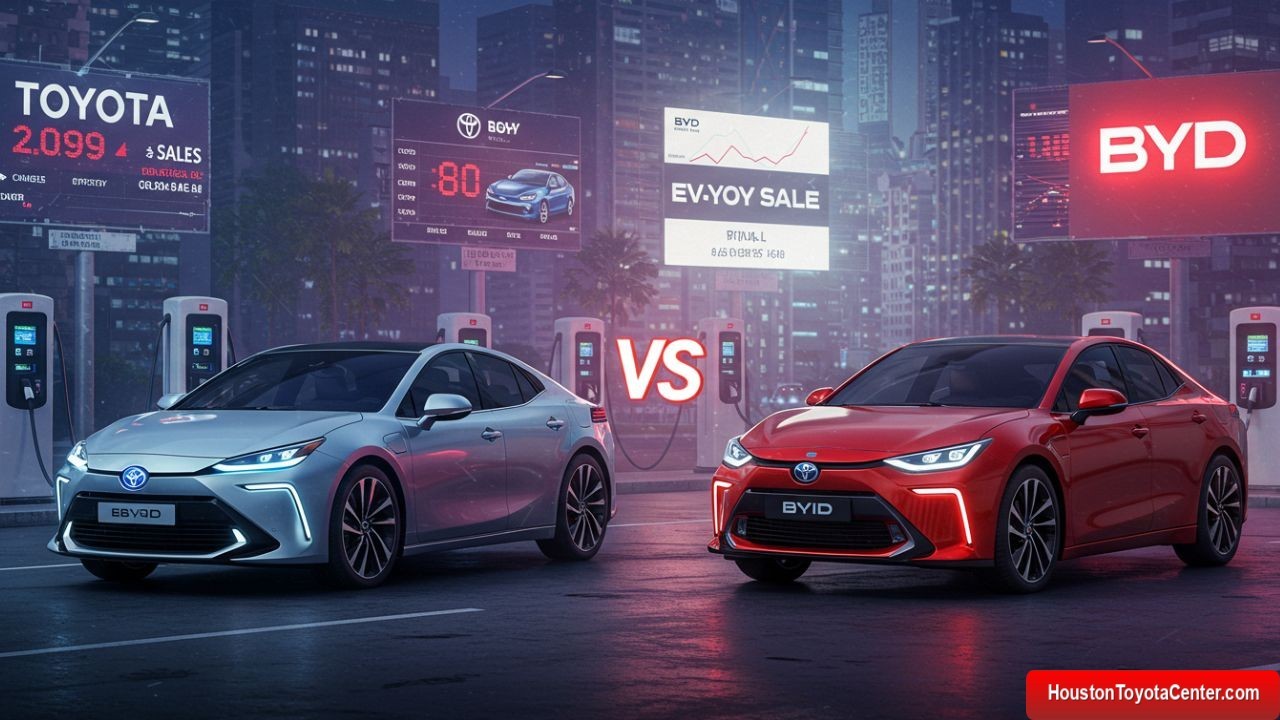
(SINGAPORE 2026.8.11) Toyota is trying to add speed to quality. Some Chinese cars, particularly BYD, are trying to add quality discipline to speed.
That may be the defining competition of the next decade in the global automobile industry, reported the Chinese and Japanese media.
BYD founder Wang Chuanfu (王传福) has given Toyota a five-year warning, reported Britian’s Guardian newspaper. In June, he told BYD shareholders that the Chinese automaker would become the world’s largest carmaker by scale within five years — a direct challenge to Toyota’s position.
BYD sold about 4.6 million vehicles in 2025, compared with about 11.3 million for Toyota. Yet BYD is betting that rapid advances in batteries and charging, combined with aggressive overseas expansion, can narrow the gap.
The declaration came as BYD expanded manufacturing and EV charging infrastructure in Europe and rapidly grew overseas sales. Stella Li (李柯), the executive overseeing BYD’s international expansion, later said the company believed it could overtake Toyota even without relying on the US market.
Toyota, meanwhile, is confronting an uncomfortable question: what happens when the company that spent decades teaching the world how to build cars reliably begins to believe that its greatest weakness is speed?
“I think we are losing to China.” That blunt assessment came from a Toyota development engineer in Inside Toyota, a documentary broadcast by Japan’s NHK on July 19.
The engineer was talking about time. Chinese automakers, he said, can take a vehicle from the drawing board to mass production in about two years. Toyota can still take five or even six. “By the time the car is finally built, the market has already changed.”
That captures Toyota’s strategic dilemma. It does not simply need to build better cars. It needs to shorten the distance between recognising what consumers want and putting that product in their hands — without destroying the quality-control system that made Toyota one of the world’s most successful manufacturers.
The drawing that stopped at the factory gate
The NHK documentary offers an unusually intimate look at Toyota’s effort to change. Cameras were allowed into a Toyota R&D facility designated by the company as “top secret”, where they filmed creation of the next-generation Corolla.
The Corolla is one of the world’s best-known automotive nameplates, with cumulative sales of more than 57 million units. The next generation is being developed around a platform designed to accommodate internal-combustion engines, hybrids and battery-electric powertrains.
Yet its development process looks different from Toyota of old. Rather than designing the chassis first and the body afterwards, engineers are working on the two simultaneously.
Before the chassis was fully locked in, engineers were already testing body configurations. They even cut sections from a Prius engineering prototype and welded them onto the new Corolla architecture, creating a cobbled-together “Frankenstein” prototype that could be taken to a test track.
The objective was simple: get feedback early. Do not wait for final tooling. Do not wait for every engineering decision to be signed off. Do not wait until the entire vehicle is finished before discovering that something does not work.
This is essentially concurrent engineering, an approach widely used by Chinese automakers.
When the development team tried to hand the platform drawings to the factory so tooling could begin, the manufacturing department refused to accept them. The front chassis rail had not been finalised. The spacing of weld points was still under discussion. The details matter.
The rail is part of the vehicle’s crash structure, and changes in geometry or weld placement can affect crash performance. Once expensive dies have been manufactured, changing them can mean substantial additional costs.
The development team wanted speed. The factory wanted certainty. The drawings stopped at the gate. That confrontation is a perfect metaphor for Toyota’s dilemma.
For decades, Toyota’s competitive edge rested on the belief that tedious processes existed for a reason. Verification was not an inconvenience; it was a barrier against mistakes. But the automobile landscape has changed.
A modern vehicle is now a software platform and a continuously evolving electronic system. Waiting for every component and function to be perfected before testing the complete vehicle can mean losing years in a market where competitors are already iterating.
Toyota has therefore begun studying competitors it once regarded as just production rivals. Its engineers dismantled vehicles including the Zeekr 007 and BYD Qin L to understand how Chinese manufacturers achieve such short development cycles. What they discovered went far beyond the use of cheaper components.
Some Chinese vehicles had moved toward centralised computing and zonal electronic architectures, reducing the number of electronic control units from more than 100 to just over 20. Hardware and software could be separated more effectively, allowing software functions to be modified without redesigning the entire electronic architecture.
That matters because software can move much faster than metal. A physical component requires tooling, suppliers and validation. Software can be updated overnight.
Chinese automakers have also made greater use of virtual simulation, cloud-based testing and digital twins to shift portions of testing away from physical models. The reality is not simply about “working harder”. It is a different industrial system.
Toyota’s traditional process is relatively sequential: one department finishes, another takes over, and decisions pass through layers of authority.
The newer Chinese system is more parallel and decentralised. Engineering, software and suppliers can operate inside tighter development loops, allowing changes to move from design to testing and production faster.
That is how shortening the timeline to two years becomes possible. And that is precisely what worries Toyota.
China discovers the danger of speed
Yet the Chinese way has its own problem, reported the Chinese automotive industry media outlet known as Auto Commune (汽车公社).
The same system that makes rapid refinement possible can also make it easier to push a product into the market before every long-term problem has been identified. Chinese regulators are clearly acknowledging this risk.
In January, China’s Ministry of Industry and Information Technology revised requirements for road-vehicle manufacturers and products, strengthening reliability-testing standards and incorporating durability, safety and new-technology verification more explicitly into the vehicle market-entry framework. The revised requirements are scheduled to take effect from January 2027.
In May, the ministry announced nationwide production-consistency inspections. Inspectors can visit factories and dealerships, randomly select vehicles and key components, seal the samples and send them for testing. Manufacturers are prohibited from using software updates to alter vehicle specifications after samples have been finalized.
In July, the ministry again told major automakers to strengthen product verification, quality and endurance checks, safety assessments, and new-technology evaluation. It also called for tighter manufacturing consistency oversight and warned against exaggerated or false claims.
The significance goes beyond regulation. China’s automotive industry is no longer a fledgling sector that simply needs to produce more cars. It is now large enough that the next challenge has shifted to controlling the consequences of speed.
The objective is not necessarily to make Chinese automakers slower. It is to ensure that companies capable of moving quickly can also prove that their products are safe and dependable.
If a company cuts development time through simulation, digital engineering, software-defined architectures and an integrated supply chain, that is genuine productivity.
If it does so by removing tests or prematurely releasing unfinished products, it is simply deferred failure. China’s regulators are taking greater steps to ensure that the two are not confused.
Two industrial models converge
For decades, the conventional wisdom was well-established. Toyota represented manufacturing discipline. Chinese automakers represented low cost and, later, speed, the Auto Commune pointed out.
Now both sides are trying to acquire what the other has. Toyota is studying Chinese vehicles to accelerate development and giving engineers and suppliers greater decision-making authority.
In the NHK documentary, Toyota’s chairman Akio Toyoda (豊田章男) said there was a “very strong sense of crisis” inside the company. In an earlier interview in Britain, he described watching the industry move toward electrification as making him feel “very lonely”.
The anxiety is understandable. Toyota has been the world’s top-selling automaker since 2020, and its strength has historically rested on scale, process discipline, global coordination, and a deeply embedded culture of verification.
But the market is becoming less forgiving of long development cycles. That changes the meaning of quality. Reliability still matters. But so does the ability to evolve. This is why BYD’s challenge to Toyota is bigger than a contest over sales volume.
The real race is marrying speed and quality
The apparent contradiction between Toyota and China is revealing. Toyota’s problem is that quality control can become bureaucracy. China’s problem is that speed can become recklessness.
Both are trying to solve the same question: how do you compress the development cycle without compressing away the things that keep a vehicle safe and reliable?
China is trying to make its speed more trustworthy. Toyota is trying to make its quality faster. The winner of the next phase of the automotive race may not be the company that is fastest or the company that is most conservative. It will be the company that can do both, concluded Auto Commune.
One side is tearing down walls. The other is building guardrails. Both are moving toward the same destination. In the future automobile industry, it will no longer be enough to launch before your rival. You will have to launch before your rival — and still have a car that lasts.