





















(Singapore,26.08.2026)South Korea’s Hyundai Motor Group is looking to China’s auto industry for ideas — and some of those ideas are now showing up in Korean cars, according to Chinese and Korean media.
The influence is visible in everything from swivelling seats and lounge-style interiors to giant screens, high-performance cockpit chips, and China-tailored software. More importantly, Hyundai Motor Group’s three brands — Hyundai, Kia, and Genesis — are treating China not merely as a market to win back, but as a place to learn how cars should be developed for a rapidly changing global market, reported Yuanmeihui (源媒汇).
The irony is hard to miss, remarked the Chinese automotive industry-focused social-media publication. For years, Hyundai and Kia were among the foreign brands setting the pace in China. Now, as Chinese automakers have raised the bar on digital cockpits, interior features, and electric-vehicle technology, the Korean group is borrowing from the Chinese playbook.
The trend was strikingly illustrated on Aug 21, when Hyundai Motor’s official account on a major overseas social-media platform posted an AI-generated reinterpretation of the viral Chinese film Bull Coming (牛来). The unusual marketing move showed how closely the Korean automaker is watching Chinese internet culture and consumer trends.
The Chinese ideas are reflected in its vehicles.
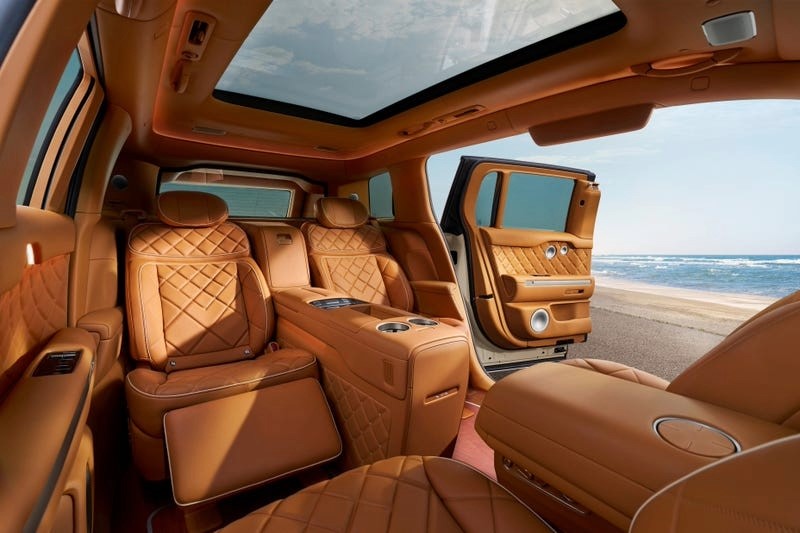
Genesis, Hyundai Motor Group’s luxury brand, unveiled its flagship all-electric GV90 and GV90 Neolun on Aug 19. Among the standout features is a pair of electrically powered front seats that can rotate 180 degrees when the vehicle is parked, allowing occupants to face one another and transforming the interior into a lounge.
Genesis presents the feature as part of its broader vision of “luxury mobility”. But the concept itself is already familiar to Chinese consumers. Rotating seats, lounge-style configurations and interiors designed to turn a car into a private living space are already commonplace among Chinese EV makers, especially in the premium segment.
Chinese brands including Zeekr (极氪) and Li Auto (理想汽车) have pushed such features into the mainstream, while Xiaomi (小米) has taken a more comprehensive approach, integrating its cars with the company’s smartphone, tablet, and smart-home ecosystem to turn the interior into a multifunctional digital living and entertainment space.
Genesis is in fact tapping into a broader trend that has characterised Chinese automakers. Its GV90 demonstrates a wider convergence in what automakers now regard as desirable automotive technology: less emphasis on the car merely being a machine for driving, and more on the interior functioning as a digital and physical living space.
Genesis itself describes the GV90 as a combination of technology, connectivity and hospitality. Its official announcement highlights features including a pop-up OLED display, AI-powered software, and the lounge-style interior.
China is becoming a development laboratory
The bigger story, however, is happening at Hyundai and Kia.
Hyundai has spent years trying to rebuild its position in China after losing substantial market share to Chinese manufacturers. Yet the company also sees China as valuable for reasons beyond sales.
At the Beijing auto show in April, Hyundai unveiled the Ioniq V, the first production model under its all-electric Ioniq brand specifically tailored to the Chinese market, reported Yonhap news agency. The model is based on a platform jointly developed with Beijing Automotive Group (北京汽车集团) and uses a battery system crafted with Chinese battery giant CATL (宁德时代). Hyundai also said it would expand cooperation with Chinese autonomous-driving company Momenta (魔门塔).
Hyundai plans to launch 20 new models in China over the next five years and is targeting annual sales of 500,000 vehicles in the country by 2030. The company has also said its China-developed vehicles could eventually be exported to other markets.
Hyundai CEO Jose Muñoz offered a telling explanation for the strategy in April: China has some of the world’s most demanding EV consumers, the fastest product-development cycles, the deepest battery supply chain, and an advanced innovation ecosystem.
That represents a significant shift in the mindset of global automakers.
China was once primarily a huge market where foreign automakers could sell vehicles developed for global markets. Now it is becoming a place where global automakers develop products precisely because Chinese consumers demand rapid technological upgrades.
Kia’s latest Seltos offers an even clearer emulation.
The new Seltos, which began presales in China on Aug 13, has been extensively adapted for Chinese consumers. All versions come with a 27-inch wide display and Qualcomm’s Snapdragon 8295P SoC for the digital cockpit, along with software and user-interface features adapted to local consumer preferences.
The starting presale price was 80,900 yuan (about S$15,304).
Kia said the new model was developed under its “In China, For China” approach, drawing on local research on Chinese users to help refine its digital-cockpit system. Xinhua News Agency also highlighted features such as AI-powered interaction, multi-zone voice recognition, and integration with major smartphone ecosystems.
The hardware itself illustrates how dramatically expectations have changed. A 8295P chip — originally associated with much more expensive vehicles — is being offered in an affordable SUV, while the 27-inch screen makes the dashboard feel more like a consumer-electronics product.
This is precisely the type of specification pressure generated by China’s EV market, where automakers compete not only on battery range or horsepower but also on computing power, screens, voice assistants, entertainment, and software.
From “made in China” to “developed in China”
The implications extend beyond the Chinese market.
Kia’s Yancheng (盐城) plant already serves as both a production base for the Chinese market and an export hub. Kia China said Dongfeng Yueda Kia (东风悦达起亚) sold 253,964 vehicles in 2025, up 2.3 per cent from a year earlier, marking a second consecutive year of growth. The company also said cumulative exports since it began shipping out complete vehicles in 2018 had reached 537,000 units across 89 countries and regions.
That means China is becoming more than a low-cost manufacturing base for the Korean group. It is becoming part of the group’s product-development process.
Hyundai’s Elexio provides another example. The electric SUV was rolled out by Beijing Hyundai for the Chinese market and incorporates locally developed technologies. Hyundai says the model combines its E-GMP platform with localized Chinese designs and is being developed under an “In China, For China, To Global” strategy. The vehicle uses an 88.1-kWh battery, a Snapdragon 8295 SoC digital cockpit, and offers up to 722 km of China CLTC range.
The Elexio subsequently entered the Australian market, making a China-developed Hyundai EV available outside China. China is thus becoming part of Hyundai’s global product pipeline, where models can be developed quickly, tailored to local consumers, and then considered for markets beyond China.
That reverses the traditional direction of technology transfer.
For decades, foreign automakers typically developed vehicles in Japan, Europe, South Korea or the United States and then modified them for China. Now, China is where vehicles themselves are being created— and some of those are then exported.
The most uncomfortable part for Hyundai and Kia is that competition from Chinese automakers is no longer limited to China.
Chinese-made EVs are now establishing a foothold in South Korea itself.
According to the Korea Automobile and Mobility Association, 69,513 China-made EVs were registered in South Korea in the first half of 2026, up 178.7 per cent from a year earlier. Their share of total new EV registrations in the country rose from 26.8 per cent to 35 per cent.
Another industry estimate put the share even higher when China-made Teslas and other China-produced EVs from brands such as Volvo, Polestar, and MINI are included, Yonhap reported. Tesla and BYD alone accounted for 67,814 of South Korea’s 172,053 electric passenger-car sales in the first half of the year, while about 97 per cent of imported Teslas are understood to be produced in China.
The distinction matters: “China-made” does not mean “Chinese brand”. But from the perspective of Korean consumers, it nevertheless means that vehicles manufactured in China are increasingly competing directly in the domestic market.
And Chinese brands are becoming prominent.
BYD has expanded its South Korean operations, while other manufacturers including Zeekr and XPeng (小鹏) are preparing to deepen their presence. This puts Hyundai and Kia in an unusual position: they must learn from the Chinese market while defending their home market against companies that emerged from that same market.
A reversal of automotive influence
Hyundai and Kia have not suddenly become Chinese automakers, nor does every feature appearing on a Korean vehicle originate in China. Swivelling seats, large displays, and advanced driver-assistance systems existed elsewhere before Chinese manufacturers picked them up.
But China has been unusually effective at combining these technologies into a new product philosophy — one that treats the automobile as a mobile digital space rather than simply a transportation device.
The Korean automakers are responding accordingly. At the same time, Chinese-made EVs are entering South Korea in growing numbers.
The result is a stunning reversal in the relationship between the two automotive industries. Korean companies once went to China primarily to sell their cars. Now they are also going there to see what the next generation of cars should look like.
The rotating seats of the Genesis GV90 may therefore be more than a luxury gimmick. They are a small but unmistakable sign of a much larger shift: China’s auto industry is becoming a reference point for Korean automakers, not just a rival.