




















(Singapore, 06.10.2026)Singapore has sent locally developed next-generation solar cells and artificial intelligence technology into orbit, as researchers look to test whether the technologies can withstand the harsh conditions of space and eventually support more capable satellites.
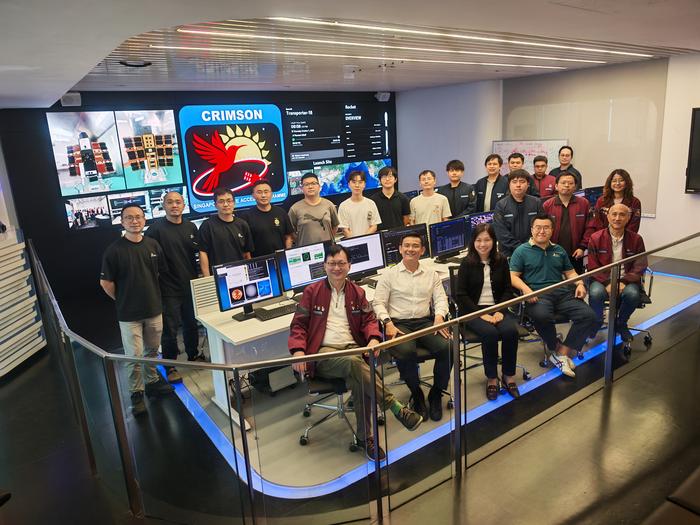
The technologies are being carried aboard CRIMSON-1, the 14th satellite launched by Nanyang Technological University, Singapore. The satellite was launched on 1 October aboard a SpaceX Falcon 9 rocket from Vandenberg Space Force Base in California as part of the Transporter-18 rideshare mission.
According to NTU, the mission will test lightweight perovskite solar cells developed in Singapore and an edge AI computing system capable of processing satellite images directly in orbit.
The experiments could provide researchers with valuable real-world data on two technologies that may become increasingly important as satellites take on more complex tasks and demand more computing power.
CRIMSON-1 is also among the first projects supported by the National Space Agency of Singapore under the Space Access Programme, part of the country’s wider Space Technology Development Programme.
Singapore has set aside S$210 million for the programme since 2022 to support research and development in space technologies and strengthen national capabilities.
Putting next-generation solar technology to the test
One of the main experiments aboard CRIMSON-1 involves perovskite solar cells, a new generation of photovoltaic technology that can potentially produce electricity using much thinner and lighter materials than conventional solar panels.
Weight is particularly important in the space industry because every additional kilogram sent into orbit adds to launch requirements and costs. Lightweight solar technology could therefore offer advantages for future satellites and other spacecraft if it can generate power reliably over long periods.
The cells carried by CRIMSON-1 were developed by NTU researchers and Singfilm Solar, a deep-tech spin-off from the National University of Singapore (NUS).
NTU has been conducting research into perovskite solar cells for more than a decade. Its scientists have worked on improving the technology’s efficiency, stability and scalability, including developing larger modules that could eventually be suitable for commercial applications.
Performance in a laboratory, however, does not necessarily mean that a technology is ready for space.
Solar cells used on spacecraft must first survive the vibration and physical stresses of a rocket launch before operating in an environment that exposes equipment to extreme temperature changes, radiation and other demanding conditions.
CRIMSON-1 will allow researchers to examine the physical durability and efficiency of the perovskite cells after launch and measure how much electricity they can produce while travelling in Low Earth Orbit.
The mission is also the first time Singfilm Solar’s technology has been sent into space.
NUS Assistant Professor Hou Yi, founder of Singfilm Solar, said the mission involves a flexible perovskite solar module built on ultrathin glass and represents the first deployment of a Singapore-made solar module in orbit.
Data collected from the experiment could help researchers further develop lightweight solar power systems for future satellites and potentially explore their use in more energy-intensive space infrastructure, including space-based AI data centres.
National Space Agency of Singapore Chief Executive Ngiam Le Na said the thin and lightweight nature of perovskite solar cells could give them an advantage over conventional solar panels in space applications, where reducing weight is especially valuable.
She added that missions such as CRIMSON-1 give Singapore-developed technologies an opportunity to establish “flight heritage” — evidence that a system has successfully operated in space — which can be important before technologies are adopted commercially.
Bringing AI processing aboard satellites
CRIMSON-1 is not only testing how satellites generate electricity. Researchers are also examining whether more of the data collected in space can be processed before it reaches Earth.
Satellites can generate large volumes of images and other information, but transmitting all of that raw data to ground stations requires time and limited communications bandwidth.
Edge AI computing could change that by allowing a satellite to analyse information on board and determine what is useful before sending selected data back to Earth.
During the CRIMSON-1 mission, AI-based image-processing tasks will be carried out directly in orbit. Researchers will monitor the computing system to determine how it handles issues such as heat and electricity consumption when operating under heavier workloads.
If the approach proves effective, future satellites could potentially identify important information more quickly while reducing the amount of unnecessary raw data transmitted through satellite communication links.
Such capabilities could become increasingly useful as satellite imagery is applied to areas including disaster response, environmental monitoring and climate research.
NTU’s Earth Observatory of Singapore, for example, already uses satellite data for applications ranging from rapid mapping of earthquakes and floods to monitoring climate change and land subsidence.
NTU is also studying how AI can be used on the ground to manage satellite operations. Earlier in 2026, the university announced a collaboration with Japanese technology company Fusic Co., Ltd. to explore AI-enabled systems for tasks including mission scheduling, allocating ground stations, managing routine operations and detecting technical problems earlier.
The two areas of research could eventually work together, with AI helping spacecraft process information autonomously in orbit while separate systems assist human teams managing increasingly complex satellite networks from Earth.
CRIMSON-1 builds on three decades of satellite research at NTU’s Satellite Research Centre. Since X-SAT, Singapore’s first locally built satellite, was launched in 2011, the university has developed spacecraft ranging from small CubeSats to larger satellites.
Its previous satellite, VELOX-AM, was launched in July 2023 and completed its mission before deorbiting in August 2026.
NTU Deputy President and Provost Professor Christian Wolfrum said CRIMSON-1 brings together the university’s research in satellite engineering, advanced materials and artificial intelligence, while collaboration with local industry partners allows each mission to contribute to the development of Singapore’s wider space sector.
For CRIMSON-1, the immediate goal is more practical: find out how technologies developed on the ground perform once they leave it. The results could help determine whether lightweight perovskite solar cells and onboard AI processing can move beyond experimental missions and play a larger role in the next generation of satellites.