


























(Singapore, 24.09.2026)As Asia enters a major period of wealth transfer, two forces are converging: Southeast Asia’s multigenerational family wealth and a newer wave of Chinese entrepreneurial wealth expanding across the region.
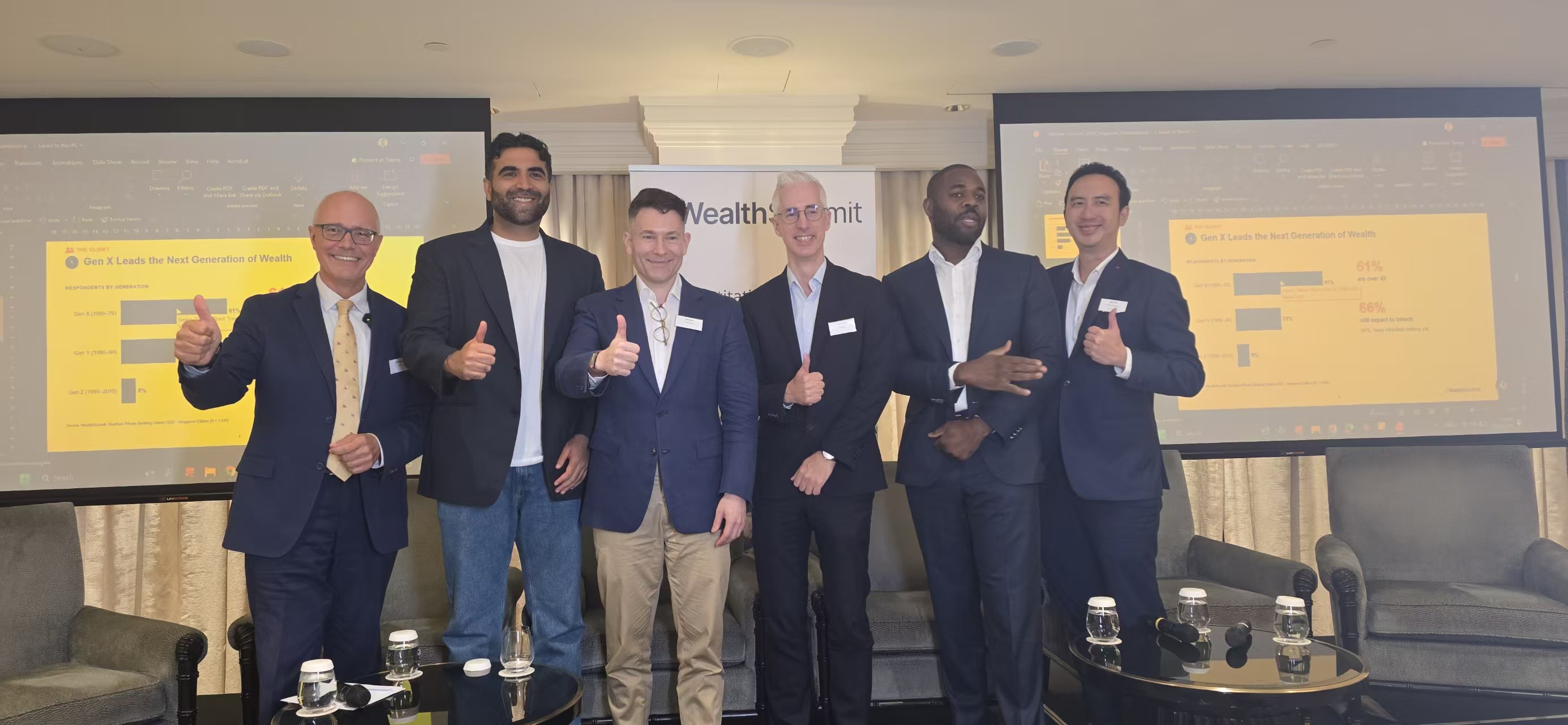
At the NextGen Private Banking Summit held in Singapore on 24 September, organised by Swiss wealth management research and strategy platform WealthSummit, Chairman Claude Baumann moderated discussions, while Founder and CEO Christoph Künzle presented the latest study, NextGen Private Banking Clients 2026 – Singapore Edition.
The study surveyed 1,049 NextGen private banking clients in Singapore and Southeast Asia, supported by nine in-depth interviews. Its central message is clear: the next generation may inherit wealth, but it does not necessarily inherit the same banking relationships.
Intergenerational Wealth Transfer Is Rebuilding Banking Relationships
The study found that 71% of respondents already bank somewhere other than their parents, while 68% maintain relationships with three or more banks. When seeking financial advice, 40% rely on relationship managers, 37% on independent asset managers and 25% on family offices.
This represents a fundamental shift for private banking. Serving one generation well no longer guarantees the loyalty of the next. Instead of leaving traditional banks altogether, NextGen clients are spreading their assets across multiple institutions — what the report describes as “dilution, not attrition.”
The challenge for banks is therefore not simply to retain today’s wealth, but to establish trust with the next generation before that wealth changes hands.
Old Money Thinks Across Generations; New Money Across Borders
During the panel discussion, Fortune Times raised a question particularly relevant to Asia: How do Southeast Asia’s established “old money” families and the new wave of Chinese entrepreneurial wealth differ in the way they approach wealth preservation, succession and globalisation?
The distinction is not simply between conservative and adventurous investors.
For multigenerational Southeast Asian families, the central challenge is often time — preserving wealth through economic cycles and passing it successfully from one generation to another.
For many first-generation Chinese entrepreneurs going global, the immediate challenge is more often space — how to diversify wealth across countries, currencies and asset classes as businesses and families become increasingly international.
Panelists observed that this changes again when wealth reaches the second generation. Younger heirs may move beyond the industries and investments familiar to their parents, pushing family offices towards technology, venture capital, digital assets and other areas reflecting their own interests.
Mark Wong, Head of Trading at Independent Reserve Group, also highlighted wealth preservation, liquidity and cross-border diversification as important considerations among Chinese wealth holders.
Yet NextGen investors are not simply chasing what is new. While 70% expect access to private markets and 51% to club deals, 82% still regard political and legal stability as a decisive factor when choosing a financial centre; only 7% cite innovation.
Technology Changes, Trust Remains
AI is also reshaping private banking, but its limits are becoming clearer. NextGen clients are increasingly comfortable allowing technology to handle routine banking, while remaining far more cautious about delegating long-term financial planning.
This points to a broader change in wealth management: technology can improve speed and access, but major wealth decisions still depend on judgement and trust.
Southeast Asia’s old money and China’s new money may begin from different places, but their paths are converging. Both increasingly need to manage wealth across borders and across generations.
For private banks, that changes the question. It is no longer simply who manages the family’s wealth today, but who the next generation will trust to manage it tomorrow.