

























(SINGAPORE 2026.10.27)A chilli sauce that has become a staple in Chinese kitchens, found its way into supermarkets across the United States and Europe, and won fans in Singapore has become the unlikely focus of a debate over artificial intelligence (AI) and jobs in China.
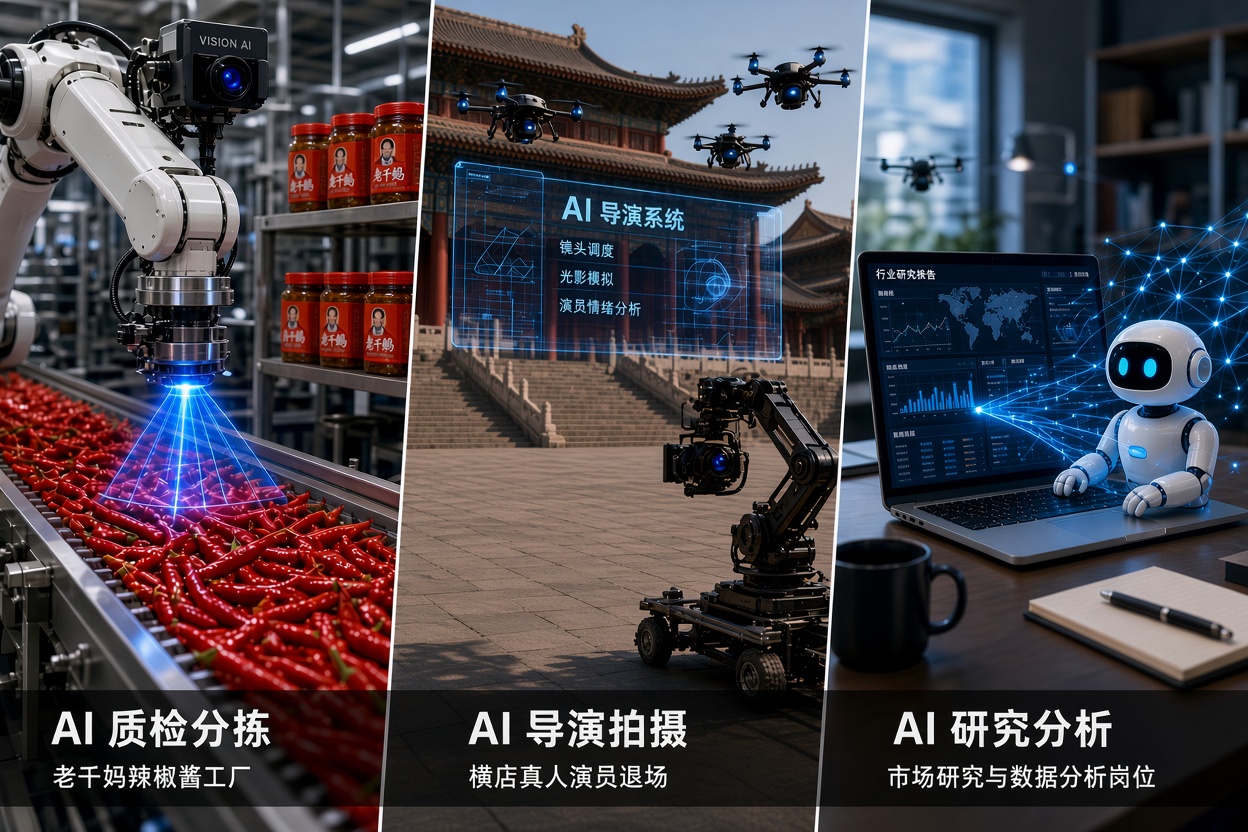
Online claims that Guizhou-based Lao Gan Ma (老干妈) had reduced its number of workers sorting chillies from more than 600 to just 48 after introducing AI-powered inspection triggered calls for a boycott of the brand across China. The company’s human resources department denied the alleged mass job cuts yesterday, although it has introduced AI visual inspection into its production process.
The controversy has struck a nerve partly because Lao Gan Ma is not a struggling business desperate to cut costs. It reported revenue of 5.39 billion yuan (about S$1.04 billion) in 2024, its third consecutive year of growth. Its adoption of AI has raised a more pointed question: when a successful company can produce more efficiently with fewer workers, what happens to those whose jobs are no longer needed?
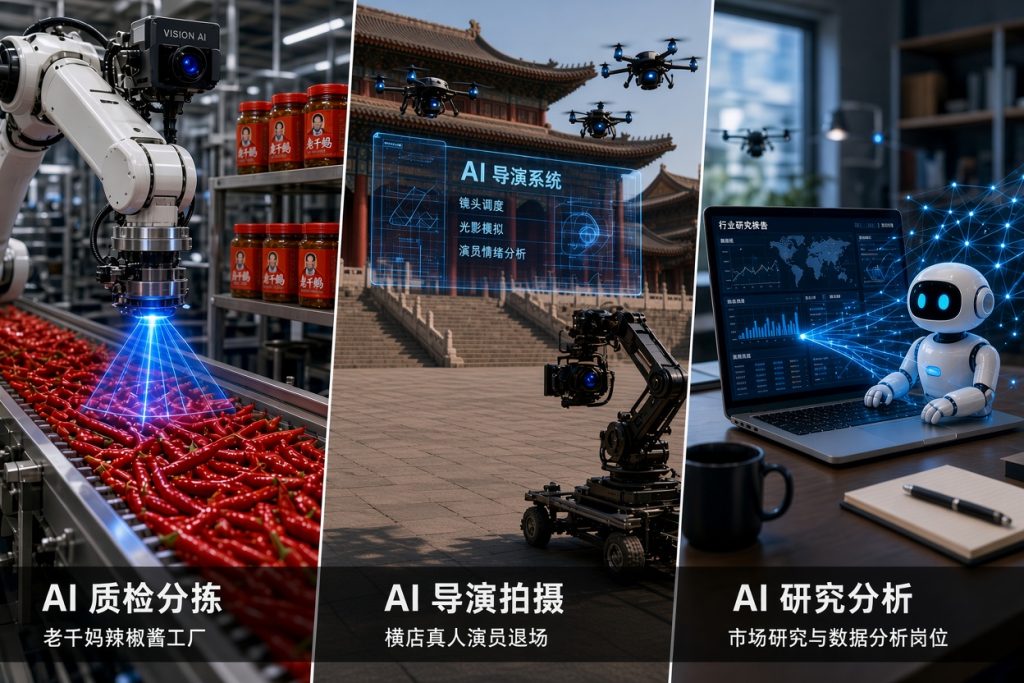
Similar pressures are emerging in China’s entertainment industry and white-collar workplaces. Actors are losing bookings to AI-generated dramas, while corporate research analysts have been told by their offices that AI has reduced the number of people they need.
Lao Gan Ma: A household name turns to AI
Lao Gan Ma, whose name means “Old Godmother”, owes its reputation to Tao Huabi (陶华碧), now 79, who built the business around a chilli sauce developed when she ran a small eatery in Guiyang (贵阳), the capital of Guizhou province.
The company grew into one of China’s best-known condiment makers. Its chilli oil and fermented bean curd are familiar fixtures in Chinese households, prized for their distinctive spicy and savoury flavour. Tao herself has become part of the brand’s identity: her stern expression appears on its logo, and the company has cultivated a reputation for sticking to its core products rather than chasing every marketing trend.
Lao Gan Ma has also found customers overseas. Its products are sold in more than 160 countries and regions, including Singapore and the US, where the sauce is stocked by Asian grocery stores and mainstream retailers. Its international following extends beyond Chinese consumers, with social media users sharing recipes that incorporate the condiment into everything from noodles to unconventional dishes.
According to China Daily, Lao Gan Ma’s revenue edged up from 5.38 billion yuan in 2023 to 5.39 billion yuan in 2024. Its overseas revenue grew 30 per cent in 2023. The company produces about three million bottles daily.
Its history shows why quality control matters. After sales declined in 2017 and 2018, in-house reports attributed the fall to changes in chilli sourcing that affected the sauce’s taste. Tao, who had then passed the baton to her son, returned to a more active management role, and the company restored its original sourcing approach.
AI-powered visual inspection is intended to help maintain quality as production scales up. Industrial cameras identify defects such as mould and black spots, while automated equipment removes affected chillies. Company executives have said that the defect rate at key production stages fell to 0.02 per cent after the system was introduced.
But the employment figures circulating online are harder to establish.
The company denied cutting staff on the scale claimed. Public records show that the number of employees covered by social insurance at Guiyang Nanming Lao Gan Ma Flavour Food Co fell from 2,912 in 2022 to 740 in 2025. This covers the company’s workforce as a whole, not just chilli-sorting workers, and does not prove that AI caused the decline.
Nevertheless, some Chinese social media users have called for a boycott, contending that consumers should not reward companies for replacing workers with machines. One media report, citing third-party e-commerce data, said daily sales on a particular platform fell as a result from a typical 5,000–10,000 yuan range to 1,000–5,000 yuan since Oct 22.
The dispute highlights a gap between what companies can measure — inspection accuracy, production speed and costs — and what may be less visible: how existing employees are affected. A commentary today in the Shanghai-based The Paper (澎湃新闻)asserted that businesses promoting AI-driven efficiency should explain how workers are affected, rather than publicise productivity gains alone.
Hengdian: AI threatens the people behind the camera, too
In Hengdian (横店), Zhejiang province, the consequences are more visible. The sprawling film and television production studio, where historical palaces and ancient streets double as film sets, provides livelihood for actors, casting staff, cinematographers, make-up artists, lighting technicians and production assistants, as well as restaurants and accommodation providers that depend on serving the filming crews.
The boom in vertical short dramas (竖屏短剧)in China created work for performers who might otherwise have to struggle to secure roles in conventional television productions. But AI-generated dramas can now be made without assembling a full cast and crew or building physical sets.
A report by news platform Toutiao (头条新闻)this month cited a Hengdian actor named Wu Weibin (吴维斌), who is said to earn an average of about 30,000 yuan a month in the second half of 2025. At his busiest, he appeared in four productions a month
After the 2026 Chinese New Year, however, Wu went 40 days without a booking. Between February and June, he worked fewer than 25 days in total. He has begun exploring social media content creation as a source of income.
Chen Yuxi (陈雨汐), a short-drama actress who had worked for years in Hengdian, had seen her daily pay rise to 3,000 yuan by 2025. But after Chinese New Year in 2026, acting offers suddenly dried up as many production companies shifted to AI-generated dramas. “For the first time in my eight years in Hengdian, I feel afraid,” she told The Paper.
The pressure reaches beyond performers. Producer Shangguan Yunhao (上官云暤)saw a project scheduled to begin filming in April cancelled after the platform involved switched to accepting only AI-generated drama scripts. His girlfriend, who supervised live-action productions at the platform, previously oversaw three to four dramas a month. Shangguan subsequently opened a dumpling shop in Hengdian.
A separate case was reported by Singapore‘s CNA. Xu Peng (许鹏), a 30-year-old actor trained at China’s Central Academy of Drama (中央戏剧学院), had found success playing domineering chief executives in short dramas. After acting offers largely disappeared this year, he left Hengdian and returned to rural Shandong, where he began helping his grandfather sell vegetables at a local market.
Xu hopes to continue pursuing acting and plans to run an acting training programme. For now, however, he is earning a living in a very different setting.
A report by China Newsweek (中国新闻周刊) said Hengdian has more than 150,000 registered actors, of whom over 60% had been earning almost nothing since the 2026 Chinese New Year.
White-collar work: AI takes over research once done by analysts
The pressure is not confined to factories or entertainment. In September, Hong Kong’s South China Morning Post reported about Clare Zhang, a Beijing-based research analyst who said her employer, a corporate advisory firm, explicitly cited AI when dismissing her.
Her work involved examining company filings and public records to help clients assess technologies and competitors, including in preparation for planned stock listings. Reports could run to 500 pages.
AI tools could collect and organise information, analyse data and generate charts much faster. The company told Zhang that it no longer needed, or could afford, as many analysts. Two of her former colleagues were subsequently also laid off.
Zhang said her former boss was also struggling with a declining number of clients as companies increasingly used AI to conduct research in-house.
AI still makes mistakes, including inventing sources and generating unreliable findings, so human verification remains important. But that does not necessarily mean employers will retain the same number of staff. A task that once took a team several days may now require fewer people, even if a human is needed to check the result.
Reuters reported that a contractor at a large Chinese internet company said the employer had begun quietly dismissing contract workers after instructing staff to use AI tools, including the AI agent OpenClaw. The company had also started reducing graduate recruitment.
A contract worker, identified only as Liu, said people like her were asked to document their workflows so the AI agent could perform tasks previously handled by people. She feared that once those processes had been transferred to the system, the workers could be dismissed.
Her story does not depict how widespread the practice is. But it illustrates how AI can reduce labour demand without a dramatic announcement of mass layoffs: existing employees just automate parts of their work, contract workers are cut, and fewer new workers are recruited.
Research by the International Labour Organization on Chinese enterprises, published in September, offers a more qualified picture. It found that AI was improving productivity in repetitive and data-intensive tasks such as document processing, customer-query handling, résumé screening and data collection. Among the enterprises studied, the predominant pattern was the reorganisation of work around human-AI collaboration, rather than wholesale replacement.
The overall employment effect will depend on whether productivity gains generate enough new demand and jobs to offset the reduction in labour required for existing tasks. An employer may become more productive and profitable while employing fewer people in a particular department.
Beijing moves to address the employment risks
The Chinese government is beginning to address these tensions directly.
On Oct 16, the State Council General Office issued guidelines calling for an employment-friendly approach to AI development. The document urges companies and authorities to assess employment risks, exercise caution over the scope and pace of AI deployment in labour-intensive industries, and explore arrangements to support workers during the transition.
It also calls for advance notification to affected employees when companies introduce AI on a large scale, alongside support for redeployment and retraining. Other measures include vocational training, improved job-matching services and stronger employment-risk monitoring.