

























(SINGAPORE 2026.10.8) From disposable heat patches (暖宝宝) and cooling fever sheets (退热贴) to Salonpas (撒隆巴斯) pain-relief patches and Lipovitan energy drinks (力保健), products that generations of Japanese and other Asian, particularly Chinese, consumers grew up with are entering an unfamiliar era.
Over the past two years, Taisho Pharmaceutical (大正制药) and Hisamitsu Pharmaceutical (久光制药) have both gone private. Now it is Kobayashi Pharmaceutical’s (小林制药) turn.
Their products remain household names in Japan, but the conditions that once supported their success are no longer the same: Japan’s population is shrinking; the domestic market is saturated; drugstore and retail channels are consolidating, giving retailers greater bargaining power; consumers are moving to e-commerce; and raw material and labour costs are rising.
At the same time, investors are demanding that Japanese listed companies use their capital more efficiently. Japan’s Toyo Keizai (東洋経済) noted in an analysis piece that Japanese drugmakers are being squeezed by drug-price cuts and pressure from short-term investors.
Going private can give companies more room to cut costs, restructure and invest for the long term. The bigger question for Japan’s old-line drugmakers is whether the business model that made them successful can still generate growth.
Kobayashi Pharmaceutical is the most dramatic example so far.
On Sept 25, Kobayashi said it had received an initial, nonbinding offer from Nippon Investment Corporation (NSSK) and UK private-equity firm CVC Capital Partners to buy the company and take it off the stock market.
The company stressed that no decision had been made, while Bloomberg reported that any deal could be worth more than ¥500 billion (about S$4 billion) and involve members of the founding family.
If completed, the century-old company once dubbed a maker of “Japanese miracle medicines” by Chinese consumers would leave the Tokyo Stock Exchange.
But the real question is not whether one company should sell itself. It is why Japan’s “miracle medicine” era is reaching a turning point.
Fishing in a “small pond”
Founded in 1886, Kobayashi Pharmaceutical was originally the large-scale drugmaker it is today.
The company realised early that it would struggle to compete with major drugmakers in developing new medicines. Instead, it focused on niche markets that the giants had little interest in pursuing.
Dental floss picks, keratosis-removal creams, cooling fever sheets, disposable heat patches, eye drops, allergy medicines, shoe-cabinet deodorisers, refrigerator deodorisers — mundane products solving specific everyday problems.
Kobayashi summed up the strategy as “fishing for big fish in a small pond”: rather than compete in huge, crowded markets, it sought high market share and margins in smaller ones.
The strategy worked. In 2023, Kobayashi generated ¥173.4 billion in revenue and recorded its 26th consecutive year of net-profit growth. A recovery in inbound tourism also boosted sales in Japan.
This was the logic behind the “Japanese miracle medicine” phenomenon: products did not need to be the most advanced in the world. They needed to be useful, memorable and easy for consumers to pick up and buy.
But the 2024 red yeast rice supplement health crisis exposed how much the model depended on something less tangible: trust.
The supplement was promoted as a cholesterol-lowering aid but was later linked to kidney disease in some consumers. In March 2024, Kobayashi announced a recall of affected products. The company later withdrew from the red yeast business, while chairman Kazumasa Kobayashi (小林一雅) and president Akihiro Kobayashi (小林章浩), both members of the founding family, stepped down.
The Japan Pharmaceutical Association also reminded consumers to seek accurate information from pharmacists and pharmacies when dealing with health-related products.
For consumers, the hardest issue was the question: Can I still trust this brand?
At Kobayashi Pharmaceutical’s shareholders’ meeting in March this year, a shareholder who said he had taken one of the affected batches questioned the company’s treatment of victims. He said he had called customer service during its stated operating hours but received a recorded message saying enquiries were no longer being accepted.
The complaint may not represent all consumers, but it captures the central problem: products can be remade and advertising campaigns relaunched, but consumer trust cannot simply be bought back.
Kobayashi has acknowledged the challenge. Its latest medium-term management plan marks a break from its past growth model, with the next three years focused on rebuilding trust, strengthening quality, safety and corporate governance, and laying the groundwork for future growth.
The problem has therefore expanded from product quality to corporate governance.
Hong Kong-based activist investor Oasis Management has steadily increased its stake in Kobayashi since the red yeast scandal and now owns 14.41 per cent, making it a significant shareholder.
Oasis says the founding family continues to exert significant influence and that the company’s governance and quality-control reforms remain insufficient.
At this year’s shareholders’ meeting, after its proposals were rejected, Oasis representative Philip Meyer said the fund was “deeply concerned” about what it regarded as deteriorating corporate governance, including the return of founding-family member Akihiro Kobayashi to the board and the structure of board oversight.
The company is therefore facing three pressures at once: consumers demand safety, shareholders demand better governance, and the market demands growth.
All three require money.
This is why the preliminary NSSK-CVC proposal deserves attention.
For a company undergoing a rebuilding process, leaving the public market could reduce pressure to focus on quarterly earnings and share-price performance. It could give management more room to sell non-core businesses, cut product types, restructure the supply chain and invest in quality management.
But Kobayashi’s situation differs from a typical management buyout (MBO).
The privatisations of Taisho Pharmaceutical and Hisamitsu Pharmaceutical were relatively straightforward decisions by their founding families. Taisho completed an approximately ¥710 billion MBO in 2024. Hisamitsu was taken private this year through an MBO led by an asset-management company controlled by president Kazuhide Nakadomi (中富一荣), who comes from the founding family, and formally delisted on May 11.
Hisamitsu’s reasoning was clear: going private would reduce the pressure of short-term share-price movements and allow greater focus on overseas expansion, its over-the-counter business and e-commerce.
Taisho and Hisamitsu were essentially asking: “Is there still a need for us to be listed?”
What is really fading is not the “miracle medicine”
Japanese consumers have not stopped needing these products.
Salonpas is still Salonpas. Heat patches are still heat patches.
But the business environment surrounding them has changed.
In the past, Japan’s population was stable or growing, consumers tended to shop at brick-and-mortar drugstores, and brands could rely on decades of purchasing habits to maintain market share.
Today, the population is ageing, domestic demand has limited room to grow, retail channels are changing, e-commerce is reshaping shopping habits and costs are rising. At the same time, capital markets have become less patient.
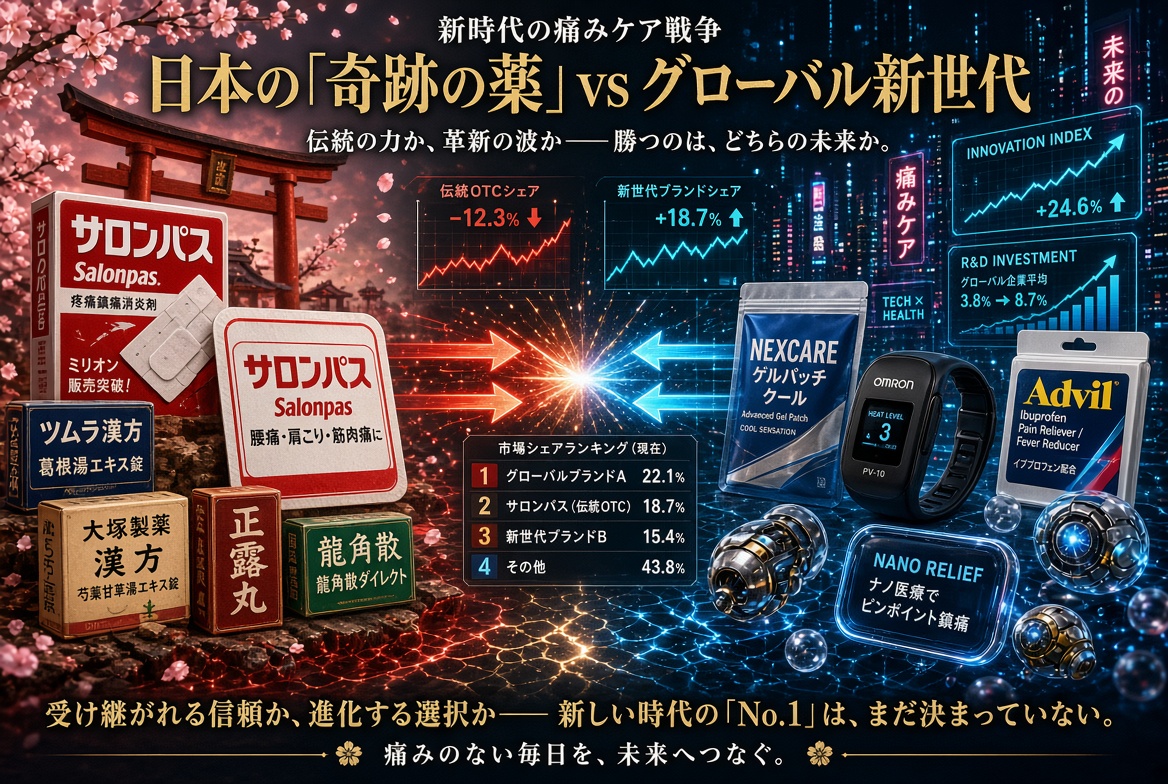
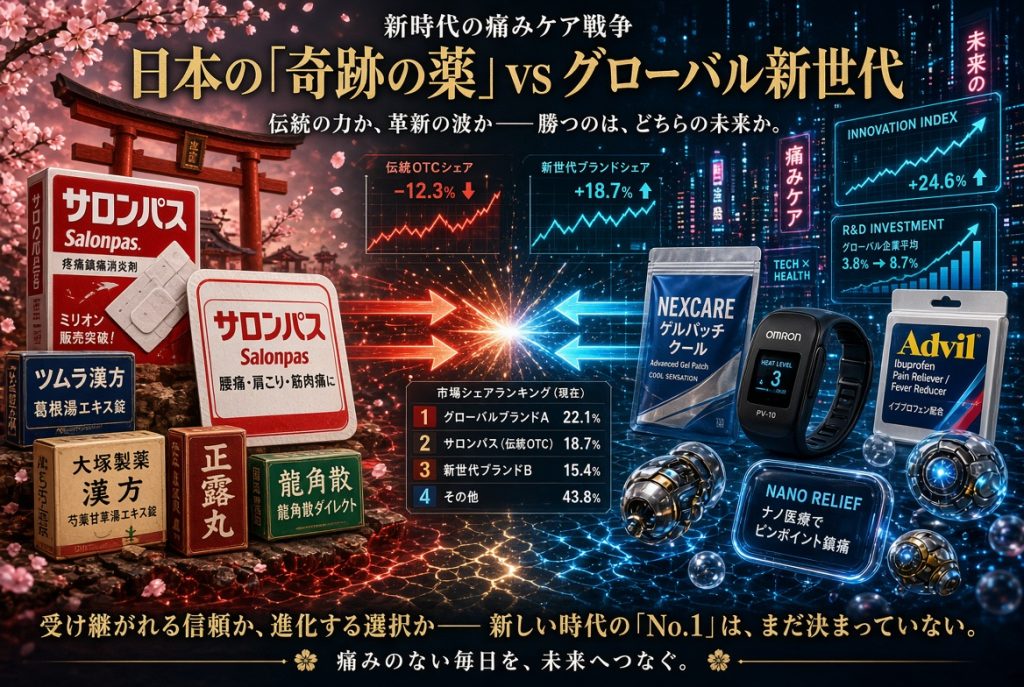
Traditional Japanese pain-relief brands such as Salonpas are facing competition from a new generation of OTC products, ranging from stronger NSAID-based patches and gels containing loxoprofen, diclofenac and felbinac to oral painkillers such as ibuprofen and newer lidocaine-based treatments. NSAID stands for nonsteroidal anti-inflammatory drugs.
Long-term family control, once seen as a source of stability, can now be viewed by investors as a governance risk. A handful of blockbuster products may still sell well, but companies must also reshape their portfolios, find overseas growth and improve returns on capital.
The common thread linking Taisho, Hisamitsu and Kobayashi is therefore not that their products can no longer sell.
It is that all three must answer the same question: what can a century-old Japanese consumer healthcare company rely on for growth over the next 100 years?