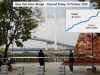
















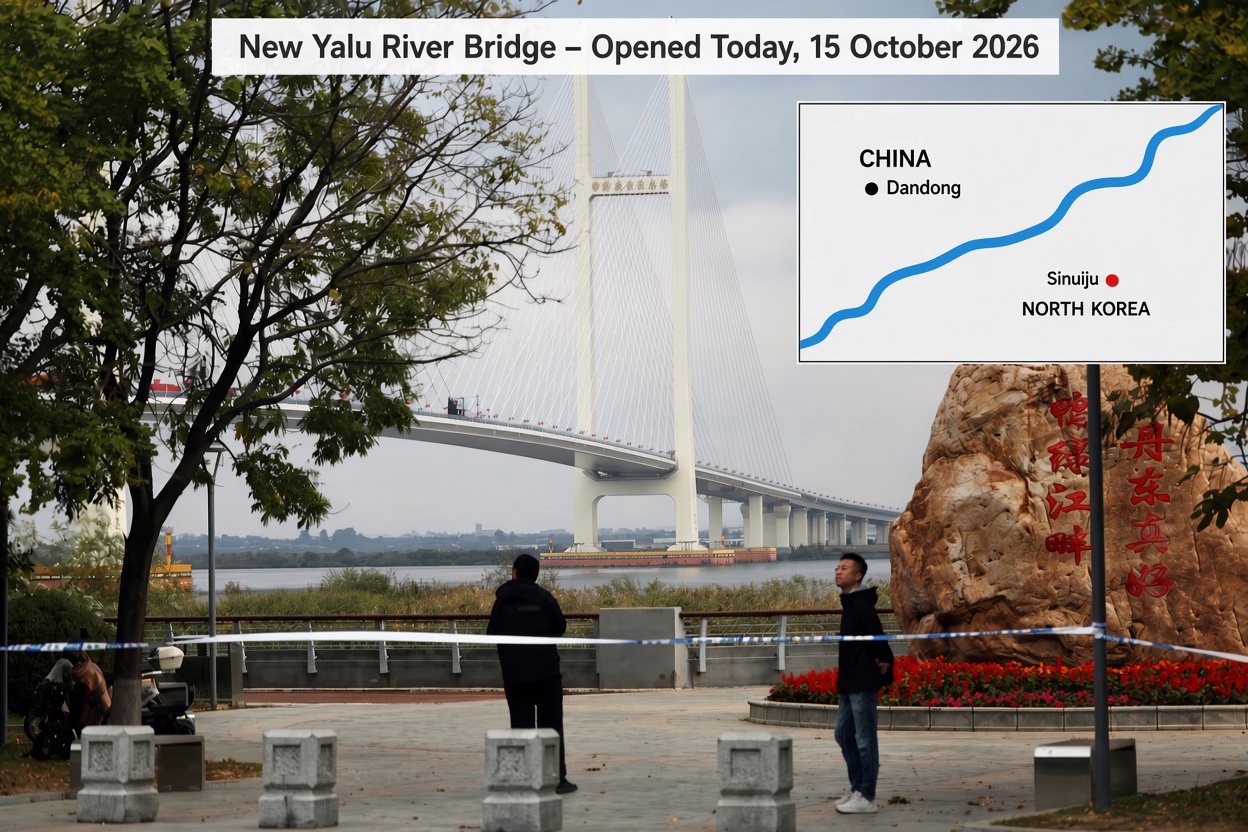
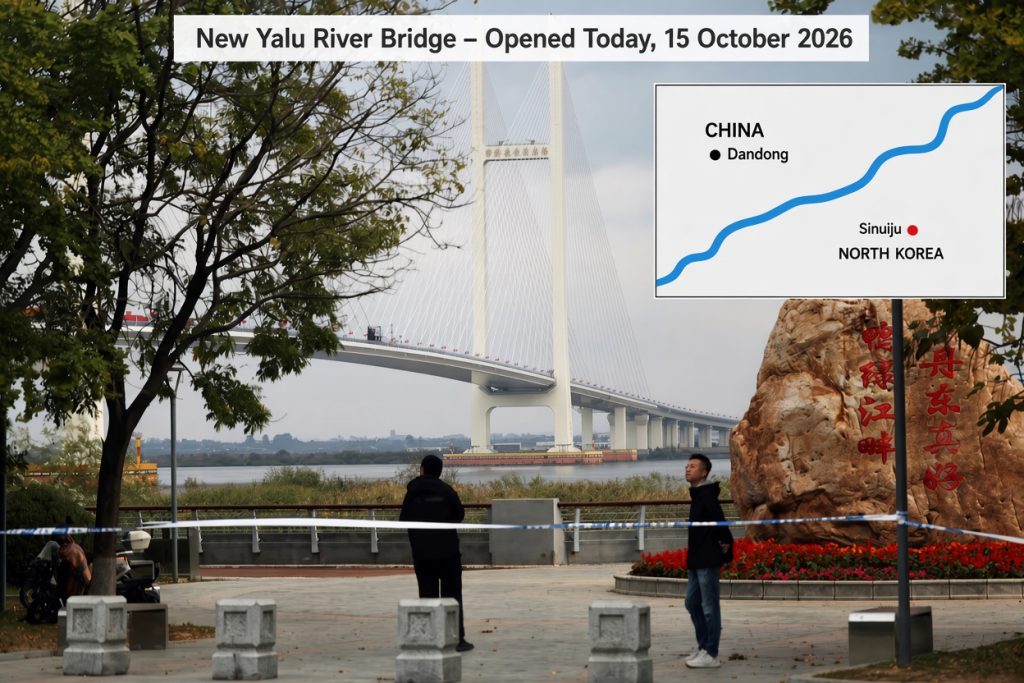
(Singapore, 2026.10.15) A new four-lane bridge linking China’s Dandong (丹东) with North Korea’s Sinuiju (新义州) across the Yalu River (鸭绿江) opened on Thursday, nearly 12 years after its completion.
The 3km crossing is expected to ease freight movement and revive trade, but its significance extends beyond transport: it reflects Pyongyang’s efforts to strengthen ties with Beijing and Moscow, expand domestic production and sustain its military build-up.
After nearly 16 years in power, North Korean leader Kim Jong Un is trying to turn a changing geopolitical environment into economic and strategic gains. Russia’s war against Ukraine has increased Pyongyang’s value to Moscow, while renewed engagement with China offers a route to trade and industrial supplies. However, this economic growth has yet to translate into greater purchasing power for ordinary North Koreans.
Diplomacy: Keeping both China and Russia close
Chinese Premier Li Qiang and North Korean Premier Pak Thae Song (朴泰成) delivered video addresses at the bridge’s opening, reported China’s Xinhua News Agency. Li described the crossing as a symbol of traditional friendship, while Chinese Foreign Ministry spokeswoman Mao Ning (毛宁) said earlier that it would promote trade and people-to-people exchanges.
South Korea’s Unification Ministry called the opening the first tangible step towards implementing agreements reached when Chinese President Xi Jinping met Kim in Pyongyang in June. The renewed engagement follows years of strained relations over North Korea’s nuclear programme and Beijing’s support for United Nations sanctions.
Pyongyang is also deepening ties with Moscow. Kim and Russian President Vladimir Putin signed a comprehensive strategic partnership treaty in June 2024, paving the way for expanded military cooperation. Russian Ambassador to North Korea Alexander Matsegora pledged to deepen bilateral cooperation at an event marking 78 years of diplomatic relations, South Korea’s Yonhap News Agency reported today.
The two relationships serve different purposes. China remains North Korea’s principal trading partner; Russia has become a more important source of strategic and military support. Cultivating both gives Kim more options, although neither relationship removes the country’s economic constraints.
Military: Trading support for strategic gains
Russia’s war against Ukraine has created opportunities for Pyongyang to deepen military cooperation with a major power. Reuters has reported that North Korea sent about 15,000 troops to Russia to fight in the war. The arrangement could bring financial compensation, military expertise or technology to North Korea, although the extent of any transfers remains difficult to verify independently.
The cooperation may also be contributing to domestic industrial output. South Korea’s Bank of Korea has cited increased weapons production associated with supplies to Russia as one factor behind North Korea’s manufacturing growth.
Military development remains a priority in its own right. North Korean state media reported today that the country had test-fired two types of submarine-launched strategic cruise missiles a day earlier, describing the tests as an assessment of its naval capabilities and the reliability of its deterrence system.
Economy: Growth without broad-based gains
North Korea’s official economic indicators have improved. South Korea’s central bank estimated in July that the North Korean economy grew by 3.5 per cent in 2025, its third consecutive year of growth above 3 per cent. Mining and manufacturing expanded by 4.9 per cent, construction by 6.3 per cent and agriculture by 3.6 per cent.
The Bank of Korea attributed the expansion partly to closer economic cooperation with Russia, increased trade with China and domestic policy initiatives.
At February’s ninth Workers’ Party Congress, Kim set priorities for 2026 to 2030 that include industrial development and regional infrastructure. Under the “Regional Development 20×10 Policy”, the government aims to build modern industrial facilities in 20 cities and counties each year, alongside public infrastructure such as hospitals.
The programme allows Pyongyang to demonstrate development beyond the capital while expanding domestic production. But the gains remain uneven.
A June report by South Korea’s Korea Development Institute (KDI) found that the formal economy expanded and foreign trade recovered in 2025 even as domestic markets suffered severe instability. The market exchange rate more than doubled over the year, eroding the won’s purchasing power. Prices of essentials, including rice and refined fuel, also surged.
The divergence is stark as higher industrial output does not automatically improve household finances. KDI’s analysis points to a widening gap between activity in the state-controlled economy and conditions in civilian markets: foreign-currency earnings increasingly channelled through state enterprises may not circulate widely enough to stabilise prices or support household purchasing power.
For ordinary people, therefore, the test is not simply whether factories produce more or trade volumes rise, but whether food and other necessities become more affordable.
Politics and society: Modernisation without liberalisation
Economic development also serves Kim’s political objectives. At February’s party congress, he called for progress in the economy, science, technology and culture, while criticising bureaucratic practices and the pursuit of quick results at the expense of long-term development, Reuters reported. His sister, Kim Yo Jong (金与正), was also promoted within the party, underscoring her continued influence.
Technology is becoming more visible in daily life, particularly in Pyongyang, but access remains tightly controlled. A July report by The Washington Post found that North Korean smartphones offer digital wallets, video streaming, online shopping and public transport applications. The country has more than 6.35 million mobile subscriptions, although the number of smartphone users is unclear.
Martyn Williams, a technology specialist who helped the newspaper examine the devices, told The Washington Post that the government appeared confident it could control how people used the technology. The phones operate on a restricted domestic network, not the global internet.
The contrast captures the limits of North Korea’s modernisation. The state can introduce consumer conveniences and expand digital services while restricting access to outside information. Better technology does not necessarily mean greater personal freedom or a more open society.
The bridge: A test of whether trade can deliver
The new crossing could ease a longstanding bottleneck. Overland freight has relied heavily on the older China–North Korea Friendship Bridge, built in the 1940s, whose road section permits traffic in only one direction at a time. The new four-lane bridge should improve the movement of raw materials, machinery and construction supplies.
But infrastructure alone cannot guarantee a surge in trade. The new bridge remained unused for nearly 12 years because North Korea had not completed the necessary approach roads and customs facilities. Its opening now signals renewed political commitment, not an automatic return to unrestricted commerce.
United Nations sanctions imposed over North Korea continue to restrict specified goods, financial transactions and other economic activities, although humanitarian exemptions apply. The bridge’s opening does not mean those restrictions have been lifted.
Trade growth will depend on which goods can cross the border, how customs procedures operate and whether payments can be settled. China’s exports to North Korea rose 25 per cent to US$2.3 billion in 2025, Reuters reported, but remained below their 2017 level.
For Dandong residents, the bridge’s value will depend on whether it brings more business to local shops, restaurants and transport operators. Reuters and other media reported crowds gathering to watch the opening. One woman told AFP that the bridge should be good for business after more than a decade of waiting. Another Dandong resident, Yu Shuyan, who had visited North Korea before the pandemic, said she hoped living standards across the border would improve.
Those hopes underline the distinction between a new transport link and a better livelihood. The bridge could help revive commerce in Dandong and Sinuiju, but the extent of the benefits will depend on actual trade flows and how far economic gains reach beyond state enterprises and favoured sectors.