

























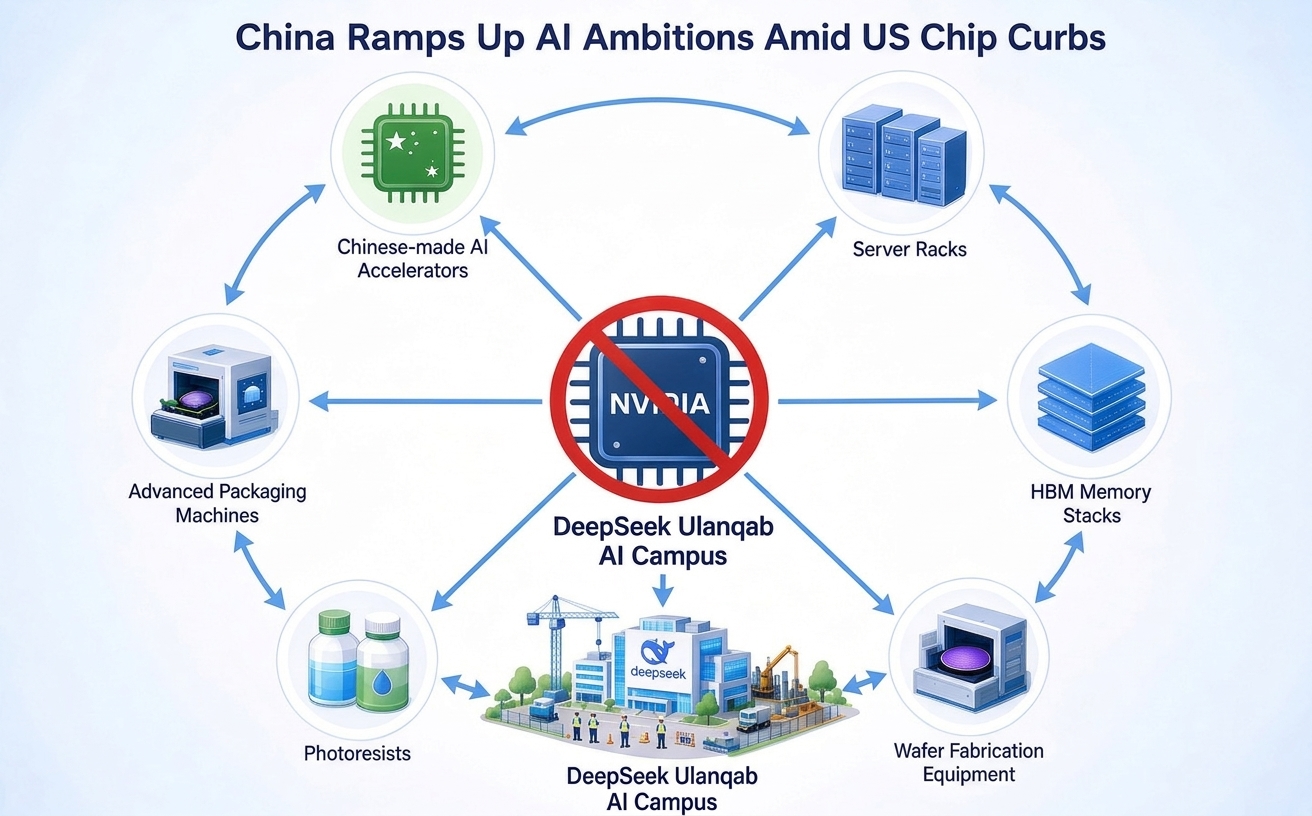
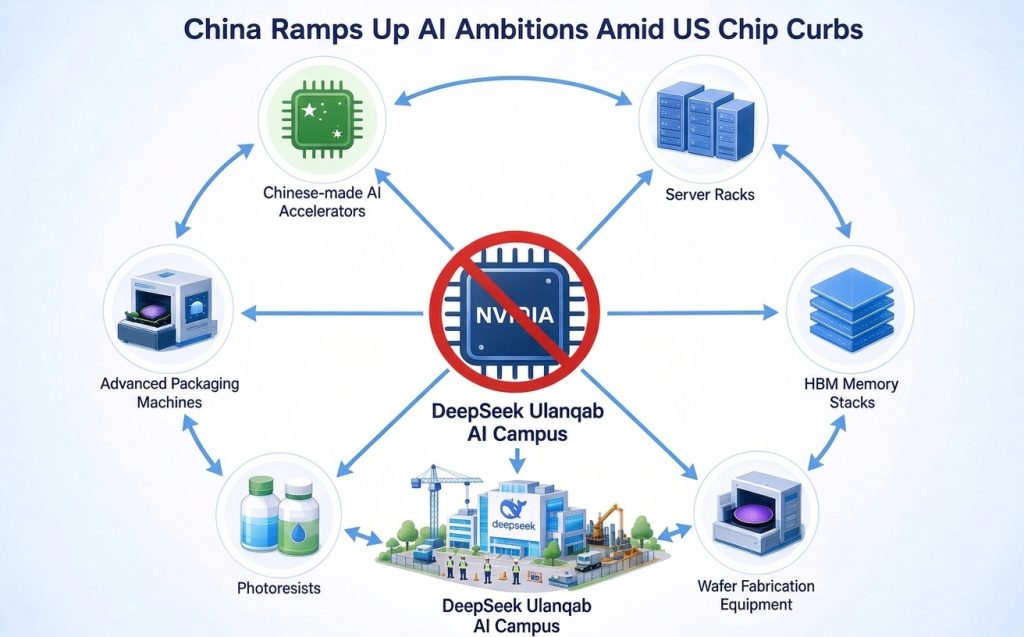
(SINGAPORE 2026.11.19) US restrictions on China’s semiconductor industry were intended to slow its access to advanced chips and manufacturing technologies. Instead, they have accelerated Beijing’s efforts to build a more self-sufficient supply chain.
From domestically developed AI accelerators, servers and high-bandwidth memory (HBM) to wafer fabrication equipment, photoresists and advanced packaging, China’s semiconductor industry is moving beyond isolated breakthroughs towards a more comprehensive industrial ecosystem.
In the first nine months of this year, the industry attracted 331.1 billion yuan (S$62.3 billion) in investment, exceeding the total for the whole of last year. There were 1,475 investment deals during the period.
Data from Chinese investment research platform CVSource (投中嘉川) shows that funding is spreading beyond chip design into memory architectures, data interconnect technologies, manufacturing equipment and materials. Companies including Lingchuan Technology (凌川科技 ), Weina Core ( 微纳核芯 ) and Houmo Intelligent ( 后摩智能 ) announced sizeable fundraising rounds this month.
The investment surge comes amid tighter US export controls and growing demand for computing power from China’s AI industry.
On Monday, the US Commerce Department’s Bureau of Industry and Security announced rules extending controls beyond physical chip exports to remote access to advanced semiconductors. The measures also tighten scrutiny of overseas data centres providing advanced computing capacity to Chinese companies and chip transfers through countries including Singapore, Malaysia, Thailand, Indonesia, and Brazil. They took effect today.
Reuters reported yesterday that US chipmaker Nvidia had halted deliveries to China of Hopper-series data centre chips that had previously received US export approval. About 600,000 H200 chips were also reportedly held up in Hong Kong pending Chinese approval for large-scale imports.
These developments highlight the vulnerability of chip supplies to policy decisions by both countries, despite earlier US efforts to ease trade tensions. For Chinese companies, securing alternative chips is no longer enough; they must also develop the capabilities to manufacture, package, store, interconnect and deploy them.
DeepSeek expands computing infrastructure as Huawei faces production constraints
One closely watched development is DeepSeek’s plan to expand its computing infrastructure in Ulanqab, Inner Mongolia.
Bloomberg reported that DeepSeek (深度求索) was planning a new data centre in Ulanqab (乌兰察布) as part of a broader effort to secure about 1 gigawatt (GW) of computing capacity, including by leasing additional resources from other providers.
Bloomberg also said the company intended to deploy at least 160,000 of Huawei’s next-generation Ascend ( 昇腾 ) 950DT AI accelerators in Ulanqab, primarily for model inference.
The plan marks a significant expansion for DeepSeek, which gained prominence early last year for developing efficient AI models with relatively limited computing resources. As model training, inference services and user numbers grow, so does its demand for computing power. Securing sufficient capacity is crucial to expanding its services and lowering the cost of generating each token.
A report by Shanghai-based IT Times (IT 时报) said DeepSeek was shifting its focus from model development towards generating tokens at lower cost.
Ulanqab’s cold climate and abundant energy resources help reduce data centre cooling and electricity costs. The city is also developing its AI computing industry. The report said 12 AI computing centre projects were signed there in August 2026 alone, involving disclosed investment of more than 130 billion yuan.
However, Bloomberg also reported that the planned deployment would depend on Huawei’s dubious production capacity. DeepSeek continues to rely mainly on Nvidia chips to train its most advanced models. It does not currently plan to use the Ascend 950DT for training, targeting it instead for inference. Shortages of high-end memory and other components are however constraining Huawei’s output.
The project illustrates why a large data centre does not automatically translate into sufficient computing capacity: accelerators, HBM, servers, network interconnects and software compatibility must all advance together.
Domestic chipmakers move beyond design towards system-level competition
Huawei is a key player in China’s effort to develop domestic computing infrastructure. Its Ascend accelerators form part of a broader strategy involving UnifiedBus interconnect (灵衢互联 ) technology, servers and supernode architecture ( 超节点架构 ), which links multiple processors to work together.
Baidu (百度), China’s Google, disclosed earlier this year that it had deployed DeepSeek R1 on its Tianchi (天池)supernode system, with each supernode connecting 32 Kunlunxin ( 昆仑芯 ) XPU processors. By optimising model distribution, memory utilisation and communication scheduling, the system improved inference efficiency. Kunlunxin is an AI chip company under Baidu.
Competition among Chinese accelerator makers is therefore extending beyond individual chip performance to software and system-level optimisation.
The Shanghai-based STAR Market Daily (科创板日报) reported early this month that at least 10 AI chip-related companies completed fundraising rounds in October, several involving more than 1 billion yuan. Their businesses span compute-in-memory technology, server CPUs, autonomous driving and embodied intelligence.
Weina Core announced on Oct 28 that it had raised more than 1 billion yuan in a Series C2 round. Together with its preceding Series C1 round, it raised more than 2 billion yuan in two months, bringing its total fundraising over the past six months to more than 3 billion yuan.
The company is developing a three-dimensional compute-in-memory (三维存算一体 ) architecture that brings computing and memory closer together to reduce data-transfer delays and energy consumption. Three first-generation chips have completed tape-out, with customer testing expected to begin in early 2027.
Lingchuan Technology, meanwhile, is targeting AI-generated video. The Beijing Economic-Technological Development Area ( 北京经开区 ), where the company is based, announced on Nov 9 that Lingchuan had completed a 1 billion yuan Series B funding round.
Its SL200 intelligent video processing chip has sold nearly 100,000 units to customers including Kuaishou (快手), Alibaba Cloud (阿里巴巴云), Baidu Cloud (百度云) and Bilibili (哔哩哔哩).
Its next-generation chip, which uses domestically developed 3D stacking technology, completed tape-out in April and has recently returned from the foundry, passing its first validation test. The company is targeting mass production and shipments in 2027.
Founder and chairman Liu Lingzhi ( 刘凌志 ) said Lingchuan would strengthen its capabilities across chips, software stacks and platforms. It has also developed LUCAS ( 凌川统一计算架构软件栈 ), a unified computing platform supporting models including Alibaba’s Tongyi Wanxiang ( 通义万相 ) and Tencent’s Hunyuan Video ( 混元视频 ).
Other companies, including Houmo Intelligent, Yicheng Technology ( 奕成科技 ) and Xixuan Zhichuang ( 曦选创智 ), have also raised fresh capital. On Nov 12, Xixuan Zhichuang completed a 500 million yuan angel funding round, with investors including chipmaker MetaX ( 沐曦 ) and robotics company UBTech ( 优必选 ).
CXMT and YMTC advance in memory, but HBM remains a weak link
AI chip performance depends not only on processing power but also on how quickly processors can access data, making HBM critical to China’s efforts to build competitive domestic AI systems.
ChangXin Memory Technologies (CXMT) (长鑫) announced on Sept 20 that its fifth-generation DRAM technology platform, G5, had entered mass production.
Using an equivalent 8-gigabit chip as a benchmark, the company said the number of dies produced per wafer had increased by at least 50 per cent from the previous generation, improving memory density and reducing unit costs.
CXMT is also moving into higher-end smartphone memory. Its LPDDR6 products have been used in the Xiaomi (小米) 18 Fold, while LPDDR5X products have entered the supply chains of other mid-range and high-end smartphones.
HBM, however, presents a much greater challenge. Reuters reported last month that CXMT planned to begin limited HBM3E production in the coming months. Its yield rate was reportedly only 20 to 30 per cent, compared with about 70 per cent at South Korea’s SK hynix.
CXMT has sent samples to Chinese AI chip designers, but test results showed performance closer to SK hynix’s previous-generation HBM3 products. HBM requires multiple DRAM layers to be stacked and connected through advanced packaging and high-density interconnect technologies, making yield improvement and equipment development major obstacles.
Yangtze Memory Technologies Co (YMTC, 长江存储 ), meanwhile, is expanding beyond NAND flash memory (闪存) into enterprise solid-state drives (SSDs, 企业级固态硬盘).
Its Xtacking architecture manufactures memory cells and peripheral circuits separately before integrating them through advanced interconnection technology, improving storage density and data-transfer speeds.
Its PE501 enterprise SSD uses quad-level cell (QLC) NAND flash and offers a maximum capacity of 122.88 terabytes, allowing data centres to store more information in fewer drive bays. YMTC also offers triple-level cell (TLC) products for workloads such as databases that require frequent reading and writing.
Data from Hong Kong’s Counterpoint Research shows that YMTC’s share of global NAND revenue rose to 14 per cent in the second quarter of this year, from 11 per cent a year earlier.
CXMT and YMTC are moving into higher-end smartphone memory and enterprise storage markets, although China’s HBM capabilities remain well behind those of leading international suppliers.
Equipment and materials are critical to supply-chain independence
China’s progress in chip design and memory manufacturing ultimately depends on its ability to produce semiconductors. US restrictions on advanced manufacturing equipment have made domestic alternatives in lithography, etching, thin-film deposition, inspection and metrology increasingly important.
On Aug 28, the National Development and Reform Commission (国家发展改革委) said the security of China’s integrated circuit supply chain had improved significantly, with more domestic equipment and materials being adopted on a larger scale.
Li Chao (李超), deputy director of the NDRC’s Policy Research Office, said the industry was moving from isolated breakthroughs towards coordinated development across the supply chain. China would continue to use its state-led mobilisation system to advance technological breakthroughs, he added.
Progress, however, remains uneven. Chinese suppliers have expanded in etching, wafer cleaning, chemical mechanical planarisation (CMP, 化学机械研磨 ) and thermal processing. Lithography, ion implantation, photoresist coating and development, and inspection and metrology remain more difficult areas.
Among the companies making inroads are Advanced Micro-Fabrication Equipment (AMEC, 中微公司 ) and Naura Technology ( 北方华创 ) in etching; Piotech ( 拓荆科技 ) in thin-film deposition; ACM Research Shanghai ( 盛美上海 ) in wafer cleaning; Hwatsing Technology ( 华海清科 ) in CMP; and Kingsemi ( 芯源微 ) in photoresist coating and developing equipment. Naura is also expanding into other manufacturing processes.
In semiconductor materials, Tongcheng New Materials ( 彤程新材 ), Nata Opto-electronic Material ( 南大光电 ), Jingrui Electronic Materials ( 晶瑞电材 ) and Hubei Dinglong ( 鼎龙股份 ) are working to localise photoresists and related products.
The STAR Market Daily reported that Chinese wafer manufacturers had stepped up testing of domestic materials following price increases by Japan’s JSR, Tokyo Ohka Kogyo ( 东京应化 ) and Shin-Etsu Chemical ( 信越化学 ).
Tongcheng New Materials said validation for some basic products had been shortened from one to two years to six to 12 months, while Dinglong said achieving stable mass production of high-end photoresists remained a priority.
Supply-chain risks are making wafer manufacturers more willing to test domestic alternatives. Previously reluctant to risk production yields with unproven products, fabs are now opening their production lines to local suppliers, giving them access to manufacturing data and opportunities to improve.
But adoption does not mean domestic equipment can already replace imported alternatives across the board. Significant gaps remain in lithography, advanced-process inspection and metrology, as well as high-end equipment and critical components. Domestic machines must also prove they can operate reliably over extended periods and maintain consistent yields across different fabs and advanced processes.
From isolated breakthroughs to an integrated industry
China’s semiconductor industry is increasingly linking chip designers, memory manufacturers, equipment and materials suppliers with data centre operators.
Wu Kaida ( 吴开达 ), head of policy research and chief strategist at TF Securities ( 天风证券), told the China Securities Journal ( 中国证券报 ) on Tuesday that the industry was moving from self-sufficiency in individual areas towards a manufacturing system covering the entire industrial chain. Domestic graphics processing units (GPUs) and semiconductor equipment were among its priorities.
Wu expects a self-reinforcing cycle in which demand drives development, domestic suppliers meet that demand, practical applications provide feedback and technological improvements strengthen their competitiveness.
But greater investment alone cannot deliver this transition. US restrictions have created opportunities for domestic suppliers while limiting access to advanced equipment, technologies and components. Chinese manufacturers must still demonstrate that their products can compete on performance and cost, achieve acceptable yields and ensure reliable supplies.
The 331.1 billion yuan invested in the first nine months reflects growing confidence in the domestic semiconductor industry. Yet the mass-production targets of companies such as Lingchuan and Weina Core, both looking towards 2027, show that much of the investment is still funding product development and customer validation.
DeepSeek’s Ulanqab project illustrates how these gaps are interconnected: a large data centre cannot deliver its intended computing capacity if Huawei cannot produce enough accelerators or if HBM and server interconnect technologies fail to keep pace.
China is making progress towards a more comprehensive semiconductor supply chain, but reducing its dependence on foreign suppliers will require more than technological breakthroughs. The decisive test will be whether domestic companies can achieve stable mass production, improve yields and turn sample testing into sustained commercial orders.