















(SINGAPORE 2026.9.29) At 40 in 1989, Song Zhenghuan (宋郑还) was vice-principal of a middle school in China’s Jiangsu province. He took over a factory run by his school. The factory was on the verge of collapse carrying more than 1 million yuan (about S$191,000) in debt.
He borrowed 50,000 yuan from a bank and bet the factory’s future on a baby stroller.
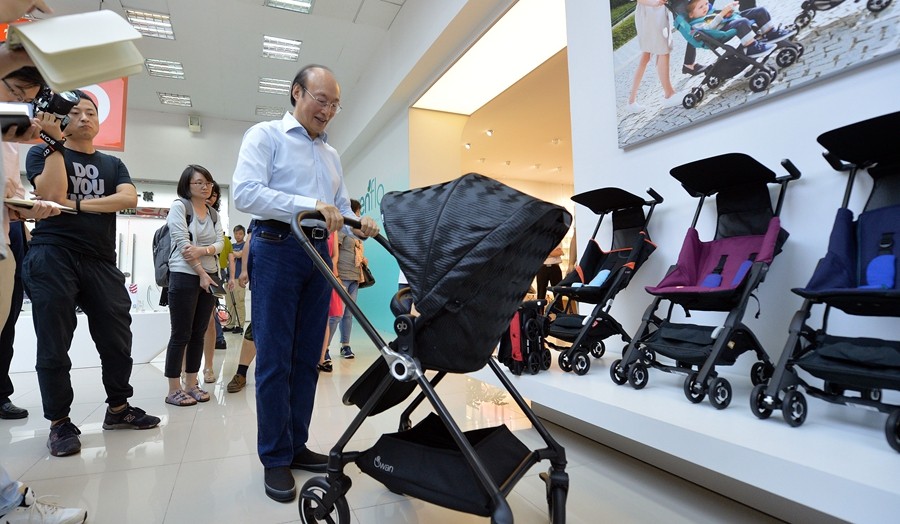
Thirty-six years later, the company that grew out of that factory sells products in more than 110 countries and regions. Goodbaby International Holdings(好孩子) owns Germany’s CYBEX(赛百适) and US’ Evenflo(伊芙乐), both premium baby-products brands, and has expanded from strollers into car seats, children’s furniture, apparel and other products.
But now surprisingly it is preparing to leave the Hong Kong stock market.
On Sept 27, Goodbaby announced that Crystal Aurora International, wholly owned by Song, had proposed taking the company private at HK$1.50 (about S$0.24) a share, a 38.9% premium to its Sept 25 closing price of HK$1.08. The maximum cash consideration is estimated at about HK$1.322 billion.
The move is more than a change in ownership. Goodbaby’s 36-year journey is almost a microcosm of China’s light industry: from making cheap products at scale, to designing its own products; from manufacturing for foreign brands, to building Chinese brands; and from relying on China’s huge domestic market to competing for consumers around the world.
Also, that transformation is becoming less a choice than a necessity: China is ageing, births are falling, the number of babies is shrinking, and geopolitical tensions are making global supply chains harder to navigate.
The stroller that started it all
Goodbaby’s birth came almost by accident.
A military factory brought Song a baby stroller and said it would buy the strollers if his factory could make them. Song switched production, bought the materials and got to work.
Then the military factory could not honour the arrangement.
The factory was left with materials it could not sell and debts it could barely service.
Song decided to make and sell the stroller himself. But when he looked at the market, he saw little reason to produce another ordinary stroller.
Inspired by a photograph of a reclining chair, he designed a stroller with a built-in rocking function, then added features to help babies learn to walk and recline. The result was a four-in-one stroller.
At an exhibition in 1989, someone offered 150,000 yuan for the patent. Song refused.
His reasoning was simple: if someone was willing to pay that much for the patent, there must be a market for the product.
He manufactured it himself. Orders soon approached 200,000 units.
Goodbaby was born.
The story captured a broader change in Chinese manufacturing: moving from copying existing products towards designing products that could compete on innovation and quality.
Goodbaby entered the US in 1996 and by 1999 its strollers were best-sellers there. Europe followed.
But initially, much of its business remained under the ODM model. Goodbaby designed and manufactured products that were sold under foreign brands. Song later said the model was more profitable than simply being a contract manufacturer, but it was still essentially about selling products, designs and manufacturing capability rather than the value of Goodbaby’s own brands.
The next transformation came after its 2010 Hong Kong listing.
From making products to owning brands
In 2014, Goodbaby acquired CYBEX and Evenflo. It also acquired overseas distributors, bringing products, brands and distribution channels under its own control.
The strategy has since changed the composition of the company.
In 2025, Goodbaby generated HK$8.66 billion in revenue. CYBEX contributed HK$5.047 billion, or 58.3% of group revenue, up 13% year on year.
Meanwhile, Evenflo revenue fell 11.2%, the gb (Goodbaby) brand declined 18.8%, while its Blue Chip and other businesses fell 24.8%. Blue Chip refers to manufacturing and service relationships with major international customers, and these were heavily affected by US tariff policies in 2025.
The shift became even clearer in the first half of 2026. Revenue rose 5.8% to HK$4.55 billion, driven mainly by CYBEX, whose revenue jumped 10.5% to HK$2.71 billion and accounted for 59.6% of group revenue. Evenflo was broadly flat and gb revenue slipped 0.6%.
In other words, Goodbaby could no longer bet on babies born in China. They were arriving in an ever-thinner trickle.
Its biggest growth engine is now the German premium brand.
Fewer babies, tougher competition
That matters because China’s demographic landscape has changed dramatically.
The National Bureau of Statistics said 7.92 million babies were born in China in 2025, with the birth rate falling to 5.63 per 1,000 people. Deaths reached 11.31 million, while 323 million people, or 23% of the population, were aged 60 or above.
Families may spend more on each child even as the number of children falls. But for products whose basic demand depends on the number of newborns, the demographic dividend is no longer what it was.
Goodbaby has responded by reshaping its gb business. It has cut some low-priced, low-margin non-durable products, concentrated resources on durable products such as car seats and strollers, closed underperforming stores and expanded direct-to-consumer sales.
The result can look contradictory: gb revenue fell sharply, yet the company says its core durable products like stroller performed strongly.
That is the nature of the transformation. The goal is not simply to sell more units, but to sell products with higher value and stronger margins.
And this is where Goodbaby becomes a useful window into China’s wider light industry.
China’s light manufacturing sector is not disappearing. It is changing.
In the first half of 2026, value-added industrial output among major light-industry enterprises grew 5%, while revenue reached 11.2 trillion yuan. Light-industry exports reached US$487.04 billion, up 6.7% year on year. Retail sales of 11 categories of light-industry products rose 4.4%, reflecting stronger demand for upgraded products.
A government work plan for stabilizing light-industry growth in 2025-26 also identified children’s products as a potential growth area and called for support for leading companies globalizing their brands, developing cross-border e-commerce and expanding overseas marketing channels.
Goodbaby has followed almost the entire route: from manufacturing to marketing brands, from domestic demand to global consumers, and from wholesale distribution towards DTC and e-commerce.
That evolution is likely to become important for Chinese light industry as demographics weaken at home and geopolitical tensions complicate access to overseas markets.
Goodbaby’s global strategy, however, has not insulated it from geopolitics.
In 2025, US tariffs and new product regulatory requirements hit Evenflo and added costs, including for car seats. Its Blue Chip business was also significantly affected.
In the first half of 2026, however, the US government refunded about US$25.3 million in previously paid tariffs to Goodbaby’s US subsidiary. The refund was one of the major factors behind a sharp rise in gross profit.
Group gross profit increased 19.7%, while net profit rose 162.3% to HK$276.7 million from HK$105.5 million.
So, the story is not one of a company simply going downhill. Goodbaby is recovering financially, but the business driving that recovery is no longer the same China-focused manufacturing business it started with.
Why go private?
That brings the story back to the HK$1.50 privatization offer.
Goodbaby still has growth opportunities. But its Hong Kong listing has long been marked by thin trading.
Before the announcement, average daily trading volume over the previous six and 12 months represented only about 0.13% and 0.16% of issued shares respectively.
The offer price is 38.9% above the last closing price, but still well below Goodbaby’s book value of about HK$3.92 a share at the end of June 2026.
The company’s announcement said the offer price took into account recent and historical share prices, trading volumes, financial performance, macroeconomic conditions, consumer sentiment in major markets and the group’s business prospects.
The most direct explanation, therefore, is straightforward: Song is prepared to use cash to buy out other shareholders and end Goodbaby’s long-running existence as a thinly traded listed company.
There is also a broader strategic interpretation. As the business becomes dependent on overseas brands, private ownership could give management more room to pursue longer-term investments without the same pressure from short-term market trading.
Goodbaby’s current chapter shows what China’s light industry may have to do: move up the value chain, own brands rather than simply make products, sell directly to consumers, develop global distribution and use Chinese manufacturing capabilities to compete internationally.
At 36, Goodbaby may be entering another beginning.
The question is no longer how to sell its next stroller.
It is whether a company born in a Chinese school factory can keep reinventing itself as a global consumer brand — and, in the process, offer a glimpse of where China’s light industry goes next.