
























(SINGAPORE 10.3. 2026) As AI becomes part of everyday life, its value will lie not just in automating work or boosting productivity, but in helping people live with dignity, sustain human relationships and build inclusive societies across generations and cultures.
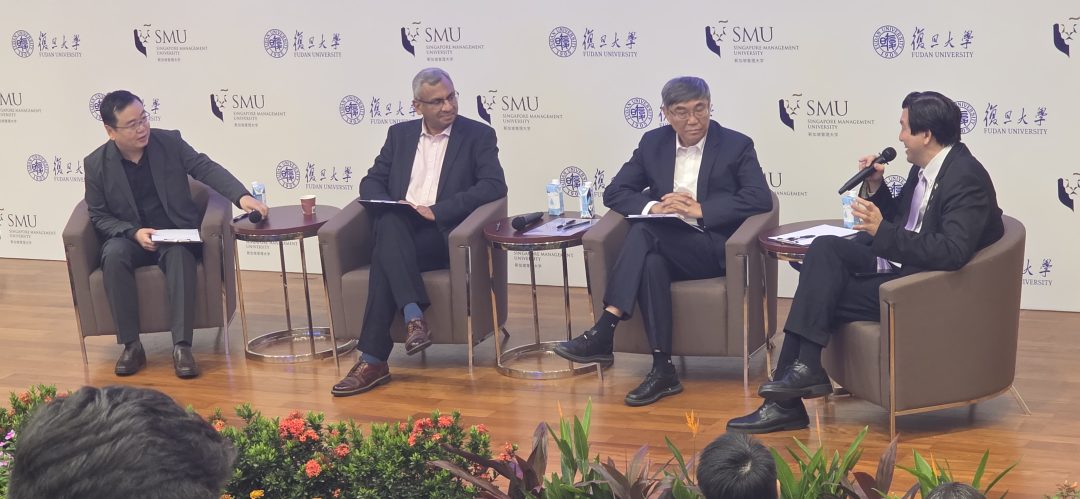
That was the central message of a forum jointly organised today by Singapore Management University (SMU) and Shanghai’s Fudan University, where scholars from Singapore, China and Britain examined how AI could advance human flourishing and improve societies.
Their discussion spanned ageing, eldercare, human-robot relationships, cultural diversity and urban futures, united by the view that technology must serve human needs, social values and cultural understanding.
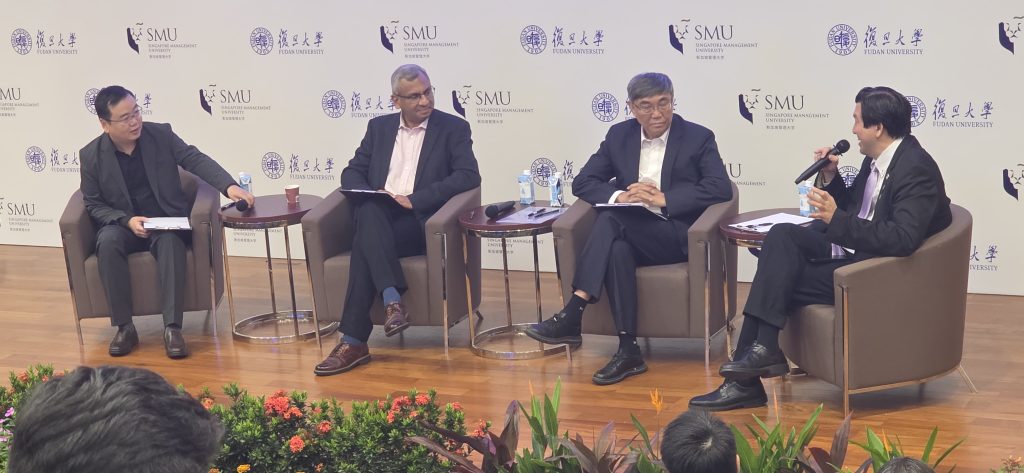
Moderated by Dr Cheong Wei Yang, SMU’s Vice Provost (Strategic Research Partnerships), the forum, themed Living Well with AI: Interdisciplinary Pathways to Human Flourishing and Liveable Societies, featured Professor Jin Cheng of Fudan University’s College of Computer Science and Artificial Intelligence; Professor Peng Xizhe, Dean of the Fudan Institute on Ageing; and Dr Subramanian Ramamoorthy, Professor of Robot Learning and Autonomy at the University of Edinburgh.
Dr Cheong kicked off by urging panellists to look beyond AI’s impact on jobs and productivity and consider what human flourishing means in an AI-enabled society.
AI should be judged not just by its impact on jobs and productivity, but by whether it upholds human dignity, broadens participation and helps people fulfil their potential, he said.
Ageing with dignity, not dependency
The implications are especially pressing for ageing societies, where AI could help meet rising healthcare and social support demands.
China has more than 300 million older people, Prof Peng noted, straining healthcare, long-term care and limited resources. But he cautioned against viewing longer lives as a societal burden.
A liveable society, he emphasized, enables people of all ages to live with dignity, receive support and remain active members of society.
AI could improve health assessments, care delivery, and resource allocation as China faces tens of millions of older people needing long-term care.
But technology alone cannot solve the challenges of aging. Society must also rethink how it views older people.
We need to entirely change our mentality,” Prof Peng said, urging a shift in conventional measures that treat people beyond a certain age primarily as dependents rather than individuals who can continue to contribute.
That new perspective also has implications for the growing use of robots in care settings.
For Dr Ramamoorthy, the goal is not simply to build machines that follow instructions, but systems that understand the people they assist. In eldercare, where preferences, routines and cultural expectations are personal, a useful robot must know not only how to help, but when to step back.
Persuading people to welcome such technology into their homes may be just as difficult as developing it. Drawing on his own family experience, Dr Ramamoorthy said that if he suggested bringing a robot into his mother’s home in India, she might see it as abandonment rather than assistance.
For robots to be accepted into daily life, society must see them as collaborators rather than substitutes for human care, a perception that should be fostered long before old age. The deeper challenge lies in understanding human relationships. Empathy, fairness and adapting to others are essential to coexistence, yet machines can still imitate these qualities only imperfectly.
For humans and robots to live comfortably together, Dr Ramamoorthy said machines must learn and adapt continuously, just as language, culture and human relationships do.
AI must understand culture, not just language
How machines adapt to people raises another challenge: whether AI can respect differences in language, traditions, values, and social norms.
Professor Jin highlighted AI’s potential to broaden access to cultural participation. Digital tools, for example, could help younger generations in China engage with traditions such as Chinese calligraphy.
But he distinguished productivity from meaning. AI development is driven largely by commercial interests and efficiency, while cultural life cannot always be measured against fixed goals. What matters in culture, he suggested, may be meaning rather than measurable output.
This distinction matters because AI must adapt to societies with different values, traditions and expectations.
Prof Peng noted that large language models have historically been trained mainly on English-language material. AI for Chinese elderly users therefore needs to understand more han the Chinese language; it must also recognise Chinese values, social relationships and cultural contexts.
Localisation, in this sense, goes beyond translating interfaces or adapting software. Societies may share basic values but differ in how they approach family, ethics and the balance between individual and collective interests. Prof Jin thus warned against a future in which AI is dominated by a single model, programme or cultural view. Recommendation algorithms and online echo chambers can narrow exposure to information and reinforce the belief that one’s worldview is the only valid one.
A more diverse AI ecosystem, he suggested, could expose users to different viewpoints and promote greater understanding instead of deepening social divisions. The issue is not simply whether AI can reflect cultural differences, but whether its design and use can preserve varied ways of thinking rather than reinforce existing biases and social divides.
From interdisciplinary research to liveable cities
These challenges go beyond computer science. Addressing them will require universities and researchers to link technological innovation with healthcare, social policy, cultural studies and urban development.
Prof Peng called for aging and AI research to become truly interdisciplinary, linking technology with medicine, social security, welfare and public decision-making. He also urged universities to embrace lifelong learning and provide opportunities for people to continue learning throughout their lives, regardless of age.
Dr Ramamoorthy stressed the need for universities to work together over the long term. Many AI challenges, he noted, outlast individual research grants and student projects. Cross-university partnerships can provide the lasting ties needed to tackle problems that continue to evolve.
Prof Jin proposed an “AI-empowered liveable city” as a common research agenda. Cities of different sizes and cultures could become living laboratories for examining how AI can support people at different stages of life, from childhood to old age.
Such research would bring together the forum’s central concerns. AI’s success in improving people’s lives depends not only on technological capabilities, but also on whether public services, social institutions and cities can adapt to them. Closing the discussion, Dr Cheong distilled the forum’s ideas into three themes: interdisciplinarity, intercultural awareness and intergenerational thinking.
Together, the three themes offer a broader framework for assessing AI’s role in society. More capable models and robots may expand technology’s potential but cannot alone determine whether people live better. That depends on whether AI can serve different cultures and generations, balance competing human needs, and preserve the relationships and values that give life meaning.
The question facing universities and societies is shifting. It is no longer simply how intelligent AI can become, but how technology can help build a future where human dignity, diversity and well-being remain central.