

























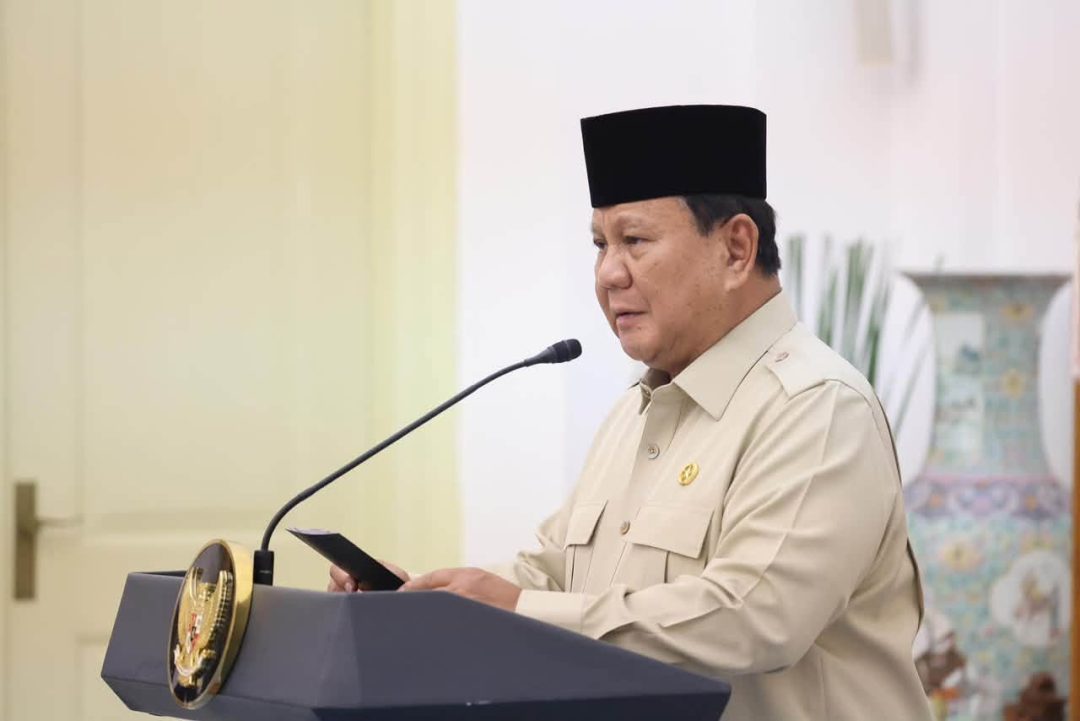
(Singapore, 16.11.2026)Indonesia’s efforts to sustain economic growth and attract investment face fresh uncertainty as President Prabowo Subianto consolidates political power and seeks a larger state share of the country’s mining wealth, against a backdrop of currency weakness and falling share prices.
The resignation of Vice-President Gibran Rakabuming Raka has widened a rift between Prabowo and former president Joko Widodo, while a new directive on mining benefits has raised questions about how the government intends to balance greater national control with the need for private capital.
Bloomberg reported that, as of mid-November, the rupiah had fallen about 9% against the US dollar this year and the benchmark Jakarta Composite Index had lost roughly 40%, with investors also monitoring governance concerns that could threaten Indonesia’s emerging-market classification.
Although the economy expanded by roughly 5.5% in the third quarter from a year earlier and foreign direct investment has continued to rise, weaker consumer confidence and uncertainty over policy implementation are complicating the outlook.
Political Changes Put Investor Confidence in Focus
Gibran, the eldest son of Jokowi, formally submitted his resignation on 12 November after court rulings over his educational qualifications and mounting pressure from lawmakers seeking his impeachment. Prabowo accepted his departure, while Jokowi said he would continue supporting the administration.
His exit weakens an alliance that helped Prabowo win the 2024 presidential election. Jokowi’s backing and Gibran’s place on the ticket had offered voters and businesses a sense of continuity after a decade of roughly 5% annual economic growth.
Since taking office, Prabowo has increasingly reshaped the government around his own priorities. Changes have included the replacement of veteran finance minister Sri Mulyani Indrawati in 2025 and the removal of other senior figures associated with the previous administration.
For investors, these personnel changes have added to questions about the direction of economic management, fiscal discipline and the expanding role of the state.
However, analysts do not expect Gibran’s departure alone to produce a major shift in economic policy, given his limited role in shaping the government’s agenda.
Dedi Dinarto, associate director at strategic advisory firm FGS Global, said the resignation would give Prabowo greater room to consolidate power. State-led development, resource nationalism and the role of state investment body Danantara were unlikely to change materially, he said.
Indonesian stocks rose following Gibran’s resignation, offering some relief amid the broader market downturn, with the Jakarta Composite Index gaining 2.7% that day and extending its gains during the following morning’s trading.
Broader market concerns persist as MSCI has warned that Indonesia could be reclassified as a standalone market over governance issues, increasing pressure on regulators to improve transparency and strengthen enforcement against stock manipulation.
Such a move could reduce the market’s presence in international investment benchmarks and trigger further capital outflows. The reclassification remains a risk rather than a confirmed decision.
Currency stability will be in focus when Bank Indonesia meets on Wednesday, following its unexpected decision to leave interest rates unchanged in October. That decision highlighted the tension between supporting economic growth and defending the rupiah.
Mining Directive Adds to Policy Questions
Prabowo’s latest push for greater state benefits from mining has brought the administration’s approach to private investment into sharper focus.
Speaking in Palu, Central Sulawesi, on 14 November, he instructed the government to ensure that at least 70% of the benefits from mining permits accrue to the state, adding that control of company shares could be considered where necessary.
The announcement left key details unclear, including whether the directive would apply to existing operations, new permits or both, and how the state’s share of benefits would be calculated. The Government Communication Agency did not immediately respond to Bloomberg’s request for clarification.
The reference to 70% concerns the benefits from mining permits rather than a specified ownership stake in each company, while any implications for shareholdings will depend on the implementation rules that follow.
The stakes are significant for an economy whose export earnings rely heavily on natural resources. Indonesia is a major global supplier of coal, nickel and palm oil, as well as a producer of copper and tin.
State participation in mining was already well established under Jokowi, whose administration secured greater Indonesian ownership of major operations involving Freeport-McMoRan and Vale following lengthy negotiations.
Prabowo has taken a more assertive approach, with his administration seizing mines and palm oil plantations and imposing substantial fines on operators. Some proposed interventions have subsequently been revised or withdrawn.
That record makes implementation particularly important for companies assessing long-term projects, which require substantial upfront spending and confidence in future operating conditions.
Government officials have repeatedly said Indonesia welcomes international investment while maintaining that Indonesians should receive greater benefits from the country’s resources.
The administration must also manage competing demands on public finances, including Prabowo’s free school meal programme and major infrastructure commitments. These spending priorities come as households remain concerned about living conditions despite continued headline growth.
For mining operators and prospective investors, the next step will be to examine the rules behind the president’s directive, particularly how existing agreements will be treated, how state benefits will be measured and whether ownership changes will be required.