



















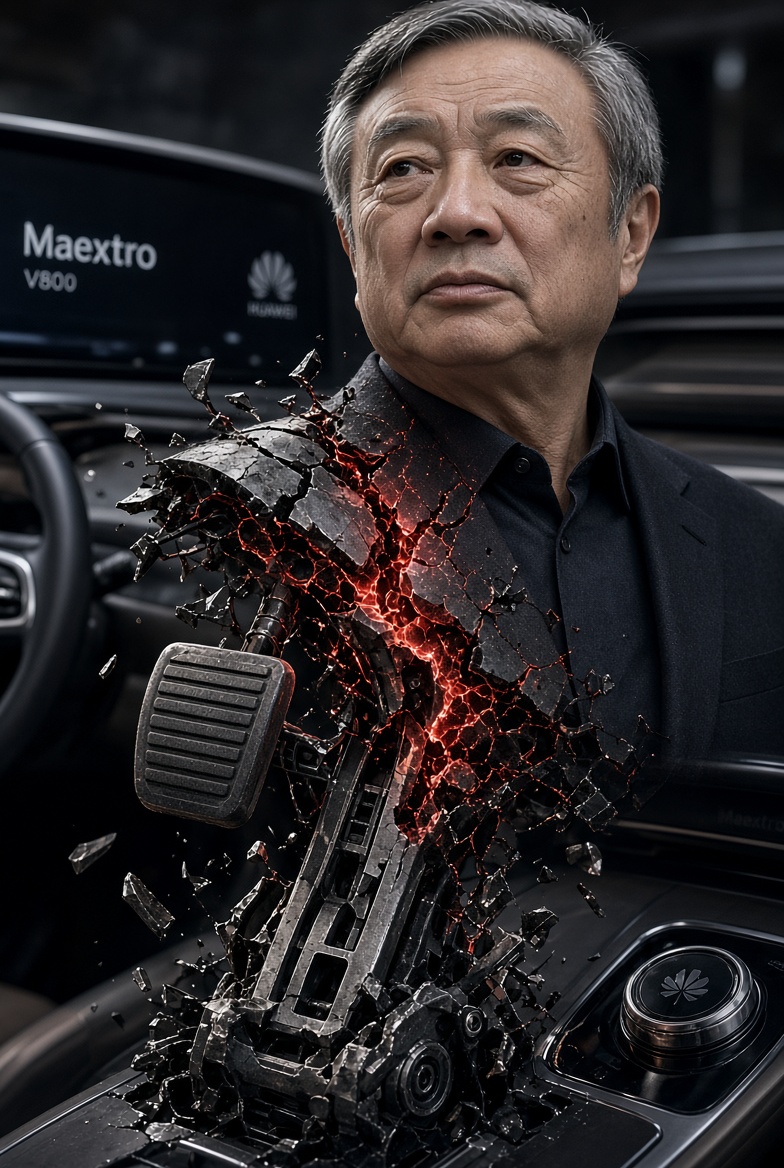
(SINGAPORE 2026.10.13) A luxury car model jointly developed by Huawei (华为)and priced at more than 1 million yuan (about S$191,000) at the top end in China has repeatedly seen its brake pedal bracket break off during emergency braking tests.
Before that, rumours have circulated across overseas Chinese-language media claiming that Huawei founder Ren Zhengfei (任正非) had gone missing and had left China stealthily with his entire family.
The two incidents differ in nature, but both have thrust Huawei into the centre of controversy. While the Chinese technology giant has long faced public scrutiny, these two cases, along with two other recent developments, have drawn particularly intense attention.
It now faces questions over product safety, changing relationships with its automotive partners, and overseas legal risks, alongside speculation that its once-close ties with the Chinese state — which have ostensibly helped secure its privileged position in China — may be under strain.
On Oct 8, Chinese automotive platform Dongchedi (懂车帝)released videos showing three Maextro (尊界) V800 vehicles undergoing emergency braking tests at a closed test facility. During the braking trials in which the vehicles decelerated from 100kmh to a complete stop, the brake pedal brackets broke one after another, with similar fracture locations and patterns.
Maextro is a luxury multi-purpose vehicle brand developed jointly by Huawei and JAC Motors (江淮汽车). Huawei supplies the vehicle’s intelligent automotive technology, while JAC handles its manufacturing. The V800, launched in August at prices ranging from 766,000 yuan to 1.016 million yuan, had only recently begun large-scale deliveries in China when the safety concerns emerged.
Maextro issued a response that evening, saying its braking system had undergone testing and validation in accordance with standards exceeding national and industry requirements. It added that no similar failures had been reported by customers since deliveries began.
The company said it would optimise the component’s design and offer existing owners the option of a free upgrade. JAC said it was investigating the incident and conducting tests.
However, the statements did not explain why the brackets had broken, nor did they immediately spell out the proposed upgrades. An investigation published by Beijing-based newspaper The Beijing News《新京报》on Oct 12 found that four Maextro dealerships in Beijing gave inconsistent accounts of the planned upgrades.
Maextro’s customer service team subsequently said the details were expected to be finalised by the end of October, with implementation scheduled for November.
Mr He, a prospective buyer in Chengdu city who had paid a 50,000-yuan deposit, told The Beijing News that he had decided not to take delivery of the vehicle, even though he might not get his deposit back.
He had selected additional features, including a particular body colour and a coffee machine, and expected the final price to exceed 1.2 million yuan. But the brake pedal bracket failure had shaken his confidence in the car’s safety.
“As a car owner, I no longer feel safe,” he said.
His decision highlights one of the toughest challenges facing a premium car brand: rebuilding customer trust in a vehicle’s quality and safety is far harder than developing new features or technology.
Maextro has maintained that the tests by Dongchedi, which is owned by ByteDance (字节跳动), were conducted under extreme conditions that do not conform to standard testing procedures. Some in the automotive industry have also questioned whether the tests were conducted properly. But the controversy should not be reduced to a war of words between the testing platform and the automaker.
Automotive engineers point out that the forces exerted on a vehicle in an emergency are difficult to predict. Critical components must therefore have sufficient safety margins.
The fallout has also extended beyond a single vehicle model. Several government departments subsequently issued draft guidelines seeking to strengthen the management of automotive innovation, design, research and development, and testing and validation.
The flagship People’s Daily also criticised automakers for shortening development cycles and cutting back on real-world vehicle testing in their rush to capture market share. Whether regulators will tighten requirements further has become another important thread in the story.
For Huawei, the challenge is not just a faulty component, but how much responsibility it assumes in the automotive industry.
Huawei, whose core business is smartphones and microchips, helps automakers develop new brands by providing intelligent driving systems, in-car technology and marketing expertise.
But vehicle manufacturing, component procurement and quality control involve multiple parties. Consumers may not fully understand how these responsibilities are divided. When a safety issue emerges, customers are likely to direct their anger first at the brand that had won their trust.
Against this backdrop, news that Huawei and Chongqing-based car manufacturer Seres (赛力斯)are adjusting their partnership model for the Aito (问界) brand is particularly significant.
On Sept 15, the two companies announced that they would explore a new operating model under which Seres would take the lead in product definition, design, brand marketing, sales channels,and customer service, while Huawei’s consumer business would continue to provide technological and other support.
Huawei executive Yu Chengdong (余承东)said publicly on Sept 24 that Seres had proposed taking the lead itself, and that Huawei supported the move.
This does not mean the two companies are breaking apart. Rather, it suggests that as partners building up their own capabilities, they also want greater operational autonomy.
For Huawei, deep involvement helps it maintain control over the product experience and brand image. But it also means that when problems arise, the public may concentrate much of the blame on Huawei. If it gradually retreats to the role of a technology supplier, the division of responsibilities may become clearer, but its control over the brand could weaken.
Beyond the automotive controversy, Ren Zhengfei’s political standing in China has also become a topic of online speculation in recent weeks.
In mid-September, Chinese-language social media accounts based overseas circulated claims that the 81-year-old had gone missing and was preparing to flee China with his family.
The rumours were accompanied by purported screenshots of internal Huawei chats and a video said to show a chauffeur-driven van heading towards Shenzhen’s coast late at night. He was reportedly planning to seek refuge on an island he had purchased in the South China Sea.
Some online posts linked the rumours to China’s new exit-and-entry regulations, which took effect on Sept 15 and expanded the grounds on which authorities can bar Chinese citizens from leaving the country, including violations that could threaten national industrial or technological security.
But there was no substantiated evidence that Ren himself was affected by the rules or had fled China. Currently there is also no reliable evidence that the Chinese leadership is targeting Ren.
Taiwan media reported on Sept 16 that his daughter, Annabel Yao (姚安娜), had appeared publicly at an event in Beijing. On Sept 23, they also reported that Ren had met senior executives from Dongfeng Motor (东风汽车) the previous day to discuss strategic cooperation and technological collaboration. Neither the purported internal screenshots nor the video of the vehicle has been verified.
Nevertheless, the rumours themselves reflect the fraught environment in which Huawei operates.
The company is both a leading symbol of China’s drive for technological self-reliance and a longstanding focal point of US-China technology rivalry, export controls and national security disputes. It is easy for outsiders to link changes in its business operations or the movements of its founder to shifts in China’s political climate. A lack of transparency in China also leaves ample room for speculation.
Huawei’s overseas legal risks, however, are a different and genuine concern.
In September, US prosecutors began a criminal trial against Huawei in New York involving allegations related to trade secrets, fraud and violations of sanctions regulations.
Huawei denies the allegations, maintaining that its growth has been driven by its own innovation and rejecting accusations that it stole technology. The outcome and subsequent developments of the trial could affect Huawei’s international reputation and have implications for US-China technology relations.
Meanwhile, Huawei’s efforts to achieve greater self-sufficiency in semiconductors remain constrained by manufacturing technology, production yields, capacity and costs. Its telecommunications equipment also faces restrictions in some overseas markets, driven by national security concerns as well as geopolitical tensions and industrial competition.
These long-standing pressures, combined with the quality concerns surrounding its automotive business, mean Huawei must demonstrate that its technological capabilities, product reliability and corporate governance can all withstand scrutiny.
For Huawei, the most immediate test remains the brake pedal bracket incident. Publishing independent test results, explaining the cause of the breaks and clearly setting out the upgrade arrangements would give the company a chance to restore consumer confidence.
If its response remains focused on portraying the tests as extreme and promising improvements at a later date, public doubts are unlikely to dissipate.