























(Singapore, 02.11.2026)The London School of Business & Finance (LSBF) marked its 15th anniversary in Singapore on Monday with a S$1 million bursary commitment, while setting out an ambitious next phase of growth centred on artificial intelligence, industry relevance and greater mobility for students across Asia.
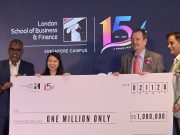
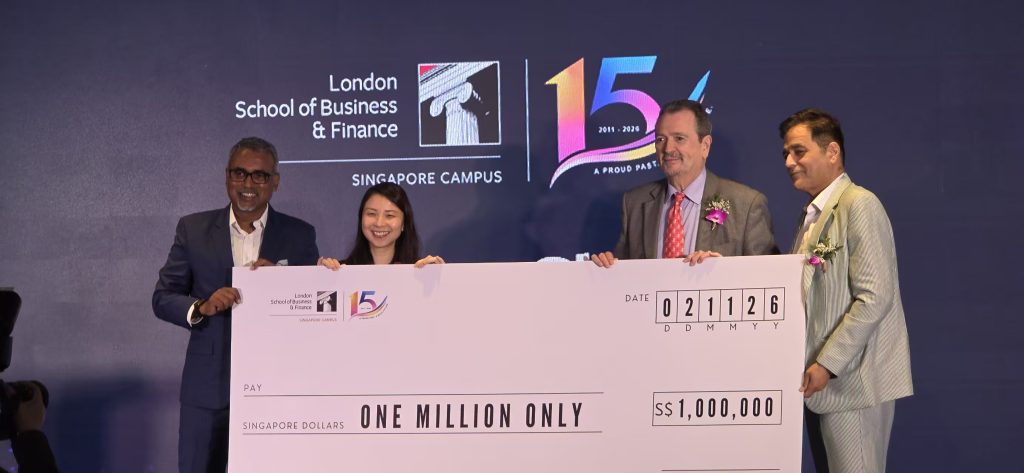
On 2 Nov, the anniversary celebration, held at Amara Singapore, brought together education leaders, industry partners and representatives from the public and private sectors. The S$1 million bursary was presented in the presence of Guest-of-Honour Dr Charlene Chen, Member of Parliament for Tampines GRC and a member of the Government Parliamentary Committee for Education.
Dr Charlene Chen highlighted the growing importance of applied learning and lifelong education as technology and industry needs continue to evolve.
She said education should help learners turn uncertainty into direction through practical experience, industry exposure and mentoring, while providing working adults with the flexibility and support to continue learning throughout their careers.
Beyond technical knowledge, Dr Chen noted that employers increasingly need people who can exercise judgement, communicate effectively, assess information, work with others and take responsibility for their decisions. These human capabilities, she said, need to be developed alongside professional and technical skills.
Her message also pointed to a broader challenge facing education providers: as access to information becomes easier, greater value lies in how people apply knowledge, exercise judgement and make decisions in changing circumstances.
Rethinking Education in the AI Era
For LSBF, the milestone comes at a time when rapid advances in AI are forcing education institutions to reconsider not only what students should learn, but what education itself should deliver.
In an interview with Fortune Times, LSBF Global CEO G. Rathakrishnan said one of the biggest changes will be a move away from education that rewards students simply for recalling information or producing standard answers. As AI becomes increasingly capable of researching, writing, analysing data and solving problems, the greater value will lie in whether students can question an answer, understand its implications and make sound decisions.
This does not mean fundamental knowledge or established business theories are becoming obsolete. On the contrary, Rathakrishnan believes students need a strong foundation precisely because AI can produce answers that appear convincing while missing context, depth or relying on inappropriate assumptions. Without subject knowledge, students may struggle to recognise those weaknesses.
The challenge for business schools, therefore, is to teach students how to work with AI without outsourcing judgement to it.
“Knowing how to generate an answer is useful. Knowing whether to act on it is where the real value lies,” Rathakrishnan told Fortune Times.
That philosophy is reflected in LSBF’s Future Ready initiative, which is built around four priorities: industry-relevant education, AI-integrated learning, global mobility and global employability. AI is being incorporated into learning according to the needs of individual subjects and industries, with an emphasis on students understanding both how to use the technology and how to challenge its outputs.
From Singapore to a wider Asian network
Over the past 15 years, the Singapore campus of LSBF has nurtured more than 36,000 students representing over 40 nationalities. Its academic offerings span business and management, finance and accounting, hospitality, logistics and supply chain management, technology and other disciplines.
Its Asian footprint has also expanded. LSBF opened a college in Kuala Lumpur in 2024 and established physical offices in Shanghai and New Delhi in 2026, as it seeks to build a more connected education network across the region.
For Rathakrishnan, Asia represents one of the institution’s most important growth opportunities over the coming decade.
Two forces are shaping that outlook.
The first is AI. Its impact on jobs and industries is developing so rapidly that knowledge acquired at one point in a career can no longer be assumed to remain sufficient. Rathakrishnan sees continuous learning becoming a shared responsibility between employers and employees, while students will need to become more comfortable moving between roles, industries and even countries during their working lives.
The second is geopolitics. Changing entry requirements and geopolitical uncertainty can make traditional international study routes more difficult for students and families to plan. This, in LSBF’s view, creates an opportunity for institutions able to offer credible international education and mobility within Asia.
China and India are important parts of that strategy. By establishing a presence in Shanghai and New Delhi, LSBF aims to understand students’ aspirations earlier, build local relationships and connect them with education and career opportunities across its regional network.
S$1 million bursary puts access at the centre of anniversary
Alongside its future strategy, LSBF announced a S$1 million bursary commitment to support students facing financial need. The bursary gives the anniversary a purpose beyond celebrating institutional growth. It links LSBF’s expansion with a broader question facing education providers: as learning becomes increasingly important throughout a person’s career, how can access to those opportunities be widened?
The institution also unveiled a commemorative book documenting its 15-year journey in Singapore.
Rathakrishnan said LSBF’s longer-term ambition is to become a “Destination of Choice in Asia” — a goal that will depend not simply on expanding geographically, but on ensuring that its regional presence translates into meaningful opportunities for students.
The anniversary programme also featured futurist Charlie Ang, who spoke about the scale of transformation AI could bring to education and the workforce. Ang argued that as routine cognitive work becomes increasingly augmented or automated, qualities such as imagination, adaptability, entrepreneurial thinking and the ability to continuously reinvent oneself will become more important.