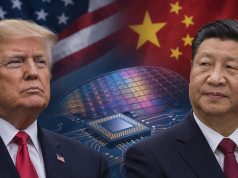




























(Singapore, 17.11.2026)US President Donald Trump began his Asia visit on Tuesday as new American restrictions on advanced artificial intelligence chips added uncertainty to Southeast Asia’s data centre investment outlook and put fresh pressure on Washington’s trade truce with Beijing.
The visit takes Trump from meetings with regional leaders in Manila to the Asia-Pacific Economic Cooperation summit in Shenzhen, where talks with Chinese President Xi Jinping will take place against renewed tensions over access to technology and critical minerals. A trilateral meeting between Trump, Xi and Russian President Vladimir Putin is also planned, Reuters and Bloomberg reported.
For businesses across the region, the immediate issue is how Washington’s latest export controls could affect access to computing power, investment decisions and cross-border technology services.
Southeast Asia’s AI Investment Faces New Uncertainty
The US Commerce Department announced new rules on Monday aimed at preventing companies from bypassing existing restrictions on access to advanced American computing technology through overseas data centres. The measures cover both shipments of advanced semiconductors and certain arrangements that allow companies to access computing power remotely.
The rules introduce additional licensing requirements for exports, re-exports and transfers of certain advanced semiconductors to Singapore, Malaysia, Thailand, Indonesia and Brazil. An exemption applies to chips destined for companies headquartered in the United States, or whose ultimate parent company is based there, subject to reporting requirements.
Separately, overseas data centres providing substantial computing capacity to Chinese companies will also face new licensing requirements.
Singapore’s government said on Tuesday that it was studying the measures, consulting affected businesses and engaging US authorities on their implementation, including ways to facilitate trusted access for Singapore companies.
The changes come as Southeast Asia has attracted substantial interest in data centres and cloud infrastructure, supported partly by demand from Chinese technology companies for computing capacity overseas.
Bloomberg reported that the restrictions could complicate those business arrangements and weigh on future investment. Robert Walker, an economist at the Lowy Institute’s Indo-Pacific Development Centre, said the measures could increase the risk premium attached to some projects in the region.
For operators serving Chinese customers, the commercial implications will depend on the scope of licensing requirements and how they are enforced. Greater uncertainty over access to chips and the ability to serve particular clients could complicate decisions on new capacity.
While parts of Southeast Asia’s cloud computing business face pressure from the new restrictions, the region’s role in supplying semiconductor-related hardware to US data centres remains more secure, Walker told Bloomberg.
Trade Talks Put Chips and Critical Minerals in Focus
The restrictions pose a new challenge to the US-China trade truce, which has rested partly on an understanding that Washington would hold off on new technology curbs in exchange for continued supplies of Chinese critical minerals.
Washington has complained about the pace of rare-earth magnet shipments, while Beijing has criticised the latest chip measures and pledged to defend its interests.
Chinese technology shares diverged on Tuesday as investors weighed the impact of tighter controls, with AI developers MiniMax and Z.AI falling as much as 6.5% and 6.8%, respectively. Semiconductor Manufacturing International Corp., meanwhile, rose as much as 9% on expectations of stronger demand for domestic alternatives.
The contrasting share-price moves highlighted the competing pressures facing China’s technology industry, as tighter access to advanced computing hardware could constrain AI developers while encouraging investment in local semiconductor capacity.
Economic security is also on the agenda in Manila, where Trump’s meeting with leaders from Japan, India and Australia marks the Quad’s first leaders’ summit in two years. Export restrictions, critical minerals, AI and undersea cables are among the potential discussion topics.
Those issues have direct commercial implications for Asian manufacturers and infrastructure investors, linking access to technology with efforts to diversify supplies of essential materials.
Alongside those discussions, Trump was due to sign a joint statement with Thai Prime Minister Anutin Charnvirakul on progress towards a reciprocal trade agreement. The United States accounted for 24% of Thailand’s exports this year, underlining the importance of access to the American market for the Thai economy.
Attention will then turn to Shenzhen, where APEC leaders meet on 18 and 19 November to discuss trade and investment cooperation, with the new chip restrictions posing a fresh test for economic ties between Washington and Beijing.
Singapore, meanwhile, said it would continue working to preserve access to advanced semiconductors and computing capabilities for legitimate businesses, while taking action against companies that break its laws.