
























(SINGAPORE 2026.8.4) — Chinese media are calling 2026 the first year of China’s AI restaurant era—and for good reason. Across the country, artificial intelligence is transforming how food is ordered, cooked, served and managed on an unprecedented scale.
Robotic arms stir-fry kung pao chicken. Humanoid waiters greet diners. AI recommends meals, takes orders, manages inventories, and even develops recipes. What once sounded like science fiction is rapidly becoming everyday reality.
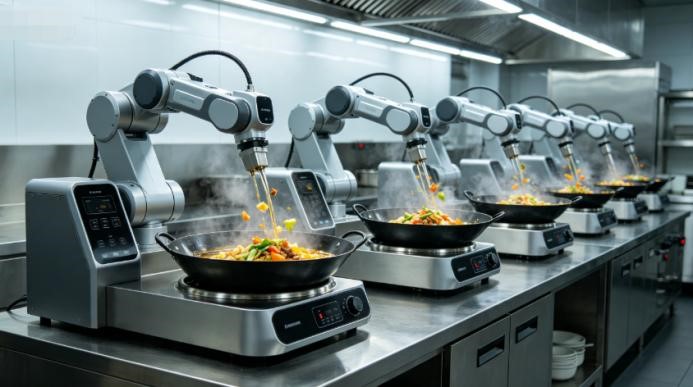
From restaurants and coffee shops to university canteens and corporate cafeterias, AI is reshaping nearly every part of China’s food-service industry. While AI kitchens have also appeared in the United States, Japan, South Korea, and Singapore, nowhere has the technology been deployed as extensively—or as quickly—as in China.
The difference is not simply that Chinese restaurants are using robots. It is the scale.
China is moving beyond isolated pilot projects to integrating AI across entire restaurant value chains —from ordering, cooking and quality control to logistics, supply-chain management and customer service. Large restaurant chains are deploying thousands of intelligent cooking machines, local governments are introducing policies to accelerate adoption, and investors are pouring hundreds of millions of yuan into AI food-tech companies.
For many industry observers, 2026 is emerging as the year AI restaurants entered the mainstream.
From Robot Chefs to AI Waiters
Perhaps nowhere better illustrates this revolution than Beijing’s Yizhuang (亦庄)district, according to Chinese restaurant industry platform Canyinj (餐饮界).
At Robot Yanjiusuo 2.0 (机器人焰究所2.0), diners are welcomed by Xiaoqi (小柒), a multilingual humanoid robot that greets guests and assists throughout their meals. Behind the scenes, specialised robots prepare hamburgers, Chinese pancakes, barbecue skewers, coffee, milk tea, and cocktails. Autonomous serving robots deliver dishes to tables, while dual-arm cleaning robots clear trays and wipe tables after diners leave.
Elsewhere in Zhengzhou, Henan province, Guoquan Chinese Stir-fry (锅圈小炒) has taken on the more arduous challenge of automating Chinese cooking.
Its open kitchen uses six intelligent cooking machines to prepare dishes including spicy chicken, steamed fish head with chopped chillies, and Xinjiang-style big plate chicken. Most meals are made within one to three minutes, while a single employee can supervise four machines simultaneously.
Delivered via Guoquan’s nationwide supply chain, the restaurant offers freshly prepared dishes at an average price of about 21 yuan (around S$5).
AI dining has also expanded far beyond commercial restaurants.
Across China, smart canteens are appearing in schools, universities, industrial parks, residential communities, and government offices. At Beijing’s Xinfadi Digital Community Canteen (新发地数智社区食堂), AI helps diners identify allergens and recommends meals based on dietary preferences. At Shanghai’s Minhang Vocational and Technical College (闵行职业技术学院), robotic arms prepare complete bowls of noodles—from boiling noodles to adding broth and serving the finished meal—with almost no human involvement.
Restaurant Giants Embed AI Across Operations
One of the clearest signs that AI dining has reached critical mass is the participation of China’s largest restaurant companies.
In February, KFC China introduced Little K (小K), an AI ordering assistant built on Alibaba’s Qwen (通义千问) large language model. Customers can complete the entire ordering and payment process through natural voice conversations. By June, KFC became the first restaurant brand integrated directly into the Qwen app, allowing users to order meals through Alibaba’s AI ecosystem. Beverage giant Mixue (蜜雪) soon followed.
Rather than navigating self-service kiosks, customers simply tell the AI what they want in everyday language.
Luckin Coffee (瑞幸咖啡) has launched AI Lucky, enabling customers to receive drink recommendations, customise beverages, and complete purchases through natural conversation.
Kitchen automation is advancing just as rapidly.
Restaurant chain Xiaocaiyuan (小菜园) has installed intelligent cooking systems in more than 660 restaurants, deploying around 3,000 robotic cooking units. Instead of depending solely on individual chefs, dishes are prepared using standardised digital recipes that ensure consistency across every outlet.
Meanwhile, Yum China (百胜中国) is extending AI beyond restaurant kitchens. Its End-to-End AI + Robotics Operations System deploys robots inside minus-18-degree Celsius frozen warehouses to retrieve products automatically, improving logistics and reducing labour requirements throughout its supply chain.
Together, these developments show China’s leading restaurant operators are no longer using AI merely to optimise individual tasks. They are embedding artificial intelligence into every stage of restaurant operations.
Government Policies and Capital Fuel Expansion
China’s rapid adoption has not been driven by businesses alone. Local governments are treating restaurant automation as part of their localities’ broader AI strategy.
Shanghai recently unveiled the Shanghai Action Plan for Promoting Smart Development of the Catering Industry (2026–2028), the country’s first local-level blueprint dedicated to AI in food services.
By 2028, the city expects more than 70 per cent of group catering, fast-food, tea and coffee chains to achieve end-to-end smart operations. More than half of full-service restaurants are expected to adopt intelligent technologies in key business processes, while over 60 per cent of restaurant supply chains will operate through smart management systems.
The plan promotes AI throughout the restaurant ecosystem.
Schools and corporate canteens will use online reservations to predict demand and reduce food waste. AI nutritionists will generate personalised meal plans. Intelligent systems will manage marketing, customer engagement, and food safety.
Perhaps most significantly, Shanghai aims to digitise Chinese cooking itself. Using sensors, the Internet of Things and machine learning, the city hopes to capture techniques such as heat control, stir-frying, knife work and seasoning, converting traditional culinary skills into reusable digital cooking models that intelligent machines can reproduce.
Investment is accelerating the industry’s growth.
Zhigu Tianchu (智谷天厨), which develops intelligent cooking robots, recently raised nearly 100 million yuan after multiple funding rounds over seven years. Combining robotic cooking equipment with AI-powered recipe models, it has become one of the few Chinese cooking-robot companies to exceed 100 million yuan in annual revenue while remaining profitable.
Another company, Xianglu Robotics (橡鹿机器人), secured 300 million yuan in financing earlier this year. It says it has become the world’s first company to commercialise AI-generated recipes at scale and has already deployed cooking systems in countries including the US, Australia, France, Singapore, Japan, and South Korea.
Restaurant operators, appliance manufacturers and internet giants are also investing heavily as competition intensifies.
Beyond Automation: Exporting Chinese Cuisine Through AI
Restaurant automation is not unique to China. American companies have developed robotic fry stations and burger assembly systems. Japan has long embraced automation in sushi restaurants and noodle shops, while South Korea has expanded robotic cafés and automated kitchens. Singapore has introduced robotic wok stations and AI-assisted restaurant management.
China’s approach, however, stands apart in both scale and integration.
Rising labour costs are encouraging restaurants to automate repetitive tasks. Large restaurant chains operating hundreds or even thousands of outlets benefit greatly from recipe standardisation. China’s advanced robotics manufacturing industry has lowered equipment costs, while its mature digital ecosystem allows AI kitchens to integrate seamlessly with mobile payments, food-delivery platforms, supply-chain management and cloud computing.
The result is that AI is becoming the operating system of restaurants rather than simply another piece of kitchen equipment.
Industry experts, however, do not believe chefs will disappear. Instead, AI is changing their roles.
Veteran executive chef Zhu Xin (朱鑫), after more than two decades in restaurant kitchens, now serves as an AI Kitchen R&D Executive Chef. Rather than cooking every dish himself, he develops recipes and trains intelligent systems to reproduce them.
For fine dining, private dining and creative cuisine, human chefs remain indispensable. Artistic judgement, improvisation and personal style cannot easily be replicated. But for chain restaurants where consistency, efficiency and scalability matter most, AI is increasingly becoming the preferred solution.
The technology is also creating entirely new professions—from robot operators and AI kitchen engineers to digital recipe designers responsible for translating traditional culinary knowledge into machine-readable instructions.
The implications could extend well beyond China.
For decades, one of the biggest challenges facing Chinese restaurants overseas has been the shortage of experienced Chinese chefs. Recruiting skilled chefs is costly, staff turnover is high and maintaining quality across multiple countries has often proved difficult.
AI could fundamentally change that equation.
Whether AI ultimately becomes as indispensable to restaurants as refrigeration or online food delivery remains to be seen.
What is already clear is that China has moved further—and faster—than any other country in integrating artificial intelligence into everyday dining. For many in the industry, 2026 will be remembered as the watershed year when AI restaurants entered the mainstream.