























(SINGAPORE 2026.7.23) India’s approval this month for Chinese smartphone maker vivo’s Indian unit, vivo Mobile India, and its Dixon Technologies to establish a joint venture carries significance beyond smartphone manufacturing. The decision not only clears a long-delayed proposal but also signals that New Delhi’s approach toward Chinese-linked investments may be entering a new phase.
Under an approval granted by India’s Department for Promotion of Industry and Internal Trade (DPIIT), Dixon Technologies will own 51% of the joint venture, with vivo India holding 49%, giving Dixon management control.
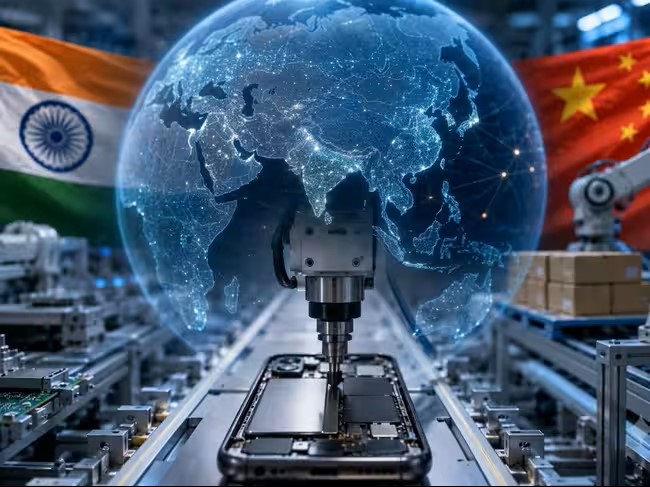
The joint venture will manufacture smartphones and electronics in India for vivo and potentially other brands.
Although agreed in 2024, the partnership remained stalled for over a year pending approval under India’s stringent FDI (foreign direct investment) rules for countries sharing its border.
According to India’s Economic Times, the approval reflects a broader shift in India’s treatment of Chinese-linked investments. New Delhi has recently also cleared projects involving Chinese firms, including Highly’s (海立) joint venture with an Indian partner and Taiwan manufacturer Foxconn’s collaboration with Chinese component suppliers.
Rather than reopening its door completely, India is adopting a selective approach, allowing Chinese investment where Indian firms retain majority ownership and strengthen manufacturing. The vivo-Dixon partnership fits squarely within that framework.
A Major Concession by vivo
For vivo, the deal means more than manufacturing, given its already sophisticated smartphone production operations in India.
Vivo has invested over 6.5 billion yuan (about S$1.16 billion) in its Greater Noida factory near New Delhi in 2015, with potential annual capacity exceeding 100 million smartphones. But much of its smartphone manufacturing is now expected to shift to the joint venture.
In May, Dixon founder Sunil Vachani revealed that the partnership would eventually manufacture about two-thirds of vivo’s smartphone sales in India—equivalent to more than 20 million devices annually.
According to India’s Press Trust of India (PTI), vivo plans to spin off manufacturing operations at its Noida factory into the joint venture and adopt a lighter-asset operating model.
Although vivo retains a 49% stake, Dixon’s majority ownership gives it effective control over manufacturing decisions.
The arrangement therefore marks a fundamental shift in vivo’s India strategy—from directly owning and controlling manufacturing to sharing production under an Indian-controlled entity.
From Model Market to Regulatory Pressure
The significance of that shift becomes clearer against the backdrop of vivo’s decade-long expansion in India.
According to China’s tech-focused media platform lxInsight (连线Insight), vivo entered India aggressively in 2014, identifying the country as the company’s most important overseas growth market.
Senior executives personally travelled to India with Chinese distributors to conduct market research, eventually establishing operations across more than 200 cities in 28 Indian states within months.
The company rapidly built an extensive offline retail network and recruited hundreds of local employees.
In 2015, vivo leveraged Prime Minister Narendra Modi’s “Make in India” initiative by constructing its Greater Noida manufacturing plant, taking advantage of lower import duties for locally produced smartphones.
Drawing on the playbook that had helped build its brand in China, vivo secured the title sponsorship of the Indian Premier League (IPL), India’s premier professional cricket league, and dramatically increased its brand recognition.
According to International Data Corporation, a global market intelligence firm, vivo consistently ranked second in India’s smartphone market during 2016 and 2017, behind only Samsung. By early 2019, it had become the leading brand in India’s mid-to-high-end smartphone segment.
At the end of 2018, vivo founder Shen Wei (沈伟) visited the company’s operations in India. A month later, he unusually singled out India for praise, saying overseas sales had exceeded domestic sales for the first time and that vivo had become India’s No. 1 offline smartphone brand.
At the time, many believed India would become vivo’s greatest international success story. Instead, the operating environment changed dramatically.
From Expansion to Investigation
According to lxInsight, the turning point came in 2020.
Following heightened tensions between China and India, New Delhi tightened investment rules by requiring government approval for all investments from neighbouring countries, effectively preventing Chinese companies from freely injecting capital into their Indian operations.
Regulatory actions soon expanded beyond investment approvals.
In 2022, India’s Enforcement Directorate froze assets worth 55.5 billion Indian rupees (about S$835 million) belonging to Xiaomi India, the Indian unit of Chinese smartphone maker Xiaomi, over alleged foreign exchange violations. The same year, vivo came under investigation.
Indian authorities alleged that vivo had transferred 624.8 billion rupees overseas to evade taxes and subsequently froze 119 bank accounts linked to the company, together with 4.65 billion rupees in assets.
Although the Delhi High Court allowed vivo to continue operating, it did not fully lift the Enforcement Directorate’s restrictions. Vivo had to provide bank guarantees worth 9.5 billion rupees and leave the already-frozen bank deposits untouched while the investigation continues.
Pressure intensified in December 2023 when India’s Enforcement Directorate arrested two vivo India executives, including a Chinese national, over money laundering allegations. Investigations remain unresolved.
Against that backdrop, the newly approved joint venture with Dixon appears less like a conventional commercial decision than the culmination of years of regulatory pressure.
Rather than withdrawing from India, vivo has chosen to relinquish part of its operational control in exchange for remaining in one of the world’s most important smartphone markets.
Dixon Emerges as the Bigger Winner
For Dixon Technologies, the agreement represents a major strategic victory.
According to the Economic Times and Moneycontrol, one of India’s most influential financial news platforms, the company expects vivo’s business to increase annual smartphone production from 20 million to 22 million units over time, with part of the increase earmarked for exports.
But Dixon’s ambitions extend well beyond assembling smartphones.
The company aims to expand into higher-value components such as displays, camera modules and structural parts, supporting India’s push for greater electronics value addition. Currently, only about 15% of a smartphone’s value is generated locally, with the government targeting 30% to 35% through increased domestic component production.
Vivo’s manufacturing expertise and supply-chain capabilities could accelerate India’s efforts to localise electronics production and strengthen its domestic ecosystem.
Ripple Effects Across the Supply Chain
The restructuring is also expected to alter vivo’s supplier network.
According to lxInsight, the Noida factory relies on Chinese suppliers for batteries, chargers, components, and packaging. Many have reduced operations since India tightened investment restrictions after 2020.
With Dixon leading manufacturing, vivo is expected to rely more on Indian suppliers, reducing Chinese component makers’ role in India’s smartphone industry.
The implications extend beyond India. Vivo’s Noida facility is a key overseas manufacturing hub, producing over 25 million 5G smartphones since 2022, with some exported to neighbouring markets. Changes of manufacturing ownership could affect its broader global supply chain.
Too Important to Leave
Despite years of regulatory pressure, leaving India has never been an attractive option for vivo.
According to Omdia, a global technology market research firm, vivo shipped 32.1 million smartphones in India in 2025, including some made elsewhere, securing a 21% market share to become the country’s largest vendor. Samsung ranked second with 23 million shipments and 15%.
At the same time, growth in China’s domestic smartphone market has slowed. In 2025, vivo’s shipments in China declined 6.6% year-on-year, the steepest fall among the country’s five largest smartphone makers.
According to lxInsight, citing Bloomberg, vivo COO Hu Baishan (胡柏山) said India is the company’s largest overseas market, with overseas revenue exceeding half of its total sales and expected to grow further.
After more than a decade of investment in manufacturing, distribution, branding and local talent, abandoning India would mean writing off one of vivo’s biggest international successes.
The newly approved joint venture between vivo and Dixon is about more than the restructuring of a single company.
It reflects a new reality for Chinese companies operating in India: participation in one of the world’s fastest-growing consumer markets increasingly comes at the cost of surrendering greater ownership and control to local partners.
For India, that appears to be precisely the point. For vivo, it may simply be the price of staying in the game.