

























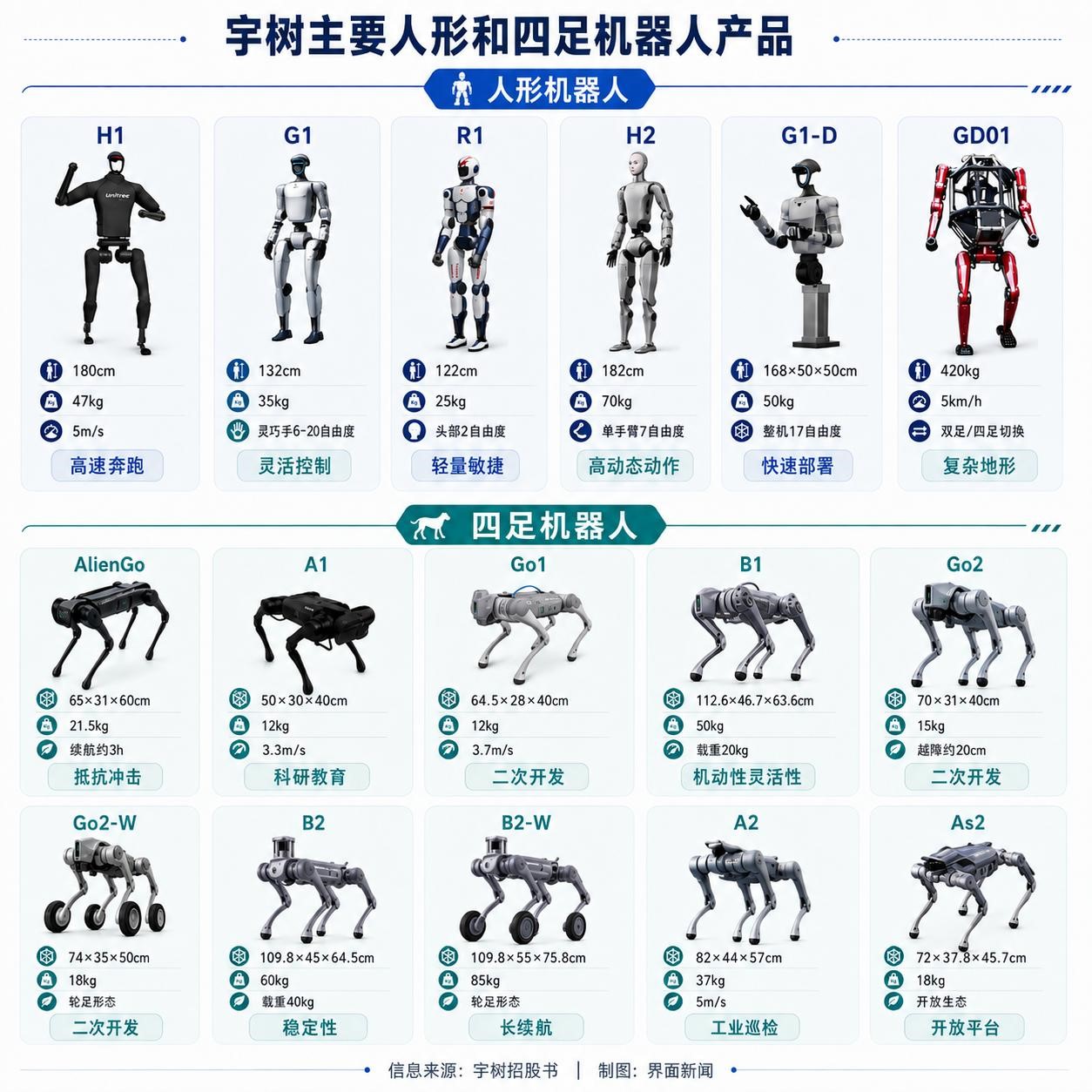
(Singapore,20.08.2026) Yesterday, the opening bell at the Shanghai Stock Exchange rang for China’s Unitree Robotics (宇树科技). The company opened at 1,100 yuan (about S$208) a share, then soared 629% from its IPO price and briefly pushed its market capitalization above 440 billion yuan. It was a spectacular debut for what was billed as China’s first A-share listed humanoid-robotics company.
Almost 10 million people fought for a very limited number of Unitree shares, but only about 18 out of every 100,000 online applicants got any. Those lucky enough to receive a full lot could see paper gains of nearly 500,000 yuan when the stock reached its peak on its first trading day.
The trading floor was packed and buzzing. Yet at the listing ceremony, Unitree founder and CEO Wang Xingxing (王兴兴) looked remarkably unaffected, looking down at his phone with little visible excitement, reported the Sina news media outlet. The contrast was striking: the market was in a frenzy and the man who built the company remained unmoved.
That scene almost perfectly captured Unitree’s story over the past decade: extraordinary wave of attention from the outside world and an almost single-minded focus within.
From Overlooked Startup to Robotics Powerhouse
A few years ago, Unitree was still a small, largely overlooked company. At an industry conference, Wang was invited to speak about the technology sector. When his turn came, he launched into a technical and lengthy presentation. At one point, a senior figure interrupted him: “You’re talking too much.”
The organizers later tried to invite Wang back. By then, they could no longer get hold of him. Inside the industry, the story of “the man who interrupted Wang Xingxing” became a long-running joke.
At the time, few people paid much attention to the determined young entrepreneur. Investors dismissed Unitree’s quadruped robots as little more than research toys. “Apart from scientific research, what can they actually be used for?” was a common reaction. Unitree was so small that suppliers often did not even want to deal with it. When the company needed customized parts, makers were frequently unwilling to take the orders.
Wang, however, seemed largely indifferent to the lack of recognition.
Even after Unitree was no longer short of cash, he would still ask at business meetings who was paying for the hotel bill. Having experienced times when the company was painfully starved of funding, Wang developed a fixation on cash flow and cost control.
The company had managed to bring the price of one of its humanoid robot models down from 590,000 yuan to 160,000 yuan, yet its gross margin rose rather than fell, eventually reaching as high as 60%. In the hardware industry, where lower prices usually mean thinner margins, that is a stupendous feat.
The secret was vertical integration. Unitree developed as much of its technology in-house as possible, including motors, joints and reducers. If something could be built internally, the company preferred not to buy it from outsiders. What began as a constraint imposed by Unitree’s lack of bargaining power gradually became one of its deepest competitive moats.
In that sense, Unitree represents a broader strength of Chinese manufacturing ecosystem: decades of accumulated supply-chain capabilities have been compressed into a single company, allowing it to design, build and scale complex machines at a speed and cost that would have been difficult to achieve elsewhere.
Unitree’s IPO prospectus offered a glimpse of just how far that strategy has taken the company. In 2025, it shipped more than 5,500 humanoid robots and generated nearly 1.7 billion yuan in revenue, with adjusted net profit of 591 million yuan. It is one of the very few companies in that sector in China to have achieved both meaningful scale and profitability.
Its peers have not been nearly as fortunate. UBTECH (优必选), DEEP Robotics (云深处科技) and Leju Robotics (乐聚机器人) all remained loss-making during the same period. DEEP Robotics’ highest net profit was only 15.12 million yuan.
Unitree’s growing orders have also begun reshaping its upstream supply chain. Suppliers that once produced customized parts for small batches are moving toward standardized components, with some expanding to levels capable of serving as many as 200,000 robots a year.
Unitree is therefore becoming more than simply another robot maker. It is functioning as a de facto anchor of China’s robotics supply chain.
The Body Is Built. The Brain Is Not.
And yet, buried inside that glossy IPO prospectus was one eye-catching admission.
Unitree acknowledged that, during its early years, its research and development efforts focused primarily on the physical body and motion-control systems of its robots. It was only from 2024 onward that the company gradually increased its investment in embodied AI foundation models. During the period covered by the prospectus, it did not carry out large-scale real-world data collection or factory-based training.
Its R&D spending as a share of revenue actually fell sharply, from 31.39% in 2024 to just 8.53% in 2025. Although absolute R&D expenditure increased to 145 million yuan, the ratio was not really high compared with peers.
Put more bluntly: Unitree has built the body of robots. The brain is still a work in progress, the Chinese digital media outlet Jiemian Xinwen (界面新闻) pointed out.
And this is not a problem unique to Unitree. Across China’s embodied-intelligence industry, there is growing recognition of an underlying imbalance: Chinese companies are relatively strong at building robotic bodies, but considerably weaker when it comes to building the intelligence that allows those bodies to understand and operate in the physical world.
The Data Bottleneck
The real bottleneck is data.
Collecting data from the real physical world is very expensive. Under traditional methods where humans remotely control robots to gather training data, a single usable data sequence can cost between 10 and 50 yuan to collect. Training a model capable of performing useful tasks can require hundreds of thousands of such sequences. One major technology company is said to have spent millions of yuan simply on data collection.
Internet videos do not provide a sufficient alternative. They may show what an object looks like or how a person moves, but they generally lack crucial physical information such as friction, force, weight, and contact dynamics. Such data can be useful for visual learning, but when a robot actually has to grasp, push, pull or manipulate something in the real world, the missing physical information becomes critical.
Guizhou’s (贵州) provincial big-data authorities estimate that China currently has only about 500,000 hours of legally compliant data involving real-world physical interaction. Commercial deployment, however, could require tens of millions of hours. That leaves a gap of more than 99%.
This makes Unitree’s approach to IPO fundraising especially instructive.
Of the 4.2 billion yuan it had originally planned to raise, the largest share — 2.022 billion yuan — would go toward “intelligent robot model development.” That was substantially more than the 1.11 billion yuan allocated for robot-body R&D and the 624 million yuan for building manufacturing facilities.
In other words, a company that fought its way to the top largely through manufacturing is now putting the biggest share of its new ammunition into the area where it has the least competitive edge — and where money alone may not be enough to catch up.
Unitree still depends on Nvidia for chips and on overseas suppliers for some high-end sensors. Its capabilities in developing large AI models also lag quite behind the leading global players. These are not problems that can simply be solved by building another factory or increasing production capacity.
Physical Intelligence and Generalist of the US continue to set the pace globally in general-purpose robot models. Chinese companies can perform impressively in controlled demonstrations, but once their robots are placed in unstructured and unpredictable environments, their capabilities can deteriorate sharply.
From Research Equipment to Real Workers
Hence at the heart of China’s robotics industry lies a deep paradox.
In 2025, Unitree’s five largest customers by assets accounted for only 12% of its total revenue. What is concerning is that research and education customers contributed 73.6% of its humanoid-robot revenue, while genuine industrial applications constituted less than 10%.
The Paper, a Chinese news outlet, reviewed 302 procurement projects involving humanoid robots across China. Together, they represented 1.838 billion yuan in winning bids. Of those projects, 205 were for schools, while state-owned enterprises made up the largest share of overall spending.
The picture that emerges is sobering. Robots are being purchased to conduct experiments, equip laboratories and generate data — not necessarily to perform economically valuable work.
In other words, the Chinese robotics market is beginning to look less like the dawn of a humanoid workforce and more like a massive buyer of research equipment.
Wang Feili (王斐丽), an industrial sector analyst at UBS Securities China, offered a useful analogy. If autonomous driving were graded from L1 to L5, the current intelligence of China’s humanoid robots would be about equivalent to L3: capable of performing one or two tasks in controlled environments, but far from being able to operate reliably in the messy, complex conditions of everyday life.
That distinction matters.
A robot that can walk, run, dance, pick up an object or perform a chore in a carefully prepared demonstration is not necessarily a robot capable of working eight hours a day on a factory floor, helping an elderly person at home or navigating an unfamiliar kitchen without human supervision.
Unitree has spent a decade proving that China can manufacture humanoid robots, make them affordable and produce them at scale. But the company’s biggest challenge is no longer whether it can build the body.
It is whether it can give that body a brain capable of truly understanding the world.
The irony is that the same manufacturing strengths that helped Unitree dominate the hardware race may offer little shortcut in the next stage. Motors can be redesigned. Components can be standardized. Factories can be expanded. Supply chains can be optimized. But intelligence depends on data, algorithms, training infrastructure and, ultimately, the ability to make a machine learn from the physical world, noted Jiemian Xinmen.
Those capabilities cannot simply be purchased off the shelf.
That is why Unitree’s IPO fundraising plan is more significant than the blockbuster first-day rally. The stock market has placed an enormous valuation on what the company has already demonstrated: its ability to make and sell robots profitably. But the largest portion of its new capital would be directed toward something it has not yet mastered.
At the listing ceremony, Wang Xingxing’s choice to look down at his phone may have seemed almost incongruous against the backdrop of a 440-billion-yuan market capitalization. But perhaps he understood better than anyone what the market was actually buying.
Investors today are paying for the certainty of Unitree’s “body.” The harder question is whether they will continue paying for the uncertainty of its “brain.”
The marathon to build the brain has only just begun.