



















(2026.9.5 QINZHOU) In the coastal port city of Qinzhou (钦州) in China’s Guangxi province, progress is never a clean break from the past. It is a negotiation of balance —sometimes tense, sometimes tender—between what is built, what is saved, and what is reluctantly let go.
Two transformations, unfolding just miles apart, lay bare a quiet contradiction. One breathes new life into mangrove vegetations along a coastal inlet that is part of the linkage between the newly built Pinglu (平陆)Canal and the open waters of the Beibu Gulf (北部湾), restoring an ecosystem marked by the salt-tolerant roots and tidal rhythm.
The other paves over the memory of oyster ponds that once spread over the Maowei Sea (茅尾海), the very estuary where the canal meets the ocean, burying beneath the current the brackish history of generations farming those shallow beds, now leaving only a few racks scattered on the waters.
Together, they reveal a truth: that revival and erasure can spring from the same stretch of shore.
The first transformation is green, deliberate, and legally codified.
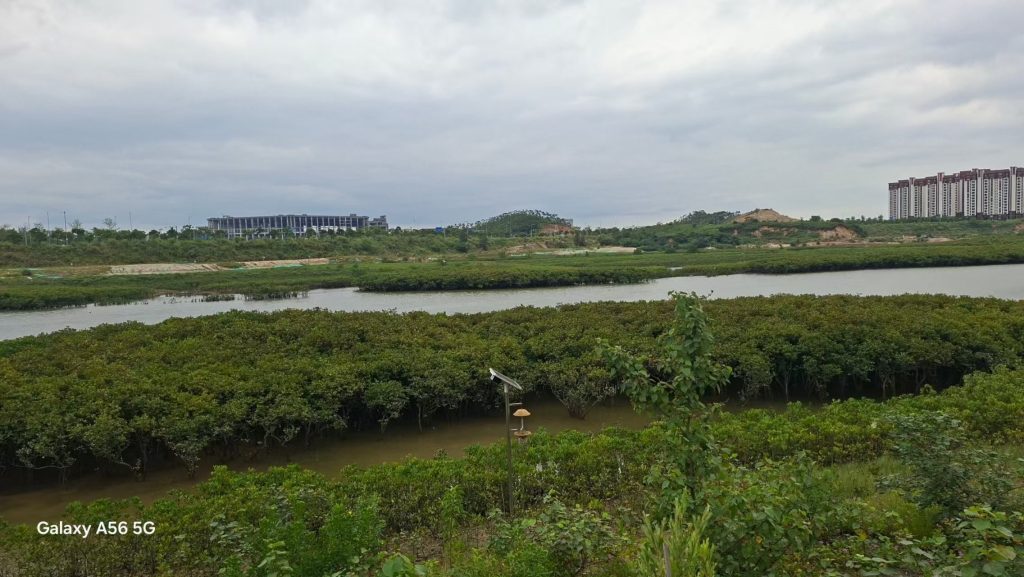
Along the muddy edges of Qinzhou bay on the Jingu River (金鼓江) , a Blue Bay Park project has become a global showcase for the “Green Belt and Road”, echoing China’s global “One Belt, One Road” initiative.
Here, mangroves are not just being protected; they are being multiplied.
Under China’s strict environmental laws, any industrial project situated near such vital ecosystems as existing in the Qinzhou Bay must pass a rigorous “necessity and uniqueness” test.
“ If approved, it faces a non-negotiable ‘1:3’ rule: for every hectare of mangrove impacted, three must be replanted elsewhere,” said Senior Manager Zou Taiping (邹太平) from the Construction Management Department of Qinzhou Industrial Park.
He was speaking to a delegation of Southeast Asia journalists visiting Guangxi to cover the inauguration of the Pinglu Canal, which will be open for navigation from September 15.
Since 2020, this “1:3” framework has restored 110.8 hectares of mangroves, a figure that has swelled to over 170 hectares as the self-reproductive nature of the plant strengthened and extended its foothold.
The project earned a spot among China’s “Top Ten Ecological Restoration Cases” for 2024—a quiet triumph that attracted officials from Cambodia and Madagascar, who came to study Qinzhou’s methods as part of the broader Belt and Road cooperation.
But the mangroves are more than an ecological trophy. Their revival has catalyzed Guangxi’s first “blue carbon” trade, monetizing the carbon absorbed by these salt-tolerant trees and turning conservation into a financial asset.
The guiding philosophy, as local authorities often repeat, is simple: “Big industry and mangroves must exist together.”
And so they do—factory smokestacks visible in the distance, while egrets pick their way through the resurrected roots below. It is a fragile peace, proving that industrial corridors need not be ecological graveyards.
“Coastal farming—through conversion of the coastline and nutrient pollution —had been one critical factor in the degradation of mangroves in this area,” added Mr Zou.
“But we’ve now restored the landscape—and even made it look neat and aesthetically pleasing,” the manager said cheerfully, gesturing toward the mangroves lining the coastal section in the Blue Bay Park. “The only pity is that they can’t grow as tall and magnificent as their Southeast Asian counterparts, since the temperatures here just aren’t warm enough.”
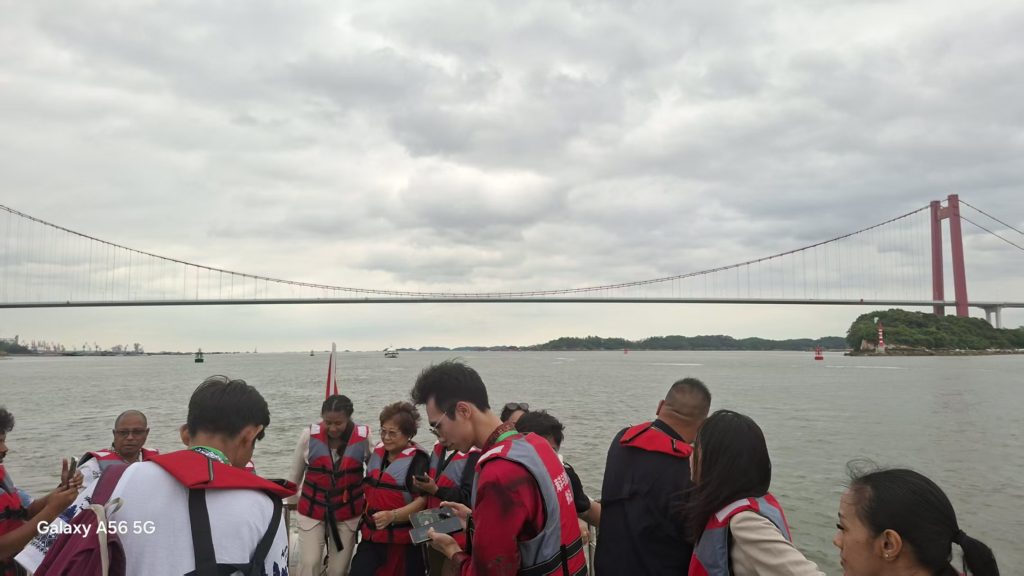
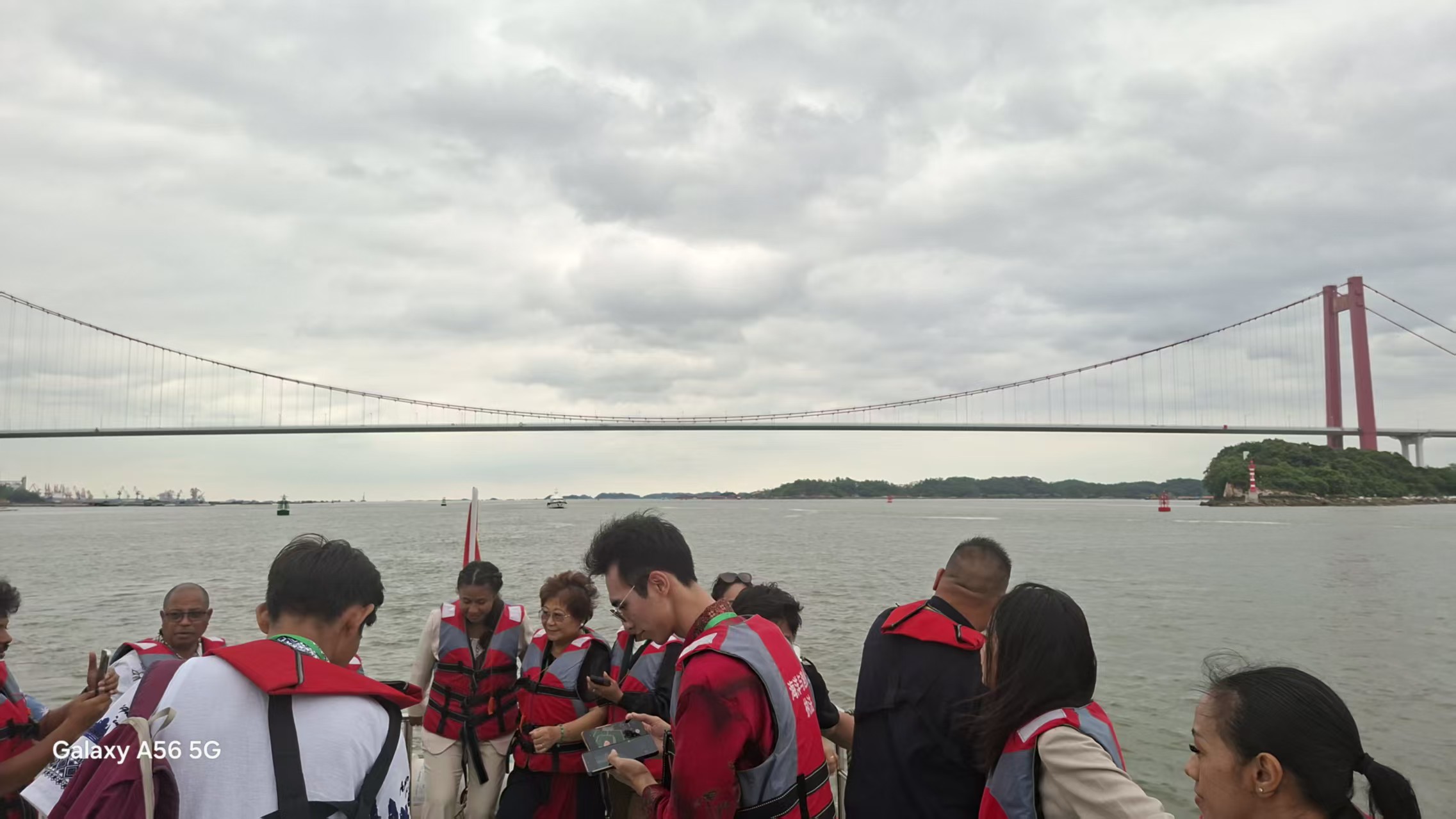
Just a short drive away, a different kind of change is stirring. The Longmen Bridge (龙门大桥), a modern engineering marvel, now arcs across the Maowei estuary with a main span of 1,098 meters.
This single-span, full-floating steel suspension bridge carries six lanes of high-speed traffic, connecting Qinzhou Port to the Fangchenggang Port ((防城港). It has cut travel time from almost 90 minutes to 25 minutes. It is a ribbon of concrete and steel, a symbol of connectivity. The entire Maowei Sea is in the jurisdiction of Qinzhou.
Beneath its soaring cables, the water tells another story. Until recently, this estuary was lined with oyster ponds—so extensive that locals once called their home the “oyster pond of China.”
These were not mere aquaculture farms; they were a way of life passed down through generations. Families woke to the smell of brine, spent their days tending submerged racks, and gathered in the evenings to pick up oysters fitting to be sold.
The ponds had been relocated to open the way for the Pinglu canal to flow into the sea, but some racks still survive, standing here and there jutting out from the waters.
“Before, here were all oyster ponds,” said Ms Huang Xiaosheng (黄小升), chief of the toll station that collects fees from trucks carrying cargo into Fangchenggang from Qinzhou across the bridge. “Maowei was originally a sea bay but now it is part of the artery connecting the gulf to the vast hinterland of China via the canal.”
“The geography has changed and so has the livelihood of many people here,” added Ms Huang.
Obviously, even as the landscape shifts, the memories endure—not as bitter defiance, but as a quiet recognition that a former identity is not so easily shed.
The mangroves and the oyster ponds in Qinzhou are two sides of the same coin. Both represent its deep entanglement with its coastline and the sea. Both have been reshaped by the same forces of industrialization and connectivity. And both demand a kind of reckoning—deciding what to save and what to sacrifice.