

























(SINGAPORE 10.6.2026)China’s microdrama (短剧)industry is trapped in a “production dilemma”: artificial intelligence (AI) is making short dramas cheaper and faster to produce. Yet the easier they become to make, the harder it is for the industry to make money.
That is the central paradox now facing China’s AI microdrama industry.
Hong Kong’s South China Morning Post reported on Sunday that as AI-generated content floods China’s microdrama market, the industry’s challenge has shifted from producing more dramas at lower cost to making audiences stop selecting and watch. In the first eight months of this year, 430,000 microdramas were released in China, with more than 90 per cent generated by AI. The figure was already about 13 times the total for all of 2025.
AI has turned microdrama production into a high-speed content factory. But the amount of time audiences have to watch on their phones has not expanded. Nor have the number of viewing platforms, advertising budgets or consumer spending grown enough to absorb the explosion in supply.
An industry once constrained by production capacity is therefore confronting a different problem: too much content competing for too little attention.
Microdramas did not begin with AI.
They emerged from the convergence of short-video platforms, mobile internet and online literature. Early live-action hits typically lasted only a few minutes. Stories moved quickly, conflicts appeared almost immediately, twists arrived in rapid succession and episodes ended with cliffhangers designed to keep viewers engaged.
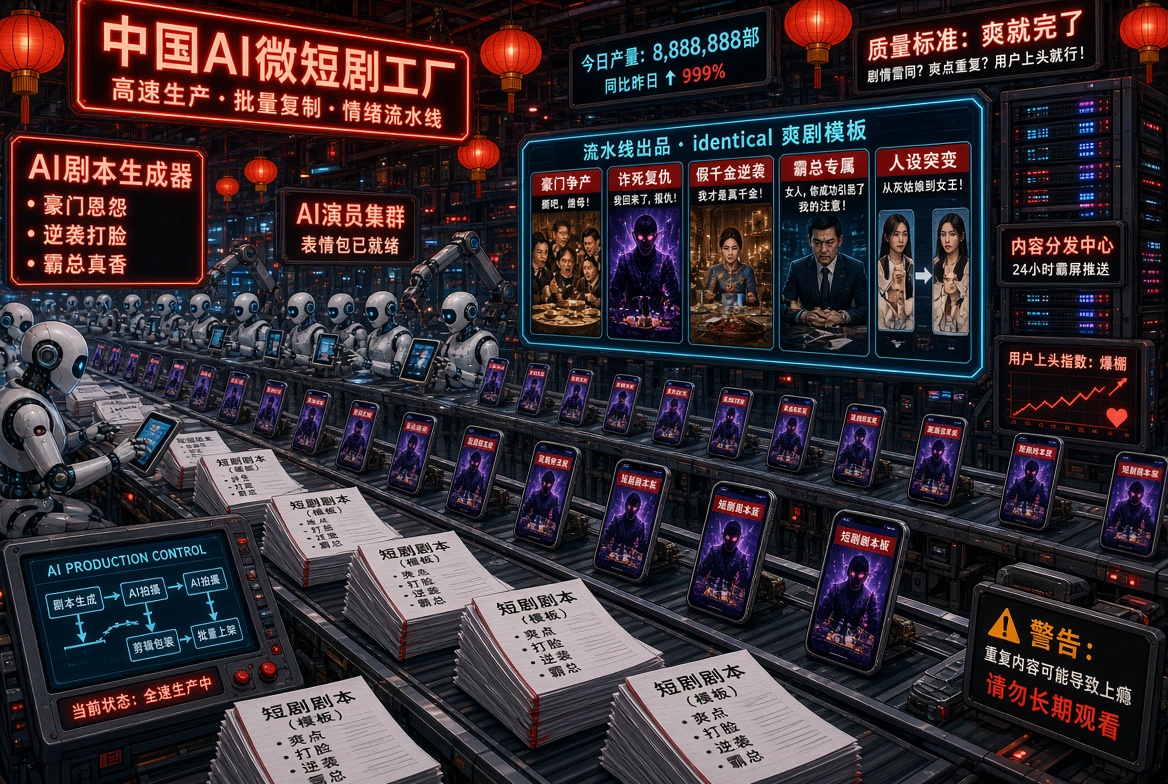
The hits often revolved around family feuds among the wealthy, protagonists returning to life to seek revenge, fake heiresses, domineering CEOs and stories of personal or social transformation.
Short production cycles and low costs, combined with the huge audiences on platforms such as Douyin (抖音)and Kuaishou (快手), turned microdramas from peripheral entertainment into a major business.
AI has now pushed that model to an extreme.
Scripts, visuals, voice-overs and even “actors” can be generated or assisted by algorithms. A production that once took months can now be completed in days or a week.
A report by Zhejiang Daily (浙江日报)in August said more than 1,500 new AI dramas were entering the market every day on average in the first half of 2026. Production costs had fallen by more than 90 per cent compared with live-action productions, with the fastest projects completed within a week.
But the audience has not expanded with the same speed.
The result is a brutal change in the economics of failure.
The Paper (澎湃新闻)reported on Sept 1 that 221,900 original AI and animated dramas were newly released on Douyin in the first half of 2026, generating more than 515.7 billion views. Their user base had grown from about 120 million in 2025 to 600 million.
Yet only one in every 77 new dramas recouped its investment, with 98.7 per cent failing to break even.
Mid-tier AI animated dramas cost about 800 (about S$152.6) to 1,200 yuan per minute to produce, about one-fifth the cost of live-action microdramas.
“AI is not lowering costs so much as lowering the threshold for losing money,” Lin Qiwen (林启文), vice-president of Chinese digital-content marketing and industry-data company DataEye (数据眼), told The Paper.
The point is simple. When production becomes dramatically cheaper, producers can afford to make far more bets. But if the audience remains finite, those additional productions simply compete against one another for the same viewers.
Lower production costs therefore increase supply without increasing returns.
The problem is already visible in individual producers’ experiences.
The Paper reported on Sept 16 that one team released 11 AI short dramas in two months but generated total revenue of just 9.6 yuan.
A September report by Zhejiang Daily documented the experience of an AI animated-drama creator known as “Ao Ao”. When she first entered the industry, she once made 200,000 yuan in profit in a single month. Later, the watch-through rates for four new productions fell from 42 per cent to 19 per cent. None recouped their costs, and she eventually stopped releasing new work.
“At first, I thought I just had to hang in there and things would pass,” she said. “Later I realised that wasn’t going to work, so I had to stop.”
The wider numbers tell the same story. Zhejiang Daily reported in August that 221,900 AI dramas and animated dramas were newly released on Douyin in the first half of 2026, yet the hit rate was only 0.47 per cent.
Many productions may look polished while telling remarkably similar stories: a protagonist is humiliated, a concealed identity is revealed, revenge follows, and the protagonist eventually triumphs.
A Zhejiang Daily commentary described such output as “digital swill” (数字泔水), pointing out that AI’s low barriers had allowed large numbers of factory-style teams to enter the market primarily to monetise traffic. Some productions simply “change the face of characters without changing the plot”, recycling familiar formulas around reincarnation, tyrannical CEOs, revenge and cultivation fantasies.
The SCMP similarly described the market as saturated with “lookalike productions”, with creators facing a new task: how to stand out rather than simply producing cheaply.
Audiences are not necessarily rejecting AI-generated content. They are becoming less tolerant of content that feels interchangeable.
AI initially created a clear competitive advantage because it could automate works that had previously been expensive and labour-intensive.
But once everyone has access to the same tools, the technology itself stops being an advantage.
People’s Daily (人民日报) reported in September that the supply of live-action microdramas has begun to recover.
Si Ruo (司若), a professor at Tsinghua University’s School of Journalism and Communication, told People’s Daily that live-action dramas still have an advantage in creating a stronger sense of presence through actors’ physical expressions, vocal tones, pauses and spontaneous reactions.
That distinction matters because cheaper production has not necessarily made acquisition of audience cheaper. AI drama producers are spending less to make a drama but more to persuade people to watch it.
That is encouraging some creators to put greater emphasis on scripts, aesthetics and human judgment to make their works stand out. AI can handle storyboarding, voice generation and image creation, but emotional connection and originality remain much harder to mass-produce.
Automation also does not eliminate human labour. With thousands of AI-generated titles entering the market, someone still has to screen outputs, rewrite weak scenes, correct inconsistencies and decide which productions are worth promoting.
Chinese regulators are now responding to the deluge of AI microdramas.
The Administrative Measures for the Development of Microdramas, which took effect on Sept 1, strengthened regulation of microdrama content, platforms and AI use.
China’s National Radio and Television Administration had called for greater support for live-action dramas, describing them as the “mainstay” of high-quality production. The regulator has also stressed concerns over copyright, content quality and the pressure that rapid AI growth is placing on human creators.
Its response is significant because it is not simply an attempt to stop AI. It is actually pushing for higher quality, greater originality and stronger rights protection. It has said it will support the distribution of high-quality microdramas and encourage platforms to dedicate slots for live-action productions.
Copyright is another problem. As AI-generated productions multiply, so does the possibility of unauthorised use of existing characters, performances, images and creative works. The SCMP has identified rights protection as one of the pressures accompanying the spread of AI dramas.
China’s microdrama industry has spent the past few years proving that short-form entertainment can become big business.
Now AI microdramas may be entering a second phase. The first was about proving that AI could make dramas faster and cheaper. The next is about proving that cheaper and faster production can create something audiences actually care about.
AI can make 1,000 dramas where producers once made 10. The market still has to decide which 10 are worth watching.