



























(SINGAPORE 2026.5.26) The viral spread of AI-powered “classroom pet” apps in China’s primary schools highlights just how quickly artificial intelligence is reshaping education from the ground up.
On one hand, teachers are turning to AI to cope with their overwhelming workloads. On the other, the surge points to the rise of gamified learning in classrooms. At the same time, though, the apps are also raising wider concerns — about emotionally manipulating the children, wielding pressure on them, and the rapid commercialization of AI in education.
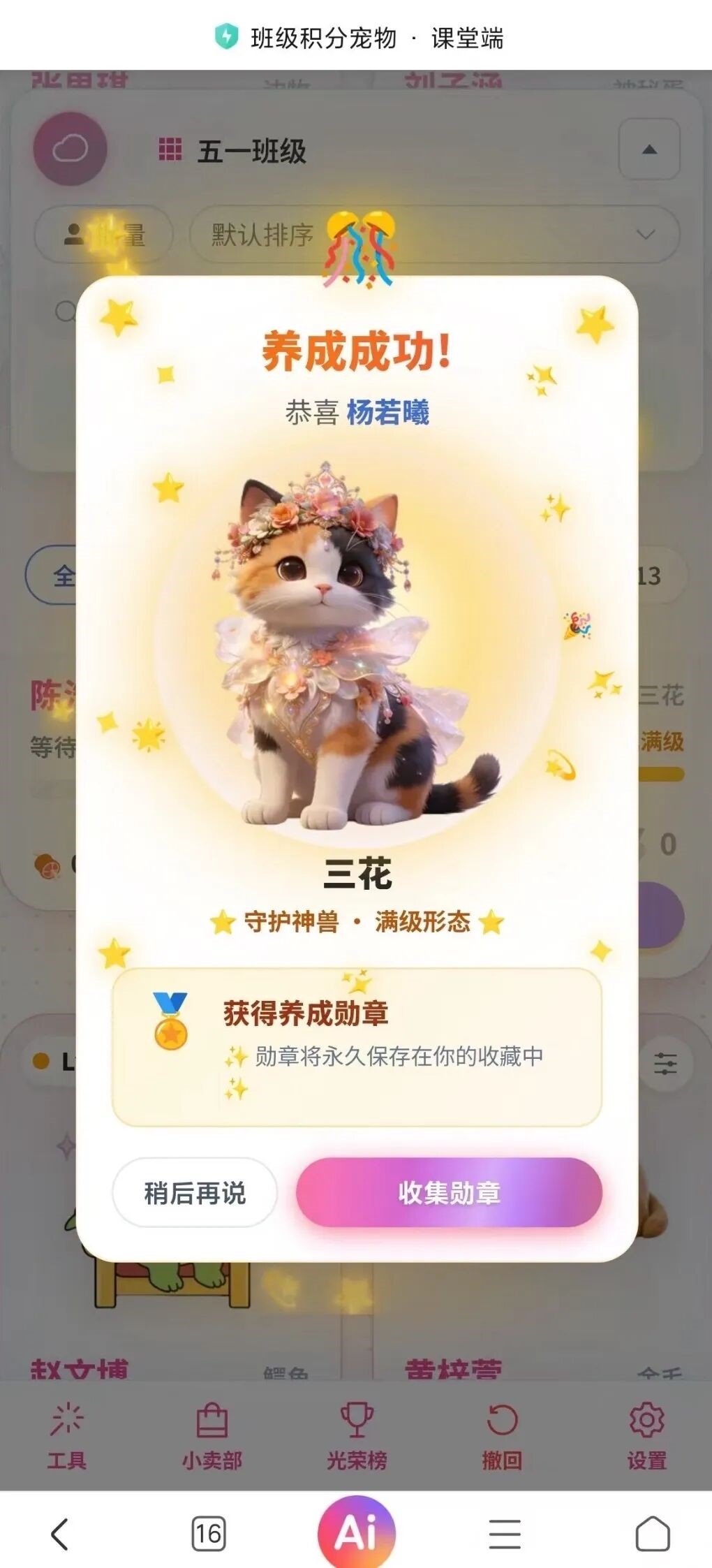
In these apps, the virtual pets — which might be in the form of a goldfish, a rabbit, a hamster, or a little dog — do not need food or water. Its entire “life” depends on how its owner performs in school — how the student behaves in class, how actively he or she participates, and how strong his or her academic results are. If performance drops, the pet may stop growing, become “sick,” or even “die.”
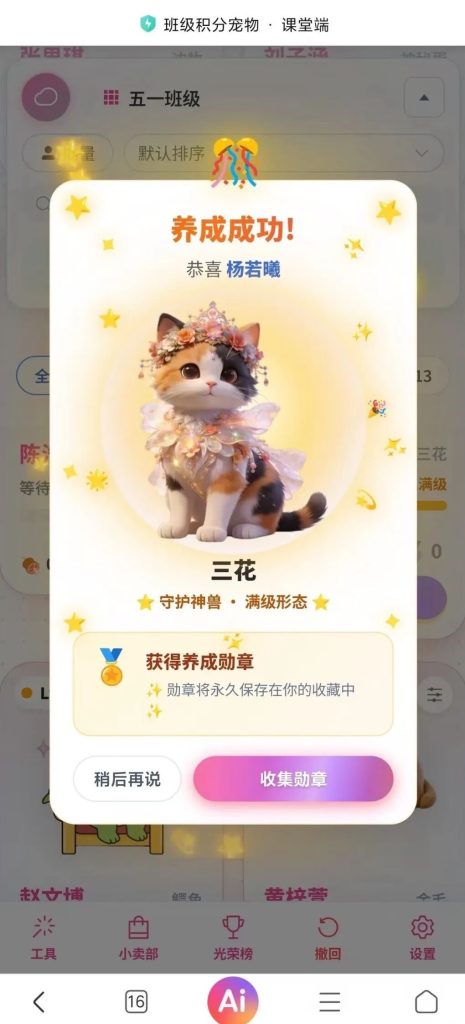
Some students may not be ready for that kind of sweet but heavy responsibility. Yet tens of thousands of form teachers across China have already made the decision to introduce such app for their classes, according to Chinese vertical media outlet Ciweigongshe (刺猬公社).
About two months ago, this new wave of “classroom virtual pet” apps suddenly took off on platforms like Douyin (抖音) and Xiaohongshu (小红书). Priced at just 9.9 yuan (around S$1.86), some versions sold thousands of copies within just a few days. Then, as AI coding tools became more widely available, copycat developers rushed into the space almost overnight.
Today, there are already more than a hundred similar AI classroom pet systems circulating online, with total sales exceeding 100,000. In just a matter of weeks, primary school classrooms across China have, in a sense, turned into small-scale “AI zoos.”
The appeal is fairly easy to understand, as Ciweigongshe pointed out. At its core, the AI classroom pet is really just a gamified classroom management system. Raise your hand in class and you earn points. Do your cleaning duty properly and you get more points. Arrive late and you lose points. Swear in class and you are penalised. Teachers can customise the scoring rules, and the system automatically tracks rankings and monitors behavioural trends.
Of course, the basic concept is not entirely new. Chinese schools have used point-based discipline systems for years — whether through apps like “Classroom Optimization Master,” or even earlier manual methods like handwritten blackboard scoreboards, “little red flower” as rewards, and classroom honour charts. What AI has done now is wrap all of that in something far more emotionally engaging: a cute virtual creature whose wellbeing depends directly on students’ behaviour.
According to many teachers sharing their experiences online, the effects among the younger students are almost immediate. Children become emotionally attached to these digital pets in much the same way earlier generations once became obsessed with Tamagotchis — the handheld virtual pets that were hugely popular in the late 1990s.
In one Shanghai primary school, for instance, a student who previously misbehaved frequently reportedly became much more cooperative after the system was introduced. In Henan province, another teacher turned “pet adoption” into a classroom ceremony, where well-behaved students could formally adopt a class pet in front of everyone and receive symbolic adoption badges.
Traditional point systems often feel cold and punitive. AI pets, by contrast, turn discipline into something more relational and emotional. Psychologists have long observed that when people feel responsible in caring for another being — whether a human, an animal, or even a plant — their self-control and social behaviour often improve.
Still, the system has sparked debate. Critics question what kind of motivation it really creates. Are children studying because they value learning itself, or simply because they want to keep their pet from getting sick? Ciweigongshe notes this concern.
And it is not a trivial one. If a child behaves well only out of fear that their pet might “die,” then once the novelty wears off, that motivation could disappear as well.
In other words, what looks like an effective educational tool may actually rest on a fragile psychological foundation. As students grow older, the system may also lose its impact. Teenagers, after all, may become less interested in keeping a virtual pet alive — and more interested in figuring out all the creative ways it can “die.”
Beyond student motivation, AI classroom pets are also being marketed as a way to save teachers time — and in reality, teachers may be the ones who need these tools most urgently.
Primary school form teachers in China often juggle an intense workload: teaching, disciplining, counselling, communication with parents, paperwork, and endless administrative tasks. So, any tool that can reduce even a small part of that burden tends to attract strong interest, Ciweigongshe observed.
A 2025 survey covering teachers in 28 Chinese cities found that 98.3% worked more than eight hours a day, while nearly 10% worked over twelve hours daily. Another large study, based on nearly 50,000 questionnaires, showed that primary and secondary school teachers work an average of 9.8 hours per day — including more than two hours spent on non-teaching administrative tasks like data entry, form-filling, and report writing.
In other words, a significant chunk of a teacher’s day is spent on work only loosely connected to actual teaching.
Against that background, a low-cost AI tool that can automatically record behaviour, calculate scores, track trends, and store data — all for the price of a fast-food meal — becomes extremely attractive. It is not really about believing in a futuristic vision of AI in education. It is about dealing with very real present-day pressure.
That helps explain why AI adoption among teachers has happened faster than many outsiders expected. Teachers are not passively accepting AI — they are actively searching for relief. Many frontline teachers have quietly integrated it into their daily routines long before official policies fully caught up.
Now policy is catching up. Last year, the education authorities of Beijing announced that all primary and secondary schools in the city would introduce general AI literacy courses starting in the fall semester of 2025. In other words, teachers are now expected not only to use AI, but also to teach students how to use it.
Ironically, educators sometimes appear even more enthusiastic about AI than people working in the tech industry itself. While many office workers worry that AI might eventually replace them, teachers seem more ready to embrace almost any tool that helps them survive their workload.
The spread of AI classroom pets also reveals something broader about how educational innovation now happens.
These apps did not spread through formal government procurement or top-down school policies. Instead, they spread horizontally — through social media, teacher networks, and viral online sharing. In effect, teachers “voted with their feet,” rushing into an unregulated AI education market because the demand is already there.
More broadly, AI classroom pets sit within a larger idea known as gamified learning — the use of game mechanics like points, badges, rewards, and progression systems to make learning more engaging.
Educators have been talking about gamification for decades. But truly effective educational games have always been rare, mainly because they are difficult to design: they need to be engaging for children while still serving clear learning goals.
Before AI, building these systems required teams of designers, developers, and artists. Now, with some creativity and basic technical skill, a teacher can build a functioning classroom pet app in just an afternoon.
And that may turn out to be the most important part of this story. AI is not only automating administrative work. It is also giving ordinary teachers the tools and confidence to experiment with entirely new ways of teaching.
Whether the app is helping in a wise or sustainable way, however, is still an open question. As Ciweigongshe concludes, this is not just a quirky classroom trend — it is a window into how AI, labour pressure, and behavioural design are quietly reshaping the everyday structure of schooling.