



























(SINGAPORE 2026/6/30) At the ongoing FIFA World Cup, Japan produced one of the tournament’s most impressive campaigns, becoming one of the few East Asian—and indeed Asian—teams to reach the latter stages. Their run ended on Monday with a knockout defeat by Brazil.
Yet throughout their journey, the Japanese side has inspired considerable enthusiasm across Asia, particularly among Chinese football fans. Many viewed Japan as carrying the hopes of Asian football and believed it could even become the continent’s first World Cup champion.

Across Chinese social media and televisions, Japan was widely cheered whenever it took the field—so much so that casual observers might be misled to assume relations between the two countries had recently improved. Against this backdrop, however, anti-Japanese nationalist voices in China began to emerge condemning the phenomenon.
On June 21, as Japan vanquished Tunisia, a sports bar in Shanghai erupted in celebration as Chinese fans zealously backed the Japanese side. The brouhaha drew sharp criticism from Shen Yi (沈逸), a professor of international politics at Fudan University known for his outspoken nationalist views and frequent controversies. He branded the supporters of Japan “hanjian” (汉奸)—a term meaning Chinese traitors of the Chinese nation.
Mr Fan, one of the organisers of that watch party and a Japan team supporter, told AFP that many of his generation had grown up watching Japanese anime. “For those of us born in the 1990s, Japanese anime, including Captain Tsubasa (足球小将), was our childhood staple,” he said.
“More importantly, we’re all part of Asia, and Japan now represents the pride and glory of Asian football,” he added.
This sense of regional identity has led many Chinese football fans to support fellow Asian teams on the international stage, in particular spirited Japan. Shen, however, rejected that reasoning outright.
During a livestream interview last Thursday by Sanmei (三妹) Summer, a Chinese self-media host based in New Zealand, Shen said these Chinese supporters of Japan had “water in their brains” — a Chinese colloquial way of saying one had “lost his mind” — and declared that “Chinese fans who support Japan are behaving like traitors.”
Alluding to Mr Fan’s mention of Captain Tsubasa, Shen claimed that from this tale to The Prince of Tennis (网球王子), Japanese sports anime has consistently portrayed sporting contests as extensions of the aggressive samurai spirit.
“This is the basic method by which right-wing and militarist ideology is systematically propagated in Japan,” he stormed.
Shen also took issue with the slogan that “Japan represents Asia’s pride.” He asserted that the phrase echoed the ideology of the “Greater East Asia Co-Prosperity Sphere” (大东亚共荣圈) —Japan’s World War II concept of Asian unity under Japanese leadership — and said those embracing such thinking were “ignorant” and “in fact harming China’s national interests.”
He further alleged that coverage of that Shanghai watch party by AFP, Singapore’s Lianhe Zaobao (联合早报), and other overseas media formed part of a coordinated anti-China propaganda campaign.
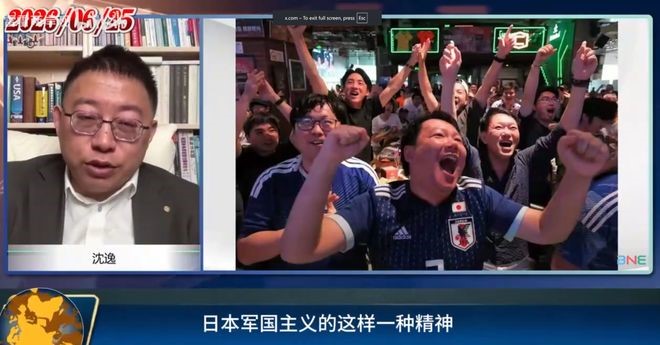
Shen also contended that Japan’s anime culture had apparently won over many Chinese fans, causing them to romanticise Japanese militarism or downplay what he called Japan’s underlying design to dominate China.
“At a time when militarism is resurging in Japan, we are disarming ourselves and succumbing to Japanese influence,” he grieved.
The Japan-Tunisia match on June 21 attracted an average television audience rating of 33.2% in Japan. However, according to official FIFA figures, some 24 million viewers in China also tuned in—equivalent to almost one-fifth of Japan’s population, to the chagrin of anti-Japan patriots like Shen.
At that Shanghai watch party, fans raised their glasses and cheered every time Japan scored. When Japan’s striker headed home to make it 4-0, the bar erupted, with some supporters jumping from their seats in jubilation. After the match, they unfurled a giant Japan supporters’ banner and posed for a group photograph beneath it.
Once footage of that gathering spread online, social media comment sections quickly brimmed with abuse and condemnations.
Some users wrote: “They’re just as disgusting as those girls who wear kimonos in public.” Others roared: “Beat them to death on the spot,” while some cried: “Must be a bunch of Japanese collaborators living in China.” One user added: “Hope these traitors get the chance to die in America.”
On June 28, the Shanghai Football Association issued a noticed titled “Civilized World Cup Viewing Initiative”, urging fans to maintain a strong sense of national identity and exercise restraint both at public viewing events and in online discussions. Although Japan was never mentioned by name, phrases such as “fans have a motherland”, “emotional boundaries” and “do not blindly idolise any team” were widely interpreted as an implicit call not to support Japan.
Despite Shen’s castigation, supporters at a later watch party appeared largely unfazed.
“There will definitely be people like that, but personally I don’t pay much attention to those voices,” Mr Fan said when asked whether backing Japan invited hostility.
Another supporter, Jasper Sun, acknowledged that fans elsewhere in China might worry about such jingoism but described Shanghai as relatively open and inclusive. He recalled travelling to Xiamen to watch a Japan-China match and said no conflicts occurred.
Chinese supporters of Japan are far from uncommon. On Weibo, China’s Watsapp, the account “@Japan Fans Club” has more than 140,000 followers, while Xiaohongshu (小红书), a popular social media platform, hosts a “Japan Fans Circle” within its World Cup community with more than 77,000 members.
Most Chinese fans who support Japan do not oppose China’s national team. Rather, many say they simply admire Japan because of the stark contrast between the two countries’ footballing fortunes and are frustrated by China’s long-standing underperformance.
One supporter at the Shanghai watch party remarked that “Chinese football culture has become increasingly insular and far less open-minded than it once was.”
Fu Jinyu (符金宇), author of A History of Japanese Football, argued that Japan has built a modern football ecosystem that nurtures talents from young, enabling its national team to compete at a European standard. By contrast, he said, Chinese football remains mired in structural problems and has yet to find a successful path forward.
Mr Fan said the current frigid political climate made people-to-people exchanges between the two countries even more important. “At a time when China-Japan relations are becoming more strained, I think it’s even more important for people like us to step forward,” he added.
“My ultimate ideal—my greatest dream—is to help build a bridge of friendship between our two countries.”
Meanwhile, an article published on the popular Chinese website China Gate criticised the growing tendency to brand supporters of Japan as “hanjian“. It noted that the term has historically been one of China’s gravest political labels, originally reserved for those who collaborated with foreign invaders during wartime. Today, however, he lamented that it is increasingly used to tar people just for expressing unpopular views.
The article also expressed concern over Shen’s suggestion that China should eventually criminalise support for Japan, warning that such move could lead to abuses of legal power.
Shen has generated numerous controversies over the years. Last year, for example, he criticised Singapore Prime Minister Lawrence Wong, accusing him of being “devious” and “malignant” in trying to subtly pressure China to yield to US President Donald Trump’s tariff clout. Shen claimed that Wong’s warning that the tariff disputes of the 1930s had contributed to the outbreak of World War II was intended to cow Beijing into making concessions.
Since Sanae Takaichi became Japan’s prime minister in October 2025, relations between China and Japan have deteriorated further, marked by intensifying strategic rivalry, unresolved historical grievances and increasingly hostile public sentiment, even as bilateral economic ties remain substantial. In recent months, Chinese Foreign Minister Wang Yi has repeatedly accused Japan of reverting to militarism.