
























(SINGAPORE 2026.4.21) Singapore is emerging as a tightly regulated but strategically important “testbed” for self-driving vehicles. Companies—particularly Chinese players—are using the city to learn how to operate under strict regulatory conditions and to build credibility for expansion across Southeast Asia. The key challenge in Singapore is not whether self-driving vehicles can drive, but whether they can earn sufficient trust from regulators and the public to scale up deployment, Chinese media reported.
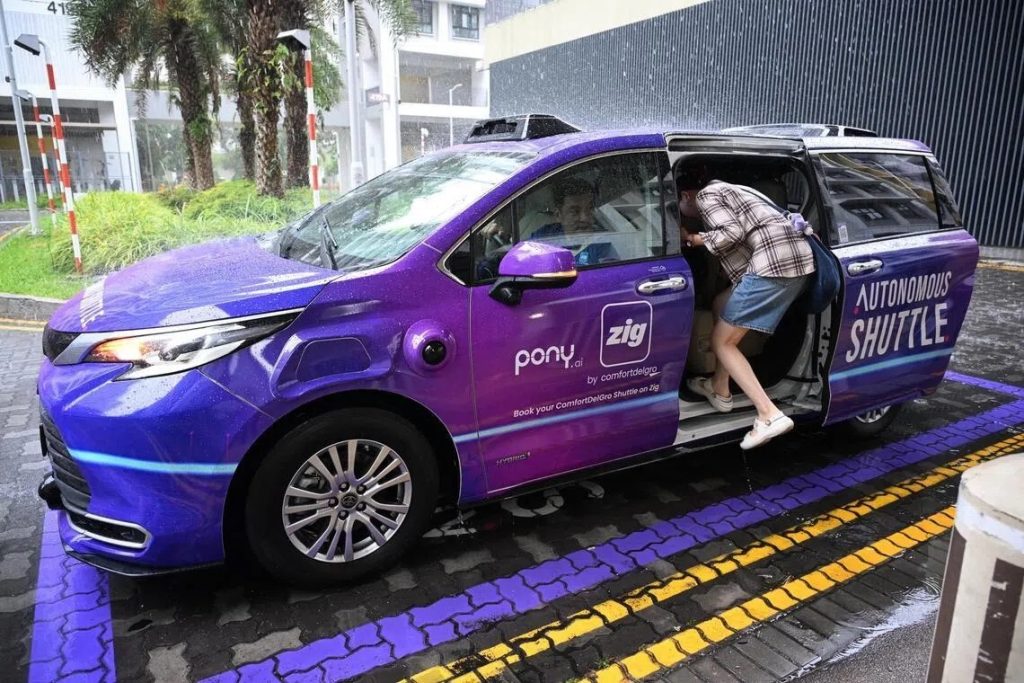
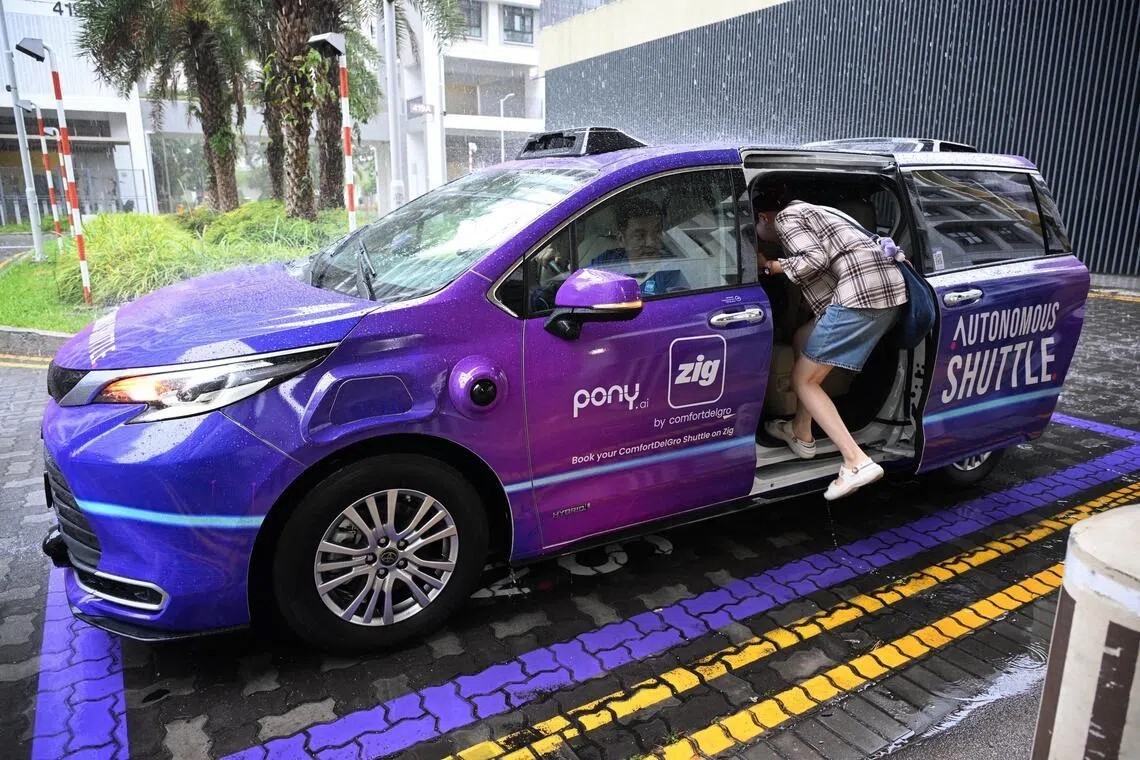
On April 7, Singapore transport giant ComfortDelGro began inviting selected participants to try out its self-driving routes. Earlier, Grab, Southeast Asia’s top ride-hailing and delivery platform, opened free Robotaxi rides to the public on April 1. With these launches, all three assigned self-driving routes in Punggol estate have entered public trial operations.
According to the Land Transport Authority (LTA)—Singapore’s government agency overseeing land transport—the free-trial routes consist of Route 1, which takes about 40 minutes; Route 2, about 50 minutes; and a shorter “mini” Route 3 of about 20 minutes. These mark Singapore’s first self-driving vehicle passenger transport operating within a residential estate.
Under the Punggol Robotaxi model, passengers select designated pick-up and drop-off points along fixed routes for their trial rides. China’s WeRide (文远知行)autonomous vehicle company told Jiemian News (界面新闻), a Chinese financial news outlet, that the service is currently free, with fares expected to be introduced around mid-year. Pricing is expected to mirror public bus fares, fixed at a flat rate of S$4 regardless of boarding or alighting point.
Notably, Chinese autonomous driving firms are involved across all three routes. Routes 1 and 3 are operated by Grab using WeRide’s technology, while Route 2 is operated by ComfortDelGro using Pony.ai’s (小马智行) system. Pony.ai was founded in California by Chinese engineers from Baidu, China’s top search engine.
The self-driving vehicles in Punggol still carry safety operators in the driver’s seat. Grab has trained 14 safety operators so far, while ComfortDelGro operates five vehicles. In total, the fleet across the three routes comprises about 20 vehicles—significantly smaller than deployments in regions such as the Middle East.
This shows that Singapore is not yet a large-scale deployment market for autonomous driving. However, within Southeast Asia, it remains one of the few countries actively building institutional and regulatory frameworks for the technology, Jiemian News noted.
As early as 2018, Singapore introduced one of the world’s earliest national standards for autonomous driving. In July 2025, it established an Autonomous Vehicle Deployment Committee, which includes senior executives from WeRide, Waymo, Grab, and ComfortDelGro. WeRide told Jiemian News that Singapore’s approach is marked by gradual opening rather than rapid scaling. The framework is also broadly aligned with global norms with only minor local variations.
WeRide also disclosed that the Punggol project required its vehicle model to have completed 10,000 kilometers of real-world driving as well as undergone a test of seven-day continuous driving prior to actual trial. Before full commercial rollout, LTA mandated a phase in which selected members of the public test the service and provide feedback, with full public access only granted after all stages are completed.
For Chinese Robotaxi companies, the main challenge in Singapore is not technical capability, Jiemian News observed. While” left-hand traffic, right-hand drive” vehicles, narrow roads, dense traffic, tropical heavy rain, vegetation, and high-rise urban environments do introduce operational complexity, companies generally view these as manageable through adapting their vehicles to traffic rules and signage rather than making core technological changes.
On the ground, Chinese firms adopt partnership-based models working with local Singapore operators. Pony.ai CFO James Peng (彭军) told Jiemian News that nearly half of the company’s new vehicles in 2026 will fit a “co-building fleet” model, in which partners finance vehicle purchases and may also participate in operations. Pony.ai provides technology and operating systems, earning revenue through licensing fees or revenue-sharing arrangements.
This “technology-for-market” model is becoming a standard entry strategy in Singapore. China’s Momenta (魔门塔) signed a cooperation agreement with Grab in December 2025 to expand Robotaxi services across Southeast Asia.
The model reduces capital burden and helps navigate Singapore’s strict licensing environment. Grab CFO Peter Oey noted that Singapore’s tight taxi licensing regime makes it difficult for new entrants to compete directly in the short term, reinforcing the importance of local partnerships with established operational expertise.
Autonomous mobility in Singapore extends beyond Robotaxis. In July 2025, WeRide announced that its eight-seater Robobus had begun fully driverless operations at Resorts World Sentosa, running primarily within a closed-loop resort environment. In October 2025, China’s Mogo Auto (蘑菇车联), together with BYD, secured Singapore’s first officially approved Level 4 autonomous bus pilot programme, which is expected to be integrated into the city’s public transport system.
Mogo Auto vice president Lü Bin (吕斌) told Jiemian News that the project aims to achieve coexistence between autonomous and conventional buses within three years, focusing on scalable deployment. Singapore places strong emphasis on regulatory compliance, requiring third-party technical evaluations covering punctuality aligned with MRT schedules, accessibility, and extreme-condition testing.
The first batch of six autonomous buses is expected to enter regular operation in the second half of 2026, initially overseen by onboard safety operators, before a gradual transition toward full autonomy within three years.
Building public trust remains a central difficulty for self-driving transports. Lü stressed that public transport safety is highly sensitive globally, and even isolated incidents can be exaggerated in public coommunications.
A single incident can also affect deployment timelines. A Robotaxi on ComfortDelGro’s Route 2 collided into a road divider due to human factors on January 17 this year during pre-trial familiarization driving. Although no injuries occurred, the project was suspended until safety reviews were completed at the end of January, after which operator training and supervision were strengthened.
In addition, multiple companies told Jiemian News that Singapore requires autonomous vehicle data to be stored locally, with no cross-border transfer permitted. This necessitates full in-country data compliance and putting in place a data infrastructure.
For an industry heavily dependent on regulatory approval, the main barriers to international expansion are not purely technological. Instead, they lie in gradual regulatory alignment, the slow accumulation of public trust, and deep integration into local operating ecosystems. This is where Singapore functions as a strategic “springboard.”
Lü said Singapore’s importance for Asean expansion can be understood in three ways: it provides internationally recognised validation that lowers compliance and trust barriers elsewhere; it serves as a test environment for right-hand drive, high-density urban conditions, and localisation; and its hub position facilitates the building of regional operational networks driving Asean’s smart mobility policies.
The Singapore government aims to develop a smart mobility system with autonomous vehicles as a core component by 2040. Acting Minister for Transport Jeffrey Siow has indicated that driverless services will gradually expand to Sentosa, Tuas, and Mandai. In the second half of 2026, Singapore also plans trials of autonomous Bus 400 in Marina Bay and Bus 191 in one-north.
However, the market size in Singapore is inherently limited, Jiemian News pointed out. For companies, long-term returns will come from regulatory experience, operational data, and localisation capabilities developed in Singapore and transferring these to larger Asean markets such as Thailand and Malaysia.