



























(SINGAPORE 2026.8.18) A Chinese animated film that opened to almost no audience has suddenly gone on to become the strangest box-office story this summer in China — not because moviegoers think it is good, but because they cannot believe how bad it is.
Niulai (牛来), which literally means “the bull comes” in Chinese, can be read as a play on the phrase “the bull market is coming” (牛市来了). It opened in cinemas on Aug 5 with virtually no fanfare. There was no trailer, no cast promotion and no publicity tour. Its only major piece of promotional material was an elegant ink-wash (水墨) poster that suggested it is a polished work of Chinese animation.
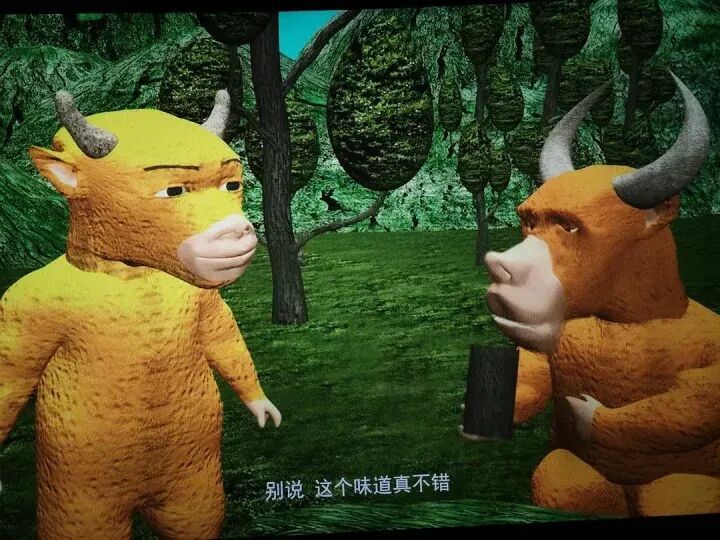
Instead, audiences found crude 3D models, stiff character movements, awkward animation, sparse storytelling, and figures with distorted anatomy.
For its first 10 days, Niulai made only about 7000 yuan (S$1,327), watched by just a few hundred people nationwide, reported Dengta Pro (灯塔专业版), a data analytics app for China’s entertainment industry. Then came the turning point.
Around Aug 15, viewers began posting cinema-recorded clips of the movie, apparently to warn others away. The images are so bizarre that the warnings had precisely the opposite effect. People became curious. Social media users began asking: How can a film this strange actually exist?
The result was an extraordinary feedback loop. By Aug 17, Niulai had taken in about 17.9 million yuan including advance sales, more than 2,000 times its box office during its first 10 days. Its projected final gross is subsequently raised sharply, with some estimates putting it in the hundreds of millions.
The film’s rise has now become more than a movie story. It has become a social phenomenon, a joke, a collective act of curiosity — and, perhaps, a mirror reflecting some of the frustrations and desires of China’s internet users, noted a commentary in the New Weekly (新周刊) magazine.
From warning to word-of-mouth
The first moviegoers who videoed Niulai may have intended to protect others from wasting their money. Instead, they became the film’s most effective marketers.
The dynamic resembles a familiar internet prank: someone tells people not to click on something, thereby making everyone want to click it.
One commenter compared the first person to record Niulai to the well-meaning alien in the sci-fi novel The Three-Body Problem (三体), who tries to warn humanity against responding to signals from his belligerent home planet, fearing that doing so would prompt it to invade Earth. Ironically, the warning itself set the catastrophe in motion. The worse the footage of Niulai looks, the stronger the curiosity becomes.
On social platforms, users began sharing screenshots of the film’s animals walking upright, their odd facial expressions, and the poorly-rendered landscapes. Some posted exaggerated five-star reviews to lure friends and strangers into cinemas. Others created AI-generated posters reimagining classic film posters in the style of Niulai — from The Shawshank Redemption to La La Land.
The joke soon spread beyond the film itself and took on a life of its own.
People are no longer asking whether Niulai is a good movie. They are asking how bad it could possibly be.
The “so bad it’s good” economy
One might see Niulai as proof that audiences have fallen in love with bad movies. That interpretation, however, misses what is happening.
It could not be that most audiences suddenly prefer poor filmmaking. Nor is Niulai necessarily evidence that sophisticated animation has lost its appeal, the New Weekly pointed out.
Its success is better understood as an unusual form of attention arbitrage (注意力套利).
The film had almost no conventional publicity budget. Instead, its production shortcomings became its selling point. What would normally be a liability — rudimentary models, clunky animation, and implausible visual choices — became the very thing people wanted to see.
In China’s crowded summer movie market, Niulai offers something expensive productions struggle to manufacture: the feeling among audiences that they have discovered something genuinely strange together.
That distinction matters.
A conventional blockbuster asks audiences to buy a ticket because it promises spectacle, stars or taste. Niulai sells a different promise: you have to see this for yourself.
That promise is particularly powerful online, where novelty and eccentricity can spread faster than conventional advertising.
The viral attention also changed the social experience of watching a film.
Reports from cinemas describe audiences laughing, shouting and filming scenes that seem particularly strange. Strangers reportedly began talking to one another before screenings, asking whether they had come because of online jokes and how much they had paid for their tickets.
For a brief period, the cinema itself became an offline venue of a social-media comment section.
This is one of the more interesting aspects of Niulai. The film is not simply being consumed; it is being experienced collectively as a joke, noted the New Zealand Chinese Herald (纽西兰中文先驱报).
People are no longer embarrassed if they do not understand the plot. They do not necessarily expect to leave with a profound cinematic insight. They are there to laugh, share the experience and have something to talk about afterwards.
In that sense, Niulai provides a form of emotional value that has little to do with traditional film quality.
It gives audiences permission to stop taking the cinema seriously for 86 minutes.
But that pleasure has limits. Viewers reportedly found the first half amusing precisely because the visual incongruity kept producing surprises. Extended over the entire running time, however, the same flaws became exhausting. Long stretches contain little dialogue or action, while slow voice acting and lingering shots further lengthen the film.
As one wry observation circulating online put it: something this strange can be hilarious for 10 minutes, amusing for 30 — but painful for 86.
Even the title has become part of the buzz.
In Chinese, Niulai sounds like “the bull market is coming”. That accidental wordplay attracted another audience: retail investors hoping to strike it lucky amid a gloomy Chinese economy.
Some stock-market users reportedly bought tickets simply to “support the bull market”.
There are also more understated comments suggesting that some viewers embraced the film as a parody of the state of China’s economy. As one commenter quipped, something marketed as “good” and “healthy” should perhaps be appreciated for what it really is: anything but.
The joke illustrates how far the film has travelled from its original purpose. Niulai is no longer merely an animated story about a young cow. It has become an adaptable piece of internet culture, capable of absorbing whatever joke a community wants to attach to it.
A folk-art story — or an industry lesson?
Behind the jokes is a more serious story about independent filmmaking.
The film was reportedly made by an extremely small team, with its director and writer also taking on manual duties. The filmmakers have described the production as a painstaking, low-budget labour-intensive effort rather than an AI-generated project.
According to the Paper digital news outlet, the screenplay was registered in 2021 and the completed film passed the relevant content and technical checks in 2024, receiving a public screening licence.
That has prompted questions about how a film with such poorly executed animation could make it into commercial cinemas.
But industry professionals have pointed out that China’s technical review of films is not primarily an aesthetic test. Technical checks focus on whether a film can be screened properly — problems such as damaged frames, audio-visual synchronisation, and playback failures — rather than whether its animation is beautiful or its storytelling sophisticated.
In other words, obtaining approval does not necessarily mean that regulators have judged a film to be artistically good.
This distinction has become one of the most important discussions surrounding Niulai: should a filmmaker be allowed to make something that looks amateurish if it meets the necessary legal and technical requirements?
There is a strong argument that the answer should be yes.
Cinema cannot be reduced to industrial perfection. If only technically polished films could enter cinemas, independent creators would have little room to experiment.
Niulai has also raised a different question: could passion and perseverance make up for a lack of artistic quality?
They should not.
A grassroots filmmaker deserves the opportunity to make a film. That does not mean audiences are obliged to like it.
This is where Niulai could become an industry lesson, the Chinese media stressed.
Its success is almost impossible to reproduce deliberately.
If producers immediately begin making intentionally terrible films in the hope of generating the same online attention, the joke will probably stop working. Audiences can recognise manufactured absurdity. Once “being terrible” becomes a marketing strategy, the element of surprise disappears.
There is also a danger of turning “ugliness” into a business model — producing unattractive content simply to generate social-media engagement.
That would miss the reason Niulai became interesting in the first place.
Its appeal comes partly from the sense that nobody involved expected this outcome. The film was not engineered as an internet meme. The audience made it one.
Niulai may not have changed what audiences want from movies.
But for a brief moment, it showed what audiences can do to a movie — once the internet decides, together, that it is time to have some fun.